Strix uralensis
The Ural owl is a large nocturnal owl. It is a member of the true owl family, Strigidae. The Ural owl is a member of the genus Strix, that is also the origin of the family's name under Linnaean taxonomy. Both its common name and scientific name refer to the Ural Mountains of Russia where the type specimen was collected. However, this species has an extremely broad distribution that extends as far west as much of Scandinavia, montane eastern Europe, and, sporadically, central Europe, thence sweeping across the Palearctic broadly through Russia to as far east as Sakhalin and throughout Japan. The Ural owl may include up to 15 subspecies, but most likely the number may be slightly fewer if accounting for clinal variations.

Jyrki Salmi from Finland · CC BY-SA 2.0 · via Wikipedia/Commons. May be a photograph of a specimen, or an artist’s reconstruction — an interpretation of a skeleton, since colour and soft tissue are almost never preserved.
On record
Recorded, not inferred- Also called
- Ural owlPBDB
- Sits inside
- StrixPBDB
- Diet
- carnivore, insectivorePBDB, for Strigidae
- Life habit
- volantPBDB, for Strigidae
- Motility
- actively mobilePBDB, for Theropoda
- Vision
- well-developedPBDB, for Strigiformes
- Environment
- terrestrialPBDB, for Strigidae
Time the record covers
At most 129 thousand years on record.
Every occurrence read is dated to somewhere between 129 ka and 0 Mya, and nothing in the dating separates them, so that window is what the record shows rather than a span.
2 occurrences of Strix uralensis on record, most of them in the Pleistocene. The Paleobiology Database records this as a living group. Bar height is expected occurrences, not a count: each fossil is spread across the span it is dated to, so a tall narrow bar means tight dating and a low wide one means loose.
When
2 occurrences- Pleistocene96%
- Holocene5%
These are dates about fossils, not the animal: the record can only begin after it arose and end before it died out, so either end may reach further. Shares are expected occurrences: a fossil dated to a span is counted partly in each period it straddles. More on what this infers.
Strix uralensis and its relatives
PleistoceneWhere Strix uralensis and its relatives were recorded in the Pleistocene.
Found in the same rock
32 taxa- Accipitridae1 site
- Amaurornis phoenicurus1 site
- Anatidae1 site
- Asio flammeus1 site
- Asio otus1 site
- Aythya1 site
- Buteo lagopus1 site
- Calidris pugnax1 site
- Columbidae1 site
- Corvus corone1 site
- Corvus macrorhynchos1 site
- Falco columbarius1 site
- Falco subbuteo1 site
- Fringillidae1 site
- Gavia1 site
- Hypsipetes amaurotis1 site
- Larus canus1 site
- Leucogeranus leucogeranus1 site
- Limosa limosa1 site
- Melanitta fusca deglandi1 site
- Motacillidae1 site
- Otus manadensis1 site
- Passeriformes1 site
- Phalaropus fulicarius1 site
The Paleobiology Database records 2 sites for Strix uralensis, and this reads all of them. The number is how many of those sites it was catalogued from too. The 24 sharing the most are listed.
This is not a list of everything alive at the time. It is only what has come out of the same ground as this animal and been written down.
Entered from
2 references- Birds of the Late Pleistocene and Holocene from the Palaeolithic Djuktai cave site of Yakutia, eastern Siberia1
- The Late Pleistocene fossil birds of the central and southern Ryukyu Islands, and their zoogeographical implications for the Recent avifauna of the archipelago1
Each of the 2 occurrences read was entered from one of these publications, ordered by how many each accounts for. This is not a search for papers mentioning the name. Entries link to doi.org where the Paleobiology Database holds an identifier, and to its own record where it does not. Relayed as the Paleobiology Database holds them, not checked against what they resolve to.
Media and terms
Media content2
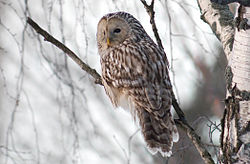
Picture of Strix uralensis
- Source
- Wikipedia/Commons
- Credit
- Jyrki Salmi from Finland
- Licence
- CC BY-SA 2.0
- Commercial use
- the licence allows it
CT scan
- Source
- MorphoSource
- Licence
- In Copyright
- Commercial use
- cannot be read from the licence given — check the record
- Specimen
- Strix uralensis · PC-AP:B-18
Smithsonian Open Access was not reached for this taxon, so this list is what the others held rather than everything there is.
The description on this site
- Source
- Wikipedia, “Ural owl”
- Licence
- CC BY-SA 4.0
This is what the site found, which is not the same as what exists.
Keep going
What may have been alongside itStrix through timeFormations of the PleistoceneThe world it lived on
Occurrence data from the Paleobiology Database, CC BY 4.0. Pallas 1771