Swartpuntia
Swartpuntia is an extinct organism from the late Ediacaran of Namibia, and was alive around 547 – 540 Ma, with possible records in the lower Cambrian of Nevada at 518 Ma, and older Ediacaran records from Canada at 567.3 Ma. It is a part of the Erniettomorpha class, and is known to be composed of three vanes attached to a large, segmented central stalk. It is a monotypic genus, containing only Swartpuntia germsi.

Bruce Runnegar, James G. Gehling, Sören Jensen, Matthew R. Saltzman (2024) · CC BY 4.0 · via Wikipedia/Commons. May be a photograph of a specimen, or an artist’s reconstruction — an interpretation of a skeleton, since colour and soft tissue are almost never preserved.
On record
Recorded, not inferred- Sits inside
- ErniettomorphaPBDB
- Diet
- suspension feederPBDB, for Erniettomorpha
- Life habit
- epifaunalPBDB
- Motility
- stationary, attachedPBDB
- Vision
- blindPBDB, for Erniettomorpha
- Environment
- inner shelf,marinePBDB
Time the record covers
At least 17 million years on record.
The record covers at least 538.8 Mya to 521 Mya. No occurrence read is dated outside 635 Mya to 506.5 Mya.
12 occurrences of Swartpuntia on record, most of them in the Cambrian. Bar height is expected occurrences, not a count: each fossil is spread across the span it is dated to, so a tall narrow bar means tight dating and a low wide one means loose.
When
12 occurrences- Cambrian33%
These are dates about fossils, not the animal: the record can only begin after it arose and end before it died out, so either end may reach further. Shares are expected occurrences: a fossil dated to a span is counted partly in each period it straddles. More on what this infers.
Found in
8 formations
- Urusis Formation · Nama Group3
- Wood Canyon Formation2
- Verkhovka Formation · Ust-Pinega Group2
- Poleta Formation1
- Uratanna Formation1
- Cid Formation · Albemarle Group1
Loading coastlines…
The named rock units Swartpuntia has been recovered from, largest first. Drawn where the rock is now, not where it formed.
Swartpuntia and its relatives
CambrianWhere Swartpuntia and its relatives were recorded in the Cambrian.
Found in the same rock
49 taxa- Aspidella4 sites
- Cloudina hartmannae2 sites
- Ernietta plateauensis2 sites
- Helminthopsis2 sites
- Parapsammichnites2 sites
- Pteridinium simplex2 sites
- Treptichnus pedum2 sites
- Albumares brunsae1 site
- Anfesta1 site
- Animalia1 site
- Archaeichnium1 site
- Archangelia valdaica1 site
- Arimasia germsi1 site
- Ausia1 site
- Ausia fenestrata1 site
- Bergaueria1 site
- Bergauria sp.1 site
- Bomakellia kelleri1 site
- Calyptrina1 site
- Cephalonega stepanovi1 site
- Charniodiscus1 site
- Cloudina1 site
- Conichnus1 site
- Corumbella1 site
The Paleobiology Database records 12 sites for Swartpuntia, and this reads all of them. The number is how many of those sites it was catalogued from too. The 24 sharing the most are listed.
This is not a list of everything alive at the time. It is only what has come out of the same ground as this animal and been written down.
Entered from
10 references- Ediacaran paleobiology and biostratigraphy of the Nama Group, Namibia, with emphasis on the erniettomorphs, tubular and trace fossils, and a new sponge, Arimasia germsi n. gen. n. sp.2
- Early Cambrian Ediacaran-type fossils from California2
- Supplemental Data for Ediacaran Diversification Rates1
- Pushing the boundary: A calibrated Ediacaran-Cambrian stratigraphic record from the Nama Group in northwestern Republic of South Africa1
- New high‐resolution age data from the Ediacaran–Cambrian boundary indicate rapid, ecologically driven onset of the Cambrian explosion1
- Biotic replacement and mass extinction of the Ediacara biota1
- Paleoenvironmental and paleobiogeographic implications of a new Ediacaran body fossil from the Neoproterozoic Carolina Terrane, Stanly County, North Carolina1
- Patterns of distribution in the Ediacaran biotas: facies versus biogeography and evolution1
- Ediacaran Fossils from the Southwestern Great Basin, United States1
- Ediacara-type fossils in Cambrian sediments1
Each of the 12 occurrences read was entered from one of these publications, ordered by how many each accounts for. This is not a search for papers mentioning the name. Entries link to doi.org where the Paleobiology Database holds an identifier, and to its own record where it does not. Relayed as the Paleobiology Database holds them, not checked against what they resolve to.
Media and terms
Media content2

Picture of Swartpuntia
- Source
- Wikipedia/Commons
- Credit
- Bruce Runnegar, James G. Gehling, Sören Jensen, Matthew R. Saltzman (2024)
- Licence
- CC BY 4.0
- Commercial use
- the licence allows it
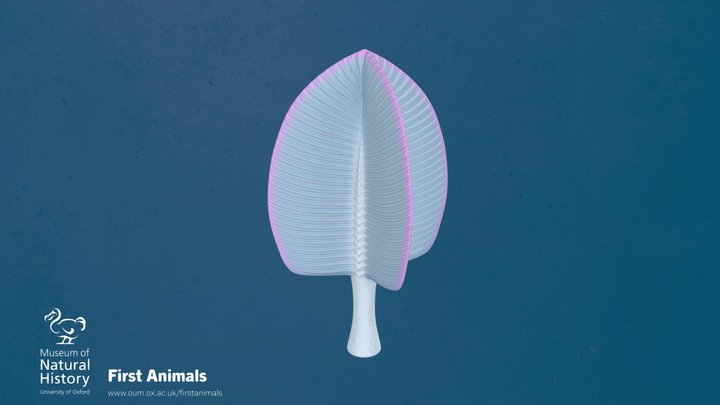
3D model
- Source
- Sketchfab
- Licence
- CC Attribution-NonCommercial
- Commercial use
- the licence does not allow it
Smithsonian Open Access and MorphoSource were not reached for this taxon, so this list is what the others held rather than everything there is.
The description on this site
- Source
- Wikipedia, “Swartpuntia”
- Licence
- CC BY-SA 4.0
This is what the site found, which is not the same as what exists.
Keep going
What may have been alongside itErniettomorpha through timeFormations of the CambrianThe world it lived on
Occurrence data from the Paleobiology Database, CC BY 4.0. Narbonne et al. 1997