Symmoriiformes
Symmoriiformes is an extinct order of cartilaginous fish. Originally named Symmoriida by Zangerl (1981), the name has since been corrected to Symmoriiformes to avoid confusion with a family. The symmoriiform fossils record begins during the late Devonian, and most had become extinct by the start of the Permian, with the genus Dwykaselachus from the Artinskian-Kungurian of South Africa being the latest known uncontroversial occurrence. Teeth described from the Valanginian of France and Austria indicate that members of the family Falcatidae might have survived until the Early Cretaceous; however, it has since been proposed that these teeth more likely belonged to neoselachian sharks.

Dmitry Bogdanov · CC BY 3.0 · via Wikipedia/Commons. May be a photograph of a specimen, or an artist’s reconstruction — an interpretation of a skeleton, since colour and soft tissue are almost never preserved.
On record
Recorded, not inferred- Sits inside
- CladoselachimorphaPBDB
- Diet
- carnivorePBDB
- Life habit
- nektonicPBDB
- Motility
- actively mobilePBDB
Time the record covers
At least 349 million years on record.
The record covers at least 372.15 Mya to 23.04 Mya. No occurrence read is dated outside 382.31 Mya to 2.58 Mya.
217 occurrences of Symmoriiformes on record, most of them in the Permian. Bar height is expected occurrences, not a count: each fossil is spread across the span it is dated to, so a tall narrow bar means tight dating and a low wide one means loose.
When
217 occurrences- Devonian6%
- Carboniferous38%
- Permian53%
- Early Cretaceous1%
- Miocene1%
- Plioceneunder 1%
These are dates about fossils, not the animal: the record can only begin after it arose and end before it died out, so either end may reach further. Shares are expected occurrences: a fossil dated to a span is counted partly in each period it straddles. More on what this infers.
Found in
46 formations
- Bell Canyon Formation40
- Khuff Formation17
- Cutoff Formation14
- Heath Formation · Big Snowy Group11
- Linton Formation8
- Cherry Canyon Formation7
Loading coastlines…
The named rock units Symmoriiformes has been recovered from, largest first. Drawn where the rock is now, not where it formed. 22 further formations hold fewer occurrences each and are not listed. 42 occurrences have no formation on record, which is common for older literature.
Symmoriiformes and its relatives
PermianWhere Symmoriiformes and its relatives were recorded in the Permian.
Found in the same rock
543 taxa- Stethacanthulus meccaensis45 sites
- Glikmanius myachkovensis24 sites
- Gunnellodus bellistriatus20 sites
- Euselachii16 sites
- Stethacanthulus decorus16 sites
- Stethacanthus altonensis16 sites
- Glikmanius occidentalis15 sites
- Stethacanthus15 sites
- Teresodus amplexus11 sites
- Actinopterygii10 sites
- Glikmanius culmenis10 sites
- Omanoselache hendersoni10 sites
- Texasodus varidentatus10 sites
- Cooleyella amazonensis9 sites
- Omanoselache angiolinii9 sites
- Symmoriidae9 sites
- Falcatus falcatus8 sites
- Heslerodus divergens8 sites
- Khuffia lenis8 sites
- Kungurodus obliquus8 sites
- Actinopteri7 sites
- Fubarichthyiformes7 sites
- Isacrodus marthae7 sites
- Osteichthyes7 sites
The Paleobiology Database records 162 sites for Symmoriiformes, and this reads all of them. The number is how many of those sites it was catalogued from too. The 24 sharing the most are listed.
This is not a list of everything alive at the time. It is only what has come out of the same ground as this animal and been written down.
Entered from
56 references- New fish assemblages from the Middle Permian from the Guadalupe Mountains, West Texas, USA25
- The "Cladodont level" sharks of the Pennsylvanian black shales of central North America22
- Permian chondrichthyans from the Guadalupe Mountains National Park of West Texas (USA)18
- A new diverse shark fauna from the Wordian (Middle Permian) Khuff Formation in the interior Haushi-Huqf area, Sultanate of Oman18
- Late Devonian - Early Permian chondrichthyans of the Russian Arctic14
- Early Permian chondrichthyans of the middle and south Urals13
- Fish microremains, Cutoff Formation (Roadian, Middle Permian) Guadalupe Mountains, West Texas, USA11
- Fish assemblage from the Capitanian (Middle Permian) of the Apache Mountains, west Texas, USA10
- The morphology of Falcatus falcatus (St. John and Worthen), a Mississippian stethacanthid chondrichthyan from the Bear Gulch Limestone of Montana6
- Permian chondrichthyans of the Kanin Peninsula, Russia5
- Symmoriiform sharks from the Pennsylvanian of Nebraska4
- Middle Permian fish microremains from the Early Capitanian of the Guadalupe Mountains, West Texas, USA4
Each of the 217 occurrences read was entered from one of these publications, ordered by how many each accounts for. This is not a search for papers mentioning the name. 44 further references are not listed. Entries link to doi.org where the Paleobiology Database holds an identifier, and to its own record where it does not. Relayed as the Paleobiology Database holds them, not checked against what they resolve to.
Media and terms
Media content1
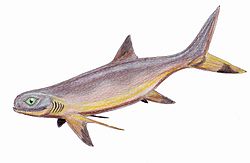
Picture of Symmoriiformes
- Source
- Wikipedia/Commons
- Credit
- Dmitry Bogdanov
- Licence
- CC BY 3.0
- Commercial use
- the licence allows it
No 3D scan of Symmoriiformes was found in Sketchfab.
Smithsonian Open Access and MorphoSource were not reached for this taxon, so this list is what the others held rather than everything there is.
The description on this site
- Licence
- CC BY-SA 4.0
This is what the site found, which is not the same as what exists.
Keep going
What may have been alongside itCladoselachimorpha through timeFormations of the PermianThe world it lived on
Occurrence data from the Paleobiology Database, CC BY 4.0. Zangerl 1981