Symmorium
Symmorium is an extinct symmoriiform cartilaginous fish from the Devonian and Carboniferous of the United States (Illinois) and Russia. The type species, Symmorium reniforme, was named by Edward Drinker Cope in 1893, with other species assigned to the genus having since been reclassified into other genera such as Petalodus. Symmorium bears close similarity in size and appearance to Stethacanthus but lacks the "spine-brush complex" in place of the first dorsal fin. Some paleontologists think that the two forms represented the males and females of related species, while other scientists think they were distinct genera.

Jonathan Chen · CC BY-SA 4.0 · via Wikipedia/Commons. May be a photograph of a specimen, or an artist’s reconstruction — an interpretation of a skeleton, since colour and soft tissue are almost never preserved.
On record
Recorded, not inferred- Sits inside
- SymmoriidaePBDB
- Diet
- carnivorePBDB, for Symmoriiformes
- Life habit
- nektonicPBDB, for Symmoriiformes
- Motility
- actively mobilePBDB, for Symmoriiformes
Time the record covers
At least 61 million years on record.
The record covers at least 365.2 Mya to 303.7 Mya. No occurrence read is dated outside 372.15 Mya to 298.9 Mya.
4 occurrences of Symmorium on record, most of them in the Devonian. Bar height is expected occurrences, not a count: each fossil is spread across the span it is dated to, so a tall narrow bar means tight dating and a low wide one means loose.
When
4 occurrences- Devonian50%
- Carboniferous50%
These are dates about fossils, not the animal: the record can only begin after it arose and end before it died out, so either end may reach further. Shares are expected occurrences: a fossil dated to a span is counted partly in each period it straddles. More on what this infers.
Found in
3 formations
- Linton Formation1
- Wild Cow Formation · Madera Group1
- Dankov-Lebedyan Beds Formation1
Loading coastlines…
The named rock units Symmorium has been recovered from, largest first. Drawn where the rock is now, not where it formed. 1 occurrence has no formation on record, which is common for older literature.
Symmorium and its relatives
DevonianWhere Symmorium and its relatives were recorded in the Devonian.
Found in the same rock
47 taxa- Acanthodes1 site
- Acanthodes lopatini1 site
- Acrolepis reticulata1 site
- Aeduelliformes1 site
- Amphicentrum jurgenai1 site
- Bothriolepis siberica1 site
- Caseodus basalis1 site
- cf. Bourbonella sp.1 site
- Chelyphorus verneuli1 site
- Cladodontomorphii1 site
- Cobelodus aculeatus1 site
- Coelacanthidae1 site
- Conchodus1 site
- Cryptolepis grossi1 site
- Devononchus1 site
- Dracopristis hoffmanorum1 site
- Glyptolepis1 site
- Glyptopomus1 site
- Holodipterus1 site
- Ischnacanthida1 site
- Jakubsonia livnensis1 site
- Jarvikia1 site
- Listracanthus1 site
- Livnolepis zadonica1 site
The Paleobiology Database records 4 sites for Symmorium, and this reads all of them. The number is how many of those sites it was catalogued from too. The 24 sharing the most are listed.
This is not a list of everything alive at the time. It is only what has come out of the same ground as this animal and been written down.
Entered from
4 references- End-Devonian extinction and a bottleneck in the early evolution of modern jawed vertebrates1
- Late Devonian - Early Permian chondrichthyans of the Russian Arctic1
- Late Pennsylvanian Chondrichthyes, Acanthodii, and deep-bodied Actinopterygii from the Kinney Quarry, Manzanita Mountains, New Mexico1
- New and little known Paleozoic and Mesozoic fishes1
Each of the 4 occurrences read was entered from one of these publications, ordered by how many each accounts for. This is not a search for papers mentioning the name. Entries link to doi.org where the Paleobiology Database holds an identifier, and to its own record where it does not. Relayed as the Paleobiology Database holds them, not checked against what they resolve to.
Media and terms
Media content1
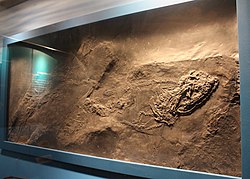
Picture of Symmorium
- Source
- Wikipedia/Commons
- Credit
- Jonathan Chen
- Licence
- CC BY-SA 4.0
- Commercial use
- the licence allows it
No 3D scan of Symmorium was found in Sketchfab.
Smithsonian Open Access and MorphoSource were not reached for this taxon, so this list is what the others held rather than everything there is.
The description on this site
- Source
- Wikipedia, “Symmorium”
- Licence
- CC BY-SA 4.0
This is what the site found, which is not the same as what exists.
Keep going
What may have been alongside itSymmoriidae through timeFormations of the DevonianThe world it lived on
Occurrence data from the Paleobiology Database, CC BY 4.0. Cope 1893