Telmatosaurus
Telmatosaurus is a genus of basal hadrosauromorph dinosaur from the Late Cretaceous of Romania. It was relatively small for its group, measuring approximately 5 m (16 ft) in length and 600 kg (1,300 lb) in body mass, which has been explained as an instance of insular dwarfism.

Franz Nopcsa · Public Domain · via Wikipedia/Commons. May be a photograph of a specimen, or an artist’s reconstruction — an interpretation of a skeleton, since colour and soft tissue are almost never preserved.
On record
Recorded, not inferred- Sits inside
- TelmatosauridaePBDB
- Diet
- herbivorePBDB, for Ornithopoda
- Life habit
- ground dwelling, gregariousPBDB, for Ornithischia
- Motility
- actively mobilePBDB, for Ornithischia
- Environment
- terrestrialPBDB, for Ornithischia
- Length
- 5 mWikidata
Time the record covers
At most 18 million years on record.
Every occurrence read is dated to somewhere between 83.6 Mya and 66 Mya, and nothing in the dating separates them, so that window is what the record shows rather than a span.
23 occurrences of Telmatosaurus on record, most of them in the Late Cretaceous. Bar height is expected occurrences, not a count: each fossil is spread across the span it is dated to, so a tall narrow bar means tight dating and a low wide one means loose.
When
23 occurrences- Late Cretaceous100%
These are dates about fossils, not the animal: the record can only begin after it arose and end before it died out, so either end may reach further. Shares are expected occurrences: a fossil dated to a span is counted partly in each period it straddles. More on what this infers.
Found in
6 formations
- Sînpetru Formation10
- Densuș-Ciula Formation4
- Sebeş Formation4
- Râul Mare Formation2
- Şard Formation1
- Pui Beds Formation1
Loading coastlines…
The named rock units Telmatosaurus has been recovered from, largest first. Drawn where the rock is now, not where it formed. 1 occurrence has no formation on record, which is common for older literature.
Telmatosaurus and its relatives
Late CretaceousWhere Telmatosaurus and its relatives were recorded in the Late Cretaceous.
Found in the same rock
156 taxa- Zalmoxes14 sites
- Titanosauria9 sites
- Allodaposuchus8 sites
- Dortokidae7 sites
- Kallokibotion7 sites
- Theropoda7 sites
- Allodaposuchus precedens6 sites
- Kallokibotion bajazidi6 sites
- Testudines6 sites
- Dinosauria5 sites
- Doratodon5 sites
- Ferenceratops shqiperorum5 sites
- Crocodyliformes4 sites
- Paronychodon4 sites
- Struthiosaurus4 sites
- Acynodon3 sites
- Albanerpeton3 sites
- Elopteryx nopcsai3 sites
- Gastropoda3 sites
- Hatzegopteryx3 sites
- Lithostrotia3 sites
- Magyarosaurus3 sites
- Petrustitan hungaricus3 sites
- Scincomorpha3 sites
The Paleobiology Database records 23 sites for Telmatosaurus, and this reads all of them. The number is how many of those sites it was catalogued from too. The 24 sharing the most are listed.
This is not a list of everything alive at the time. It is only what has come out of the same ground as this animal and been written down.
Entered from
15 references- Taphonomic modes in the Maastrichtian continental deposits of the Haţeg Basin, Romania—palaeoecological and palaeobiological inferences7
- ‘X’ marks the spot! Sedimentological, geochemical and palaeontological investigations of upper Cretaceous (Maastrichtian) vertebrate fossil localities from the Vălioara valley (Densuş-Ciula Formation, Hațeg basin, Romania)2
- An infant ornithopod dinosaur tibia from the Late Cretaceous of Sebes, Romania2
- The unusual tail of Tethyshadros insularis (Dinosauria, Hadrosauroidea) from the Adriatic Island of the European archipelago1
- The East Side Story – The Transylvanian latest Cretaceous continental vertebrate record and its implications for understanding Cretaceous–Paleogene boundary events1
- Some Maastrichtian vertebrates from fluvial channel fill deposits at Pui (Haţeg Basin)1
- An overview of the latest Cretaceous hadrosauroid record in Europe1
- Stable isotope distribution in Maastrichtian vertebrates and paleosols from the Hateg Basin, South Carpathians1
- More than just Nopcsa's Transylvanian dinosaurs: A look outside the Hateg Basin1
- New faunal elements from the Late Cretaceous (Maastrichtian) continental deposits of Sebeş area (Transylvania)1
- The Budurone microvertebrate site from the Maastrichtian of the Hateg Basin – flora, fauna, taphonomy and paleoenvironment1
- A complete skull of Allodaposuchus precedens Nopcsa, 1928 (Eusuchia) and a reassessment of the morphology of the taxon based on the Romanian remains1
Each of the 23 occurrences read was entered from one of these publications, ordered by how many each accounts for. This is not a search for papers mentioning the name. 3 further references are not listed. Entries link to doi.org where the Paleobiology Database holds an identifier, and to its own record where it does not. Relayed as the Paleobiology Database holds them, not checked against what they resolve to.
Media and terms
Media content1
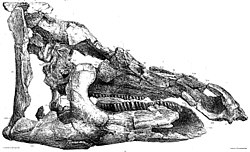
Picture of Telmatosaurus
- Source
- Wikipedia/Commons
- Credit
- Franz Nopcsa
- Licence
- Public Domain
- Commercial use
- the licence allows it
No 3D scan of Telmatosaurus was found in Sketchfab.
Smithsonian Open Access and MorphoSource were not reached for this taxon, so this list is what the others held rather than everything there is.
The description on this site
- Licence
- CC BY-SA 4.0
This is what the site found, which is not the same as what exists.
Keep going
What may have been alongside itTelmatosauridae through timeFormations of the Late CretaceousThe world it lived on
Occurrence data from the Paleobiology Database, CC BY 4.0. Nopcsa 1903