Terebratellidina
Terebratellidina is one of two existing suborders of Terebratulid brachiopods, the other being Terebratulidina.

Luis Ruiz Berti · CC BY-SA 4.0 · via Wikipedia/Commons. May be a photograph of a specimen, or an artist’s reconstruction — an interpretation of a skeleton, since colour and soft tissue are almost never preserved.
On record
Recorded, not inferred- Sits inside
- TerebratulidaPBDB
- Diet
- suspension feederPBDB, for Terebratulida
- Life habit
- low-level epifaunalPBDB, for Terebratulida
- Motility
- stationaryPBDB, for Terebratulida
- Vision
- blindPBDB, for Rhynchonellata
- Environment
- marinePBDB, for Lophophorata
Time the record covers
At least 335 million years on record.
The record covers at least 335.9 Mya to 11.7 ka. No occurrence read is dated outside 339.9 Mya to 0 Mya.
4,455 occurrences of Terebratellidina on record, most of them in the Early Jurassic. The Paleobiology Database records this as a living group. Bar height is expected occurrences, not a count: each fossil is spread across the span it is dated to, so a tall narrow bar means tight dating and a low wide one means loose.
When
4,455 occurrences- Carboniferousunder 1%
- Early Triassic1%
- Middle Triassic3%
- Late Triassic6%
- Early Jurassic23%
- Middle Jurassic14%
- Late Jurassic5%
- Early Cretaceous6%
- Late Cretaceous10%
- Paleocene3%
- Eocene6%
- Oligocene3%
- Miocene10%
- Pliocene3%
- Pleistocene7%
- Holoceneunder 1%
These are dates about fossils, not the animal: the record can only begin after it arose and end before it died out, so either end may reach further. Shares are expected occurrences: a fossil dated to a span is counted partly in each period it straddles. More on what this infers.
Found in
446 formations
- Dhruma Formation · Shaqra Group180
- Hierlatz Formation95
- Ciply-Malogne Phosphatic Chalk Formation83
- Naha Formation · Ryukyu Group65
- Hierlatz Limestone Formation60
- Wilson Bluff Formation48
Loading coastlines…
The named rock units Terebratellidina has been recovered from, largest first. Drawn where the rock is now, not where it formed. 422 further formations hold fewer occurrences each and are not listed. 1,984 occurrences have no formation on record, which is common for older literature.
Terebratellidina and its relatives
Early JurassicWhere Terebratellidina and its relatives were recorded in the Early Jurassic.
Found in the same rock
2,041 taxa- Rhynchonella37 sites
- Terebratulina chrysalis30 sites
- Zeilleria24 sites
- Argyrotheca21 sites
- Gastropoda21 sites
- Cidaris19 sites
- Argyrotheca bronnii18 sites
- Argyrotheca stevensis18 sites
- Isocrania costata18 sites
- Bivalvia16 sites
- Magas chitoniformis16 sites
- Rugia16 sites
- Terebratula16 sites
- Terebratulina gracilis16 sites
- Cretirhynchia15 sites
- Daghanirhynchia15 sites
- Rugia tenuicostata15 sites
- Kingena pentangulata14 sites
- Pholadomya14 sites
- Cryptopora13 sites
- Cymatorhynchia13 sites
- Fissirhynchia fissicostata13 sites
- Serpula13 sites
- Zeilleria norica13 sites
The Paleobiology Database records at least 1,184 sites for Terebratellidina, and this reads 240 of them. The number is how many of those sites it was catalogued from too. The 24 sharing the most are listed.
This is not a list of everything alive at the time. It is only what has come out of the same ground as this animal and been written down.
Entered from
569 references- The Pliensbachian brachiopods of the Bakony Mountains (Hungary)162
- End-Cretaceous brachiopod extinctions in the chalk of Denmark146
- Brachiopods and the stratigraphy of the Upper Campanian and Lower Maastrichtian Chalk of Norfolk, England126
- Jurassic brachiopods of Saudi Arabia113
- Les brachiopodes liasiques des Pyrénées: paléontologie, biostratigraphie, paléobiogéographie et paléoenvironnements108
- The Cenozoic Brachiopoda of Japan97
- Les terebratulidae du Dogger dans le Mâconnais, le mont d'Or lyonnais et le Jura méridional: Étude systématique et biostratigraphique. Rapports avec la paléoécologie96
- The Cenozoic Brachiopoda of the Bremer and Eucla Basins, southwest Western Australia89
- Tertiary and Pleistocene Brachiopods of Okinawa, Ryukyu Islands84
- Los braquiópodos del tránsito Jurásico Inferior-Jurásico Medio de la Cuenca Lusitánica (Portugal)79
- Early Miocene brachiopods of the Waitemata and Waitakere groups, Auckland and Northland, New Zealand77
- El Jurasico Inferior en la seccion de Almonacid de la Cuba (sector central de la Cordillera Iberica, Zaragoza, Espana) [Lower Jurassic at the Almonacid de la Cuba section (central sector of the Iberian Range, Zaragoza, Spain)]75
Each of the 4,455 occurrences read was entered from one of these publications, ordered by how many each accounts for. This is not a search for papers mentioning the name. 557 further references are not listed. Entries link to doi.org where the Paleobiology Database holds an identifier, and to its own record where it does not. Relayed as the Paleobiology Database holds them, not checked against what they resolve to.
Media and terms
Media content1
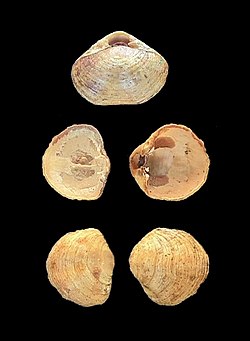
Picture of Terebratellidina
- Source
- Wikipedia/Commons
- Credit
- Luis Ruiz Berti
- Licence
- CC BY-SA 4.0
- Commercial use
- the licence allows it
No 3D scan of Terebratellidina was found in Sketchfab.
Smithsonian Open Access and MorphoSource were not reached for this taxon, so this list is what the others held rather than everything there is.
The description on this site
- Licence
- CC BY-SA 4.0
This is what the site found, which is not the same as what exists.
Keep going
What may have been alongside itTerebratulida through timeFormations of the Early JurassicThe world it lived on
Occurrence data from the Paleobiology Database, CC BY 4.0. Muir-Wood 1955