Troodontidae
Troodontidae is a clade of bird-like theropod dinosaurs from the Late Jurassic to Late Cretaceous. During most of the 20th century, troodontid fossils were few and incomplete and they have therefore been allied, at various times, with many dinosaurian lineages. More recent fossil discoveries of complete and articulated specimens, have helped to increase understanding about this group. Anatomical studies, particularly studies of the most primitive troodontids, like Sinovenator, demonstrate striking anatomical similarities with Archaeopteryx and primitive dromaeosaurids, and demonstrate that they are relatives comprising a clade called Paraves.

File:Mei Long.jpg ( Bruce McAdam ) File:Alaskan_troodont.jpg ( bryan... from Taipei, Taiwan) File:Sinovenator-Tianjin… · CC BY 4.0 · via Wikipedia/Commons. May be a photograph of a specimen, or an artist’s reconstruction — an interpretation of a skeleton, since colour and soft tissue are almost never preserved.
On record
Recorded, not inferred- Sits inside
- DeinonychosauriaPBDB
- Diet
- carnivore, omnivorePBDB
- Life habit
- ground dwellingPBDB
- Motility
- actively mobilePBDB, for Theropoda
- Environment
- terrestrialPBDB
Time the record covers
At least 82 million years on record.
The record covers at least 154.8 Mya to 72.2 Mya. No occurrence read is dated outside 168.2 Mya to 61.66 Mya.
250 occurrences of Troodontidae on record, most of them in the Late Cretaceous. Bar height is expected occurrences, not a count: each fossil is spread across the span it is dated to, so a tall narrow bar means tight dating and a low wide one means loose.
When
250 occurrences- Middle Jurassicunder 1%
- Late Jurassic3%
- Early Cretaceous10%
- Late Cretaceous87%
- Paleoceneunder 1%
These are dates about fossils, not the animal: the record can only begin after it arose and end before it died out, so either end may reach further. Shares are expected occurrences: a fossil dated to a span is counted partly in each period it straddles. More on what this infers.
Found in
58 formations
- Dinosaur Park Formation · Belly River Group36
- Oldman Formation · Belly River Group26
- Hell Creek Formation · Montana Group21
- Horseshoe Canyon Formation · Edmonton Group16
- Judith River Formation · Montana Group12
- Lance Formation11
Loading coastlines…
The named rock units Troodontidae has been recovered from, largest first. Drawn where the rock is now, not where it formed. 34 further formations hold fewer occurrences each and are not listed. 3 occurrences have no formation on record, which is common for older literature.
Troodontidae and its relatives
Late CretaceousWhere Troodontidae and its relatives were recorded in the Late Cretaceous.
Found in the same rock
1,167 taxa- Hadrosauridae74 sites
- Theropoda63 sites
- Troodon formosus54 sites
- Ceratopsidae49 sites
- Troodon48 sites
- Tyrannosauridae48 sites
- Anura44 sites
- Dromaeosauridae42 sites
- Paronychodon40 sites
- Myledaphus bipartitus39 sites
- Richardoestesia37 sites
- Chelydridae36 sites
- Scapherpeton tectum36 sites
- Baenidae35 sites
- Teleostei35 sites
- Multituberculata34 sites
- Opisthotriton kayi33 sites
- Osteichthyes32 sites
- Trionychidae32 sites
- Ankylosauria31 sites
- Mammalia31 sites
- Champsosaurus30 sites
- Saurornitholestes langstoni30 sites
- Aves29 sites
The Paleobiology Database records 222 sites for Troodontidae, and this reads all of them. The number is how many of those sites it was catalogued from too. The 24 sharing the most are listed.
This is not a list of everything alive at the time. It is only what has come out of the same ground as this animal and been written down.
Entered from
142 references- Multivariate analyses of small theropod dinosaur teeth and implications for paleoecological turnover through time13
- The paleogeographic and stratigraphic distribution of ceratopsids (Ornithischia) in the Upper Judith River Group of western Canada11
- Paleontology of the Judith River Formation (Campanian) of Dinosaur National Park, Alberta, Canada: evidence from vertebrate microfossil locality11
- Fossil Vertebrate Collections10
- Cranial anatomy of Stenonychosaurus inequalis (Saurischia, Theropoda) and its bearing on the origin of birds8
- A new troodontid (Dinosauria: Theropoda) from the Cenomanian of Uzbekistan, with a review of troodontid records from the territories of the former Soviet Union6
- Vertebrate microsite assemblages (exclusive of mammals) from the Foremost and Oldman Formations of the Judith River Group (Campanian) of southeastern Alberta: an illustrated guide6
- Troodontids (Theropoda) from the Dinosaur Park Formation, Alberta, with a description of a unique new taxon: implications for deinonychosaur diversity in North America5
- Vertebrate faunal changes through Lancian and Puercan time in southern Wyoming5
- Theropod teeth from the Lower Cretaceous Ilek Formation of Western Siberia, Russia4
- Theropod teeth from the Judith River Formation (Upper Cretaceous) of south-central Montana4
- Bird-like characteristics of the jaws and teeth of troodontid theropods (Dinosauria, Saurischia)4
Each of the 250 occurrences read was entered from one of these publications, ordered by how many each accounts for. This is not a search for papers mentioning the name. 130 further references are not listed. Entries link to doi.org where the Paleobiology Database holds an identifier, and to its own record where it does not. Relayed as the Paleobiology Database holds them, not checked against what they resolve to.
Media and terms
Media content1
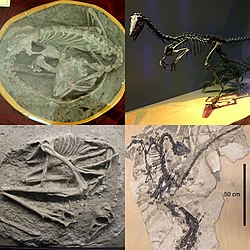
Picture of Troodontidae
- Source
- Wikipedia/Commons
- Credit
- File:Mei Long.jpg ( Bruce McAdam ) File:Alaskan_troodont.jpg ( bryan... from Taipei, Taiwan) File:Sinovenator-Tianjin…
- Licence
- CC BY 4.0
- Commercial use
- the licence allows it
No 3D scan of Troodontidae was found in Sketchfab.
Smithsonian Open Access and MorphoSource were not reached for this taxon, so this list is what the others held rather than everything there is.
The description on this site
- Licence
- CC BY-SA 4.0
This is what the site found, which is not the same as what exists.
Keep going
What may have been alongside itDeinonychosauria through timeFormations of the Late CretaceousThe world it lived on
Occurrence data from the Paleobiology Database, CC BY 4.0. Gilmore 1924