Trypanites
Trypanites is a narrow, cylindrical, unbranched boring which is one of the most common trace fossils in hard substrates such as rocks, carbonate hardgrounds and shells. It appears first in the Lower Cambrian, was very prominent in the Ordovician Bioerosion Revolution, and is still commonly formed today. Trypanites is almost always found in calcareous substrates, most likely because the excavating organism used an acid or other chemical agent to dissolve the calcium carbonate. Trypanites is common in the Ordovician and Silurian hardgrounds of Baltica.

Wilson44691 · Public Domain · via Wikipedia/Commons. May be a photograph of a specimen, or an artist’s reconstruction — an interpretation of a skeleton, since colour and soft tissue are almost never preserved.
On record
Recorded, not inferred- Sits inside
- IchnofossilsPBDB
- Diet
- suspension feederPBDB
- Life habit
- boringPBDB
- Motility
- stationaryPBDB
Time the record covers
At least 477 million years on record.
The record covers at least 477.1 Mya to 11.7 ka. No occurrence read is dated outside 486.4 Mya to 0 Mya.
32 occurrences of Trypanites on record, most of them in the Ordovician. Bar height is expected occurrences, not a count: each fossil is spread across the span it is dated to, so a tall narrow bar means tight dating and a low wide one means loose.
When
32 occurrences- Ordovician25%
- Silurian16%
- Devonian6%
- Carboniferous6%
- Early Jurassic6%
- Middle Jurassic3%
- Late Jurassic22%
- Early Cretaceous6%
- Paleocene3%
- Pleistocene3%
- Holocene3%
These are dates about fossils, not the animal: the record can only begin after it arose and end before it died out, so either end may reach further. Shares are expected occurrences: a fossil dated to a span is counted partly in each period it straddles. More on what this infers.
Found in
22 formations
- Ihmert Formation2
- Laval Formation · Chazy Group2
- Korallenoolith Formation2
- Riachuelo Formation2
- Eke Formation2
- Hale Formation1
Loading coastlines…
The named rock units Trypanites has been recovered from, largest first. Drawn where the rock is now, not where it formed. 5 occurrences have no formation on record, which is common for older literature.
Trypanites and its relatives
OrdovicianWhere Trypanites and its relatives were recorded in the Ordovician.
Found in the same rock
578 taxa- Gastrochaenolites8 sites
- Bivalvia4 sites
- Crinoidea4 sites
- Cyathophora4 sites
- Entobia4 sites
- Gastropoda4 sites
- Isastrea4 sites
- Liostrea4 sites
- Lithophaga4 sites
- Montlivaltia4 sites
- Plagiostoma4 sites
- Amplexocarinia3 sites
- Aulopora3 sites
- Fistulipora3 sites
- Gastrochaenolites dijugus3 sites
- Girvanella3 sites
- Microphyllia3 sites
- Neritopsis3 sites
- Serpulidae3 sites
- Stylina3 sites
- Stylohelia coalescens3 sites
- Talpina3 sites
- Thamnasteria3 sites
- Thecosmilia3 sites
The Paleobiology Database records 23 sites for Trypanites, and this reads all of them. The number is how many of those sites it was catalogued from too. The 24 sharing the most are listed.
This is not a list of everything alive at the time. It is only what has come out of the same ground as this animal and been written down.
Entered from
26 references- The oldest deep‑boring bivalves? Evidence from the Silurianof Gotland (Sweden)3
- Heydrichia (?) poignantii, sp. nov. (Sporolithaceae, Sporolithales, Rhodophyta), a 100 million year old fossil coralline red alga from north-eastern Brazil, and a new Hauterivian record of Sporolithon from Switzerland2
- Patch reef development in the florigemma-bank member (Oxfordian) from the Deister Mts (NW Germany): a type example for Late Jurassic coral thrombolite thickets2
- Late Jurassic coral/microbial reefs from the northern Paris Basin - facies, paleoecology and paleobiogeography2
- Paleoecology of upper Eifelian and lower Givetian coral limestones in the northwestern Sauerland (Devonian; Rhenish Massif)2
- Early Ordovician reefs in South China (Chenjiahe section, Hubei Province): deciphering the early evolution of skeletal-dominated reefs1
- Marine benthic invertebrates from the Upper Jurassic of northern Ethiopia and their biogeographic affinities1
- The Ellipsactinia Limestones of the Marsica area (Central Apennines): A reference zonation model for Upper Jurassic Intra-Tethys reef complexes1
- An early Hettangian coral reef in southern France: Implications for the end-Triassic reef crisis1
- Facies, geometry and geological significance of Late Ordovician (Early Caradocian) coral bioherms: Lourdes Formation, western Newfoundland1
- Jurassic corals from the Shemshak Formation of the Alborz Mountains, Iran1
- Massive corals in Paleocene siliciclastic sediments of Chubut (Patagonia, Argentina)1
Each of the 32 occurrences read was entered from one of these publications, ordered by how many each accounts for. This is not a search for papers mentioning the name. 14 further references are not listed. Entries link to doi.org where the Paleobiology Database holds an identifier, and to its own record where it does not. Relayed as the Paleobiology Database holds them, not checked against what they resolve to.
Media and terms
Media content2

Picture of Trypanites
- Source
- Wikipedia/Commons
- Credit
- Wilson44691
- Licence
- Public Domain
- Commercial use
- the licence allows it
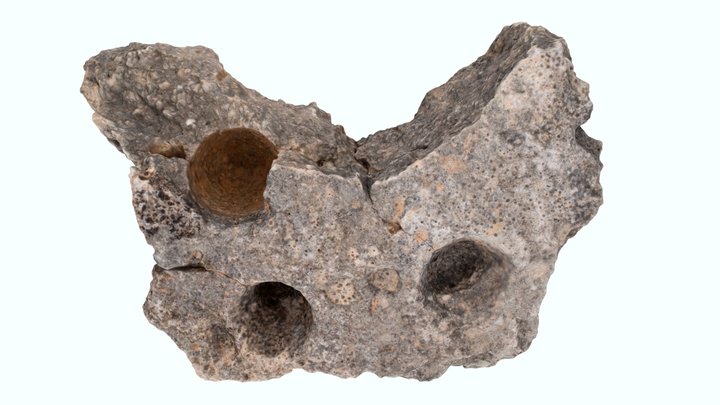
3D model
- Source
- Sketchfab
- Licence
- CC Attribution-NonCommercial-ShareAlike
- Commercial use
- the licence does not allow it
The description on this site
- Source
- Wikipedia, “Trypanites”
- Licence
- CC BY-SA 4.0
This is what the site found, which is not the same as what exists.
Keep going
What may have been alongside itIchnofossils through timeFormations of the OrdovicianThe world it lived on
Occurrence data from the Paleobiology Database, CC BY 4.0. Mägdefrau 1932