Vegaviidae
Vegaviidae is a proposed extinct family of neognathous, possibly anseriform birds which lived during the Late Cretaceous and possibly the Paleocene. The monophyly of the family has been questioned by subsequent studies, with the only definitive member Vegavis known from the Maastrichtian stage of Antarctica, though some fossil genera from other continents have been assigned to this clade.

El fosilmaníaco · CC BY-SA 4.0 · via Wikipedia/Commons. May be a photograph of a specimen, or an artist’s reconstruction — an interpretation of a skeleton, since colour and soft tissue are almost never preserved.
On record
Recorded, not inferred- Sits inside
- AnseriformesPBDB
- Diet
- herbivorePBDB, for Anseriformes
- Life habit
- volantPBDB, for Anseriformes
- Motility
- actively mobilePBDB, for Theropoda
- Environment
- terrestrialPBDB, for Theropoda
Time the record covers
At least 24 million years on record.
The record covers at least 72.2 Mya to 48.07 Mya. No occurrence read is dated outside 83.6 Mya to 33.9 Mya.
9 occurrences of Vegaviidae on record, most of them in the Late Cretaceous. Bar height is expected occurrences, not a count: each fossil is spread across the span it is dated to, so a tall narrow bar means tight dating and a low wide one means loose.
When
9 occurrences- Late Cretaceous60%
- Paleocene29%
- Eocene11%
These are dates about fossils, not the animal: the record can only begin after it arose and end before it died out, so either end may reach further. Shares are expected occurrences: a fossil dated to a span is counted partly in each period it straddles. More on what this infers.
Found in
5 formations
- López de Bertodano Formation3
- Waipara Greensand Formation2
- Quiriquina Formation · Arauco Group1
- Estratos de Algarrobo Formation1
- Northumberland Formation · Nanaimo Group1
Loading coastlines…
The named rock units Vegaviidae has been recovered from, largest first. Drawn where the rock is now, not where it formed. 1 occurrence has no formation on record, which is common for older literature.
Vegaviidae and its relatives
Late CretaceousWhere Vegaviidae and its relatives were recorded in the Late Cretaceous.
Found in the same rock
43 taxa- Elasmosauridae2 sites
- Mosasauridae2 sites
- Polarornis gregorii2 sites
- Annelida1 site
- Aristonectes1 site
- Australornis lovei1 site
- Aves1 site
- Baculites1 site
- Callianassa1 site
- Cardium1 site
- Chiasmolithus bidens1 site
- Cimoliasaurus1 site
- Coralliophila1 site
- Cytherea1 site
- Dadoxylon1 site
- Elasmobranchii1 site
- Hornibrookina teuriensis1 site
- Ischyrhiza chilensis1 site
- Kossmaticeras1 site
- Lalullia sp.1 site
- Lamnidae1 site
- Laurinoxylon1 site
- Lingula1 site
- Lucina1 site
The Paleobiology Database records 9 sites for Vegaviidae, and this reads all of them. The number is how many of those sites it was catalogued from too. The 24 sharing the most are listed.
This is not a list of everything alive at the time. It is only what has come out of the same ground as this animal and been written down.
Entered from
6 references- Vegaviidae, a new clade of southern diving birds that survived the K/T boundary4
- The Cretaceous Neornithine record and new Vegaviidae specimens from the López de Bertodano Formation (Upper Maastrichthian) of Vega Island, Antarctic Peninsula1
- Maaqwi cascadensis: A large, marine diving bird (Avialae: Ornithurae) from the Upper Cretaceous of British Columbia, Canada1
- First diagnosable non-sphenisciform bird from the early Paleocene of New Zealand1
- The morphology and systematics of Polarornis, a Cretaceous Loon (Aves: Gaviidae) from Antarctica1
- Neogaeornis wetzeli, n. g., n. s., der erste Kreidevogel der südlichen Hemisphäre [Neogaeornis wetzeli n. g. n. sp. the first Cretaceous bird from the Southern Hemisphere]1
Each of the 9 occurrences read was entered from one of these publications, ordered by how many each accounts for. This is not a search for papers mentioning the name. Entries link to doi.org where the Paleobiology Database holds an identifier, and to its own record where it does not. Relayed as the Paleobiology Database holds them, not checked against what they resolve to.
Media and terms
Media content1
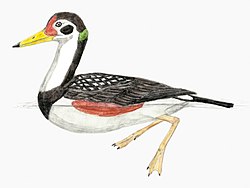
Picture of Vegaviidae
- Source
- Wikipedia/Commons
- Credit
- El fosilmaníaco
- Licence
- CC BY-SA 4.0
- Commercial use
- the licence allows it
No 3D scan of Vegaviidae was found in Sketchfab.
Smithsonian Open Access and MorphoSource were not reached for this taxon, so this list is what the others held rather than everything there is.
The description on this site
- Source
- Wikipedia, “Vegaviidae”
- Licence
- CC BY-SA 4.0
This is what the site found, which is not the same as what exists.
Keep going
What may have been alongside itAnseriformes through timeFormations of the Late CretaceousThe world it lived on
Occurrence data from the Paleobiology Database, CC BY 4.0. (Agnolín et al. 2017)