Venerupis
Venerupis is a genus of marine bivalve molluscs in the family Veneridae commonly known as carpet shells. The valves are robust and rhomboidal with the umbones turned-in and nearer the anterior end. The posterior end is wedge-shaped and the internal margins of the valves are smooth. There are 3 or 4 cardinal teeth on each valve. The foot is large and the siphons are of medium length and united except at the very tip.

Jan Johan ter Poorten; modified by Tom Meijer · CC BY-SA 3.0 · via Wikipedia/Commons. May be a photograph of a specimen, or an artist’s reconstruction — an interpretation of a skeleton, since colour and soft tissue are almost never preserved.
On record
Recorded, not inferred- Sits inside
- VeneridaePBDB
- Diet
- suspension feederPBDB, for Veneridae
- Life habit
- infaunalPBDB, for Veneridae
- Motility
- facultatively mobilePBDB, for Veneridae
- Vision
- blindPBDB, for Bivalvia
Time the record covers
At least 125 million years on record.
The record covers at least 125.77 Mya to 11.7 ka. No occurrence read is dated outside 132.6 Mya to 0 Mya.
60 occurrences of Venerupis on record, most of them in the Pleistocene. The Paleobiology Database records this as a living group. Bar height is expected occurrences, not a count: each fossil is spread across the span it is dated to, so a tall narrow bar means tight dating and a low wide one means loose.
When
60 occurrences- Early Cretaceous2%
- Eocene3%
- Miocene30%
- Pliocene21%
- Pleistocene37%
- Holocene7%
These are dates about fossils, not the animal: the record can only begin after it arose and end before it died out, so either end may reach further. Shares are expected occurrences: a fossil dated to a span is counted partly in each period it straddles. More on what this infers.
Found in
16 formations
- Tamala Limestone Formation3
- Palembang Formation3
- Koronia Formation2
- Kamicharo Formation2
- Mamara Formation2
- Toshima Sand Formation · Toyohashi Group2
Loading coastlines…
The named rock units Venerupis has been recovered from, largest first. Drawn where the rock is now, not where it formed. 36 occurrences have no formation on record, which is common for older literature.
Venerupis and its relatives
PleistoceneWhere Venerupis and its relatives were recorded in the Pleistocene.
Found in the same rock
1,116 taxa- Cardium11 sites
- Cerastoderma edule10 sites
- Chlamys10 sites
- Gibbula9 sites
- Anadara8 sites
- Astarte8 sites
- Hiatella arctica8 sites
- Mytilus edulis8 sites
- Solen8 sites
- Abra alba7 sites
- Bryozoa7 sites
- Lima lima7 sites
- Mactra7 sites
- Ostrea7 sites
- Timoclea ovata7 sites
- Aequipecten opercularis6 sites
- Arca noae6 sites
- Bivalvia6 sites
- Calyptraea chinensis6 sites
- Glycymeris6 sites
- Heteranomia squamula6 sites
- Modiolus6 sites
- Mytilus6 sites
- Nassarius6 sites
The Paleobiology Database records 42 sites for Venerupis, and this reads all of them. The number is how many of those sites it was catalogued from too. The 24 sharing the most are listed.
This is not a list of everything alive at the time. It is only what has come out of the same ground as this animal and been written down.
Entered from
31 references- Unpublished census data for the Mollusca of the Tjornes sequence, Iceland10
- Marine Molluscan Assemblages in the Early Pleistocene of Sidestrand, Bramerton and the Royal Society Borehole at Ludham, Norfolk5
- Les formations recifales coralliennes du Miocene superieur d'Algerie et du Maroc [Upper Miocene coral reef formations from Algeria and Morocco]4
- Mollusca from the raised beach deposits of the Kwantô region4
- Skwarko, 19943
- L'environnement côtier des Alpes-Maritimes à la fin de la transgression versilienne d'après l'étude biostratigraphique du site de l'Etoile à Nice (France)3
- The fossil Mollusca of the Peppermint Grove Limestone, Swan River district or Western Australia3
- Ostracods and bivalves from an Upper Pleistocene (Tyrrhenian) marine terrace near Altinova (Izmit Province, Turkey)2
- Occurence and taphonomy of bivalves from the Nijar reef (Messinian, Late Miocene, SE Spain)2
- Los Bivalvos fosiles de las Canarias orientale2
- Summary of the geology and paleontology of the Atsumi Peninsula, Aichi Prefecture, Japan2
- Molluscs as a major part of subtropical shallow-water carbonate production - an example from a Middle Miocene oolite shoal (Upper Serravallian, Austria)1
Each of the 60 occurrences read was entered from one of these publications, ordered by how many each accounts for. This is not a search for papers mentioning the name. 19 further references are not listed. Entries link to doi.org where the Paleobiology Database holds an identifier, and to its own record where it does not. Relayed as the Paleobiology Database holds them, not checked against what they resolve to.
Media and terms
Media content2
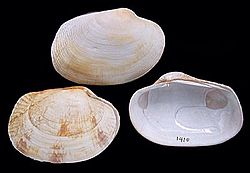
Picture of Venerupis
- Source
- Wikipedia/Commons
- Credit
- Jan Johan ter Poorten; modified by Tom Meijer
- Licence
- CC BY-SA 3.0
- Commercial use
- the licence allows it
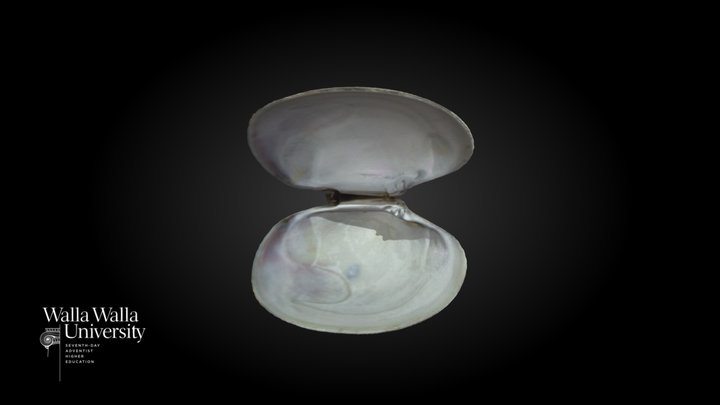
3D model
- Source
- Sketchfab
- Credit
- RosarioBeachMarineLab
- Licence
- CC Attribution
- Commercial use
- cannot be read from the licence given — check the record
Smithsonian Open Access and MorphoSource were not reached for this taxon, so this list is what the others held rather than everything there is.
The description on this site
- Source
- Wikipedia, “Venerupis”
- Licence
- CC BY-SA 4.0
This is what the site found, which is not the same as what exists.
Keep going
What may have been alongside itVeneridae through timeFormations of the PleistoceneThe world it lived on
Occurrence data from the Paleobiology Database, CC BY 4.0. Lamarck 1818