Waehneroceras
Waehneroceras is an extinct genus of cephalopod belonging to the Ammonite subclass.

Geni · CC BY-SA 4.0 · via Wikipedia/Commons. May be a photograph of a specimen, or an artist’s reconstruction — an interpretation of a skeleton, since colour and soft tissue are almost never preserved.
On record
Recorded, not inferred- Sits inside
- SchlotheimiidaePBDB
- Diet
- carnivorePBDB, for Ammonoidea
- Life habit
- nektonicPBDB, for Ammonoidea
- Motility
- fast-movingPBDB, for Ammonoidea
- Vision
- well-developedPBDB, for Cephalopoda
- Environment
- marinePBDB, for Cephalopoda
Time the record covers
At most 8.5 million years on record.
Every occurrence read is dated to somewhere between 201.4 Mya and 192.9 Mya, and nothing in the dating separates them, so that window is what the record shows rather than a span.
29 occurrences of Waehneroceras on record, most of them in the Early Jurassic. Bar height is expected occurrences, not a count: each fossil is spread across the span it is dated to, so a tall narrow bar means tight dating and a low wide one means loose.
When
29 occurrences- Early Jurassic100%
These are dates about fossils, not the animal: the record can only begin after it arose and end before it died out, so either end may reach further. Shares are expected occurrences: a fossil dated to a span is counted partly in each period it straddles. More on what this infers.
Found in
7 formations
- Fernie Formation12
- Aramachay Formation2
- Csovar Limestone Formation1
- Blue Lias Formation · Lias Group1
- Sandilands Formation1
- Sunrise Formation1
Loading coastlines…
The named rock units Waehneroceras has been recovered from, largest first. Drawn where the rock is now, not where it formed. 10 occurrences have no formation on record, which is common for older literature.
Waehneroceras and its relatives
Early JurassicWhere Waehneroceras and its relatives were recorded in the Early Jurassic.
Found in the same rock
42 taxa- Caloceras3 sites
- Coroniceras2 sites
- Pleuromya2 sites
- Alsatites liasicus1 site
- Alsatites proaries1 site
- Antiquilima (Antiquilima) succincta1 site
- Arnioceras1 site
- Bivalvia1 site
- Curviceras haidae1 site
- Dacromya1 site
- Discamphiceras pleuronotum1 site
- Discamphiceras silberlingi1 site
- Eolytoceras praecursor1 site
- Franziceras coronoides1 site
- Franziceras kennecottense1 site
- Gresslya1 site
- Kammerkarites frigga1 site
- Liostrea1 site
- Macrogrammites1 site
- Modiolus1 site
- Modiolus (Modiolus) scalprum1 site
- Modiolus minimus1 site
- Myophoria1 site
- Nevadaphyllites compressus1 site
The Paleobiology Database records 10 sites for Waehneroceras, and this reads all of them. The number is how many of those sites it was catalogued from too. The 24 sharing the most are listed.
This is not a list of everything alive at the time. It is only what has come out of the same ground as this animal and been written down.
Entered from
13 references- New Hettangian ammonite faunas and a Triassic Jurassic boundary succession, Fernie Formation, Williston Lake, British Columbia12
- The Triassic/Jurassic Boundary and Hettangian biostratigraphy in the area of the Utcubamba Valley (Northern Peru)3
- Die Ammoniten-Fauna des südamerikanischen Hettangium (basaler Jura), Teil 12
- Early Jurassic Bivalvia of western Canada. Part I. Subclasses Palaeotaxodonta, Pteriomorpha, and Isofilibranchia2
- Stratigraphische Untersuchungen im Unterjura des Südteils der Provinz Antofagasta in Nord-Chile2
- Middle and late Hettangian (Early Jurassic) ammonites from the Queen Charlotte Islands, British Columbia, Canada1
- Palaeoecology of the Late Triassic extinction event in the SW UK1
- Triassic-Jurassic boundary events inferred from integrated stratigraphy of the Csövár section, Hungary1
- Psiloceratids of the earliest Jurassic in the North-West European and Mediterranean Provinces – remarks and new observations1
- A New Marine Triassic-Jurassic Boundary Section in Hungary1
- Ammonites hettangiennes de la Gabbs Valley Range (Nevada, USA)1
- Late Triassic and early Jurassic biostratigraphy of the Felixkirk Borehole, North Yorkshire1
Each of the 29 occurrences read was entered from one of these publications, ordered by how many each accounts for. This is not a search for papers mentioning the name. 1 further reference is not listed. Entries link to doi.org where the Paleobiology Database holds an identifier, and to its own record where it does not. Relayed as the Paleobiology Database holds them, not checked against what they resolve to.
Media and terms
Media content2

Picture of Waehneroceras
- Source
- Wikipedia/Commons
- Credit
- Geni
- Licence
- CC BY-SA 4.0
- Commercial use
- the licence allows it
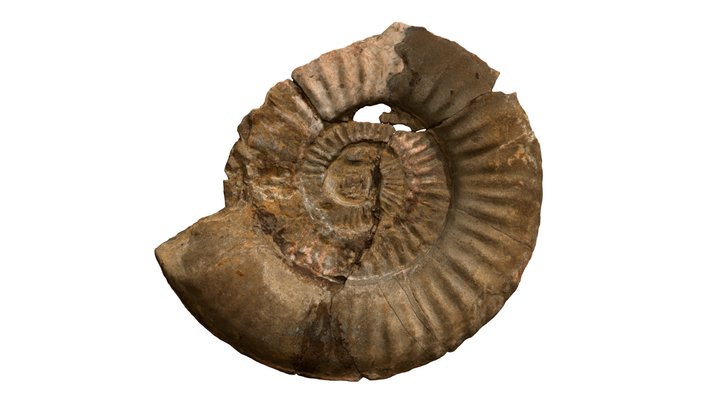
3D model
- Source
- Sketchfab
- Licence
- CC Attribution
- Commercial use
- cannot be read from the licence given — check the record
Smithsonian Open Access and MorphoSource were not reached for this taxon, so this list is what the others held rather than everything there is.
The description on this site
- Licence
- CC BY-SA 4.0
This is what the site found, which is not the same as what exists.
Keep going
What may have been alongside itSchlotheimiidae through timeFormations of the Early JurassicThe world it lived on
Occurrence data from the Paleobiology Database, CC BY 4.0.