Xenorophidae
Xenorophidae is an extinct family of dolphin-like odontocetes that lived in the Southeastern United States during the Oligocene. They were among the first major groups of odontocetes to diversify in the fossil record and are notable for their ability to echolocate.

Uncredited · via Wikipedia/Commons. May be a photograph of a specimen, or an artist’s reconstruction — an interpretation of a skeleton, since colour and soft tissue are almost never preserved.
On record
Recorded, not inferred- Sits inside
- OdontocetiPBDB
- Diet
- carnivorePBDB, for Odontoceti
- Life habit
- aquatic, depth=surfacePBDB, for Cetacea
- Motility
- actively mobilePBDB, for Cetacea
- Environment
- marine,freshwaterPBDB, for Odontoceti
Time the record covers
At most 29 million years on record.
Every occurrence read is dated to somewhere between 33.9 Mya and 5.333 Mya, and nothing in the dating separates them, so that window is what the record shows rather than a span.
29 occurrences of Xenorophidae on record, most of them in the Oligocene. Bar height is expected occurrences, not a count: each fossil is spread across the span it is dated to, so a tall narrow bar means tight dating and a low wide one means loose.
When
29 occurrencesThese are dates about fossils, not the animal: the record can only begin after it arose and end before it died out, so either end may reach further. Shares are expected occurrences: a fossil dated to a span is counted partly in each period it straddles. More on what this infers.
Found in
4 formations
- Ashley Formation · Cooper Group11
- Chandler Bridge Formation · Cooper Group6
- Belgrade Formation4
- Tiger Leap Formation1
Loading coastlines…
The named rock units Xenorophidae has been recovered from, largest first. Drawn where the rock is now, not where it formed. 7 occurrences have no formation on record, which is common for older literature.
Xenorophidae and its relatives
OligoceneWhere Xenorophidae and its relatives were recorded in the Oligocene.
Found in the same rock
110 taxa- Albertocetus meffordorum5 sites
- Xenorophus5 sites
- Odontoceti3 sites
- Xenorophus sloanii3 sites
- Albertocetus2 sites
- Ankylorhiza2 sites
- Coronodon havensteini2 sites
- Crenatosiren olseni2 sites
- Echovenator2 sites
- Natemys2 sites
- Odontoceti indet.2 sites
- Otodus (Carcharocles) angustidens2 sites
- Psephophorus2 sites
- Squalodon2 sites
- Xenorophus simplicidens2 sites
- Aglyptorhynchus1 site
- Amphictis timucua1 site
- Anadara (Sectiarca) floridana1 site
- Anchitherium1 site
- Ankylorhiza tiedemani1 site
- Anoxypristis1 site
- Archaeodelphis patrius1 site
- Archaeohippus blackbergi1 site
- Arretotherium fricki1 site
The Paleobiology Database records 21 sites for Xenorophidae, and this reads all of them. The number is how many of those sites it was catalogued from too. The 24 sharing the most are listed.
This is not a list of everything alive at the time. It is only what has come out of the same ground as this animal and been written down.
Entered from
16 references- Oligocene-Miocene marine mammals from Belgrade Quarry, North Carolina6
- New Skeletons of the Ancient Dolphin Xenorophus sloanii and Xenorophus simplicidens sp. nov. (Mammalia, Cetacea) from the Oligocene of South Carolina and the Ontogeny, Functional Anatomy, Asymmetry, Pathology, and Evolution of the Earliest Odontoceti5
- New records of the dolphin Albertocetus meffordorum (Odontoceti: Xenorophidae) from the lower Oligocene of South Carolina: Encephalization, sensory anatomy, postcranial morphology, and ontogeny of early odontocetes4
- A toothless dwarf dolphin (Odontoceti: Xenorophidae) points to explosive feeding diversification of modern whales (Neoceti)2
- Cenozoic vertebrate biostratigraphy of South Carolina, U.S.A. and additions to the fauna1
- The Origin of High-Frequency Hearing in Whales1
- Ultrasonic hearing and echolocation in the earliest toothed whales1
- A new basal odontocete from the upper Rupelian of South Carolina, U.S.A., with contributions to the systematics of Xenorophus and Mirocetus (Mammalia, Cetacea)1
- A new fossil species supports an early origin for toothed whale echolocation1
- A supermatrix analysis of genomic, morphological, and paleontological data from crown Cetacea1
- A new Xenorophus-like odontocete cetacean form the Oligocene of North Carolina and a discussion of the basal odontocete radiation1
- Excavation of Oligocene marine fossil beds near Charleston, South Carolina1
Each of the 29 occurrences read was entered from one of these publications, ordered by how many each accounts for. This is not a search for papers mentioning the name. 4 further references are not listed. Entries link to doi.org where the Paleobiology Database holds an identifier, and to its own record where it does not. Relayed as the Paleobiology Database holds them, not checked against what they resolve to.
Media and terms
Media content2

Picture of Xenorophidae
- Source
- Wikipedia/Commons
- Credit
- nobody named on the record
- Licence
- not stated by the source
- Commercial use
- cannot be read from the licence given — check the record
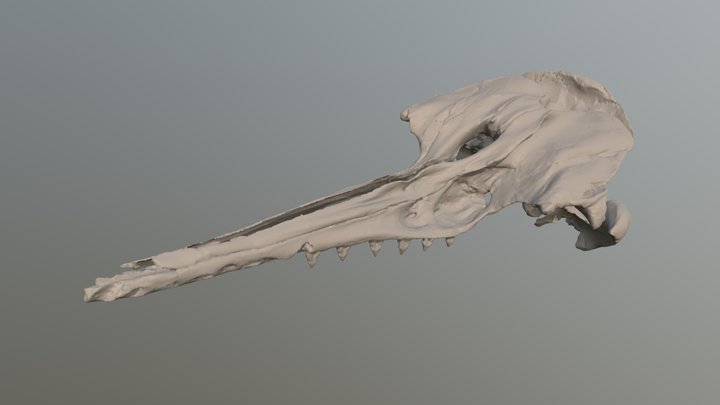
3D model
- Source
- Sketchfab
- Licence
- CC Attribution-NonCommercial-NoDerivs
- Commercial use
- the licence does not allow it
Smithsonian Open Access and MorphoSource were not reached for this taxon, so this list is what the others held rather than everything there is.
The description on this site
- Licence
- CC BY-SA 4.0
This is what the site found, which is not the same as what exists.
Keep going
What may have been alongside itOdontoceti through timeFormations of the OligoceneThe world it lived on
Occurrence data from the Paleobiology Database, CC BY 4.0. Uhen 2008