Ammonoidea indet.
No picture of Ammonoidea indet. was found. Wikipedia, Wikidata and Smithsonian Open Access were searched and had none. iDigBio and GBIF were not searched: the Paleobiology Database does not place Ammonoidea indet. firmly enough to tell it from something else bearing the same name, and a search on the name alone returns whichever of them was photographed.
Time the record covers
At least 333 million years on record.
The record covers at least 399.5 Mya to 66 Mya. No occurrence read is dated outside 538.8 Mya to 0 Mya.
650 occurrences of Ammonoidea indet. on record, most of them in the Early Cretaceous. Bar height is expected occurrences, not a count: each fossil is spread across the span it is dated to, so a tall narrow bar means tight dating and a low wide one means loose.
When
650 occurrences- Cambrianunder 1%
- Ordovicianunder 1%
- Silurianunder 1%
- Devonianunder 1%
- Carboniferous7%
- Permian2%
- Early Triassic3%
- Middle Triassic2%
- Late Triassic12%
- Early Jurassic16%
- Middle Jurassic4%
- Late Jurassic15%
- Early Cretaceous20%
- Late Cretaceous16%
- Paleoceneunder 1%
- Eoceneunder 1%
- Oligoceneunder 1%
- Mioceneunder 1%
- Plioceneunder 1%
These are dates about fossils, not the animal: the record can only begin after it arose and end before it died out, so either end may reach further. Shares are expected occurrences: a fossil dated to a span is counted partly in each period it straddles. More on what this infers.
Found in
138 formations
- Kap Leslie Formation76
- Luning Formation56
- Graham Formation · Cisco Group27
- Mancos Shale Formation25
- Fjerritslev Formation17
- Corsicana Marl Formation13
Loading coastlines…
The named rock units Ammonoidea indet. has been recovered from, largest first. Drawn where the rock is now, not where it formed. 114 further formations hold fewer occurrences each and are not listed. 199 occurrences have no formation on record, which is common for older literature.
Ammonoidea indet. and its relatives
Early CretaceousWhere Ammonoidea indet. and its relatives were recorded in the Early Cretaceous.
Found in the same rock
853 taxa- Astarte71 sites
- Camptonectes69 sites
- Entolium orbiculare69 sites
- Belemnitida57 sites
- Buchia mosquensis54 sites
- Isognomon53 sites
- Bivalvia48 sites
- Pleuromya47 sites
- Nuculana46 sites
- Taimyrothyris46 sites
- Grammatodon43 sites
- Gastropoda42 sites
- Pleuromya uniformis39 sites
- Pinna38 sites
- Hartwellia36 sites
- Protocardia striatula35 sites
- Isocyprina34 sites
- Serpula intestinalis34 sites
- Lucina31 sites
- Inoceramidae29 sites
- Liostrea28 sites
- Oxytoma inequivalvis28 sites
- Serpula27 sites
- Dentalium26 sites
The Paleobiology Database records 544 sites for Ammonoidea indet., and this reads 240 of them. The number is how many of those sites it was catalogued from too. The 24 sharing the most are listed.
This is not a list of everything alive at the time. It is only what has come out of the same ground as this animal and been written down.
Entered from
169 references- Jura Vaudois et Neuchatelois91
- Genesis and environmental significance of Upper Cretaceous shell concentrations from the Cauvery Basin, southern India57
- Community structure, paleoecology, and depositional environments within the Upper Triassic Luning Formation of Nevada50
- Early Jurassic Bivalvia of western Canada. Part I. Subclasses Palaeotaxodonta, Pteriomorpha, and Isofilibranchia37
- The paleoecology of the Cenomanian-Turonian (Cretaceous) stage boundary extinctions at Black Mesa, Arizona35
- The surficial geology, paleontology, and paleoecology of the Finis Shale (Pennsylvanian, Lower Virgilian) in Jack County, Texas28
- Unpublished data20
- Changes in the bivalve assemblage of an early Jurassic mudstone sequence (the Fjerritslev formation in the Gassum 1 well, Denmark)17
- Early Jurassic Bivalvia of Argentina: Part 1, Stratigraphical introduction and superfamilies Nuculanacea, Arcacea, Mytilacea and Pinnacea16
- Upper Cretaceous (Maestrichtian) larger invertebrate Fossils from the Haustator bilira Assemblage Zone in the west gulf Coastal Plain11
- Fossilvergesellschaftungen, Paläoökologie und paläosynökologische Entwicklung im Oberen Anisium (Mittlere Trias) von Qingyan, insbesondere Bangtoupo, Provinz Guizhou, Südwestchina9
- Upper Cretaceous (Maestrichtian) larger invertebrates from the Haustator bilira Assemblage Zone in the Atlantic Coastal Plain with further data for the East Gulf9
Each of the 650 occurrences read was entered from one of these publications, ordered by how many each accounts for. This is not a search for papers mentioning the name. 157 further references are not listed. Entries link to doi.org where the Paleobiology Database holds an identifier, and to its own record where it does not. Relayed as the Paleobiology Database holds them, not checked against what they resolve to.
Media and terms
Media content1
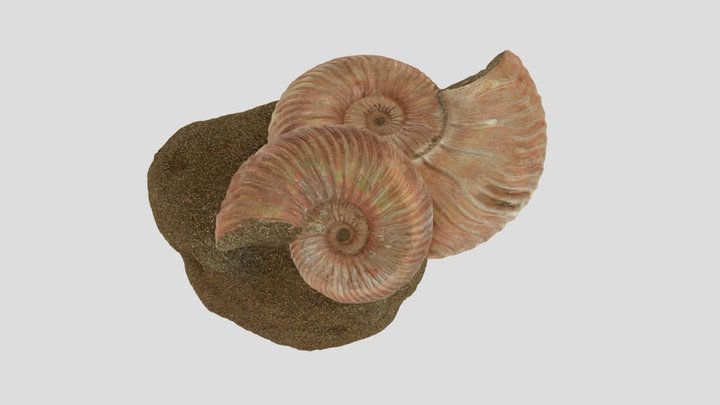
3D model
- Source
- Sketchfab
- Credit
- John Merck
- Licence
- CC Attribution
- Commercial use
- cannot be read from the licence given — check the record
No picture of Ammonoidea indet. was found. Wikipedia, Wikidata and Smithsonian Open Access were searched and had none.
iDigBio and GBIF were not searched: the Paleobiology Database does not place Ammonoidea indet. firmly enough to tell it from something else bearing the same name, and a search on the name alone returns whichever of them was photographed.
This is what the site found, which is not the same as what exists.
Keep going
What may have been alongside itFormations of the Early CretaceousThe world it lived on
Occurrence data from the Paleobiology Database, CC BY 4.0.