Anser
Anser is a waterfowl genus that includes the grey geese and the white geese. It belongs to the true goose and swan subfamily of Anserinae under the family of Anatidae. The genus has a Holarctic distribution, with at least one species breeding in any open, wet habitats in the subarctic and cool temperate regions of the Northern Hemisphere in summer. Some also breed farther south, reaching into warm temperate regions. They mostly migrate south in winter, typically to regions in the temperate zone between the January 0 °C (32 °F) and 5 °C (41 °F) isotherms.

Uncredited · CC BY-SA 3.0 · via Wikipedia/Commons. May be a photograph of a specimen, or an artist’s reconstruction — an interpretation of a skeleton, since colour and soft tissue are almost never preserved.
On record
Recorded, not inferred- Sits inside
- AnseriniPBDB
- Diet
- folivore, granivorePBDB, for Anserinae
- Life habit
- volantPBDB, for Anserinae
- Motility
- actively mobilePBDB, for Theropoda
- Environment
- freshwaterPBDB, for Anserinae
Time the record covers
At least 3.5 million years on record.
The record covers at least 3.6 Mya to 11.7 ka. No occurrence read is dated outside 11.63 Mya to 0 Mya.
93 occurrences of Anser on record, most of them in the Pleistocene. The Paleobiology Database records this as a living group. Bar height is expected occurrences, not a count: each fossil is spread across the span it is dated to, so a tall narrow bar means tight dating and a low wide one means loose.
When
93 occurrences- Miocene2%
- Pliocene3%
- Pleistocene60%
- Holocene36%
These are dates about fossils, not the animal: the record can only begin after it arose and end before it died out, so either end may reach further. Shares are expected occurrences: a fossil dated to a span is counted partly in each period it straddles. More on what this infers.
Found in
7 formations
- Gabal Silsila Formation2
- Gebel Silsila-YCS Formation1
- Yorktown Formation · Chesapeake Group1
- Palos Verdes Sand Formation1
- San Pedro Formation1
- American Falls Lake Bed E Formation1
Loading coastlines…
The named rock units Anser has been recovered from, largest first. Drawn where the rock is now, not where it formed. 85 occurrences have no formation on record, which is common for older literature.
Anser and its relatives
PleistoceneWhere Anser and its relatives were recorded in the Pleistocene.
Found in the same rock
1,533 taxa- Anas platyrhynchos30 sites
- Larus25 sites
- Anas24 sites
- Branta canadensis23 sites
- Corvus corax22 sites
- Phalacrocorax penicillatus20 sites
- Ardea herodias16 sites
- Phalacrocorax16 sites
- Phalacrocorax auritus16 sites
- Buteo15 sites
- Buteo jamaicensis15 sites
- Corvus brachyrhynchos15 sites
- Haliaeetus leucocephalus15 sites
- Numenius americanus15 sites
- Podiceps nigricollis15 sites
- Tyto alba15 sites
- Mergus serrator14 sites
- Spatula clypeata14 sites
- Anatidae13 sites
- Anserinae13 sites
- Aythya13 sites
- Anas acuta12 sites
- Anas crecca12 sites
- Anatinae12 sites
The Paleobiology Database records 78 sites for Anser, and this reads all of them. The number is how many of those sites it was catalogued from too. The 24 sharing the most are listed.
This is not a list of everything alive at the time. It is only what has come out of the same ground as this animal and been written down.
Entered from
52 references- Prehistoric human impacts on California birds: evidence from the Emeryville shellmoumd avifauna15
- Distribution and provenance of fossil avifauna on San Miguel Island5
- The fossil Birds of California5
- Pleistocene and prehistoric birds of south-west Britain4
- Polar bear fossil and archaeological records from the Pleistocene and Holocene in relation to sea ice extent and open water polynyas3
- The fossil bird associations from the early Middle Pleistocene of the Ragusa province (SE Sicily, Italy)3
- A late Pleistocene avifauna from San Miguel Island, California3
- Kom Ombo: Preliminary Report on the Fauna of Late Paleolithic Sites in Upper Egypt3
- A review of the Pleistocene birds of Fossil Lake, Oregon3
- Variability in Thule Inuit Subsistence Economy: A Faunal Analysis of OkRn-1, Banks Island, NWT2
- Early Pleistocene birds from Pirro Nord (Puglia, southern Italy)2
- Ancient Arctic Hunters: Material Culture and Survival Strategy2
Each of the 93 occurrences read was entered from one of these publications, ordered by how many each accounts for. This is not a search for papers mentioning the name. 40 further references are not listed. Entries link to doi.org where the Paleobiology Database holds an identifier, and to its own record where it does not. Relayed as the Paleobiology Database holds them, not checked against what they resolve to.
Media and terms
Media content3

Picture of Anser
- Source
- Wikipedia/Commons
- Credit
- nobody named on the record
- Licence
- CC BY-SA 3.0
- Commercial use
- the licence allows it
Photogrammetry
- Source
- MorphoSource
- Credit
- Moore Lab of Zoology
- Licence
- not stated by the source
- Commercial use
- cannot be read from the licence given — check the record
- Specimen
- Anser albifrons · MLZ:Bird:MLZ:Bird:27972
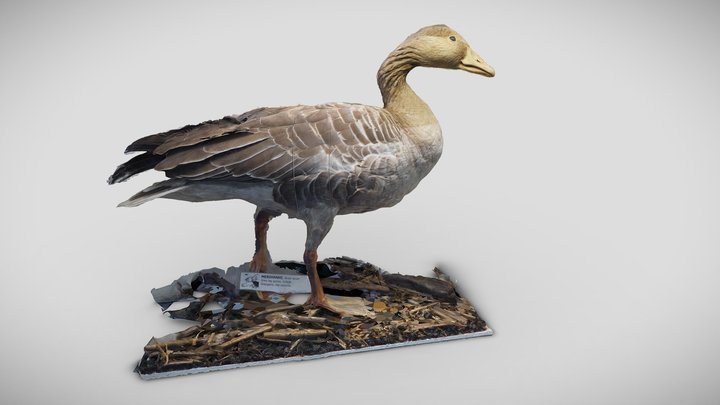
Smithsonian Open Access was not reached for this taxon, so this list is what the others held rather than everything there is.
The description on this site
- Licence
- CC BY-SA 4.0
This is what the site found, which is not the same as what exists.
Keep going
What may have been alongside itAnserini through timeFormations of the PleistoceneThe world it lived on
Occurrence data from the Paleobiology Database, CC BY 4.0. Linnaeus 1758