Aphanius
Aphanius, commonly referred to as Mediterranean killifish, is a genus of the order Cyprinodontiformes in the family Aphaniidae. They are found in fresh and brackish waters in the coastal plains of the Mediterranean region.

Etrusko25 · CC BY-SA 3.0 · via Wikipedia/Commons. May be a photograph of a specimen, or an artist’s reconstruction — an interpretation of a skeleton, since colour and soft tissue are almost never preserved.
On record
Recorded, not inferred- Also called
- nonoPBDB
- Sits inside
- CyprinodontidaePBDB
- Diet
- omnivorePBDB, for Cyprinodontiformes
- Life habit
- nektonicPBDB, for Cyprinodontiformes
- Motility
- actively mobilePBDB, for Cyprinodontiformes
Time the record covers
At least 2.7 million years on record.
The record covers at least 5.333 Mya to 2.58 Mya. No occurrence read is dated outside 11.63 Mya to 1.8 Mya.
34 occurrences of Aphanius on record. The Paleobiology Database records this as a living group, and the chart stops with its fossils rather than at the present. Bar height is expected occurrences, not a count: each fossil is spread across the span it is dated to, so a tall narrow bar means tight dating and a low wide one means loose.
When
34 occurrences- Miocene97%
- Pleistocene3%
These are dates about fossils, not the animal: the record can only begin after it arose and end before it died out, so either end may reach further. Shares are expected occurrences: a fossil dated to a span is counted partly in each period it straddles. More on what this infers.
Found in
3 formations
Loading coastlines…
The named rock units Aphanius has been recovered from, largest first. Drawn where the rock is now, not where it formed. 30 occurrences have no formation on record, which is common for older literature.
Found in the same rock
231 taxa- Gobius8 sites
- Atherina boyeri5 sites
- Spratelloides gracilis5 sites
- Accipitridae2 sites
- Alosa elongata2 sites
- Amphisbaenia2 sites
- Anguinae2 sites
- Aphia2 sites
- Apocricetus barrierei2 sites
- Apodemus gudrunae2 sites
- Arnoglossus2 sites
- Atherina2 sites
- Clupeonella2 sites
- Cyprideis2 sites
- Eucyon monticinensis2 sites
- Gobiidae2 sites
- Gobius multipinnatus2 sites
- Gobius niger2 sites
- Gomphotheriidae2 sites
- Lacertidae2 sites
- Lesueurigobius2 sites
- Lophiiformes2 sites
- Microchirus2 sites
- Mugil2 sites
The Paleobiology Database records 34 sites for Aphanius, and this reads all of them. The number is how many of those sites it was catalogued from too. The 24 sharing the most are listed.
This is not a list of everything alive at the time. It is only what has come out of the same ground as this animal and been written down.
Entered from
10 references- Données récentes sur Les téléostéens du Miocène et du Pliocéne d'Italie22
- L’ichthyofaune messinienne du bassin de Sorbas (Almería, Espagne) et ses rapports avec l’en- vironnement sédimentaire3
- Fish mass mortality in the Upper Miocene laminated gypsum of western Crete (Hania Province, Greece)2
- An overview of the late Miocene vertebrates from the fissure fillings of Monticino Quarry (Brisighella, Italy), with new data on non-mammalian taxa1
- The Zanclean marine fish fauna and palaeoenvironmental reconstruction of a coastal marine setting in the eastern Mediterranean1
- Fossil marine fishes and the ʻLago Mareʼ event: Has the Mediterranean ever transformed into a brackish lake?1
- The upper Messinian assemblages of fossil vertebrate remains of Verduno (NW Italy): Another brick for a latest Miocene bridge acress the Mediterranean1
- The record of the Messinian salinity crisis in the Tertiary Piedmont Basin (NW Italy): The Alba section revisited1
- Fish otoliths from the Messinian of Strada degli Archi (Tuscany, Italy) – Taxonomy and palaeoecology1
- A new fossil Aphanius species from the Upper Miocene of Armenia (Eastern Paratethys)1
Each of the 34 occurrences read was entered from one of these publications, ordered by how many each accounts for. This is not a search for papers mentioning the name. Entries link to doi.org where the Paleobiology Database holds an identifier, and to its own record where it does not. Relayed as the Paleobiology Database holds them, not checked against what they resolve to.
Media and terms
Media content2
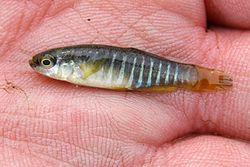
Picture of Aphanius
- Source
- Wikipedia/Commons
- Credit
- Etrusko25
- Licence
- CC BY-SA 3.0
- Commercial use
- the licence allows it

CT scan
- Source
- MorphoSource
- Credit
- MCZ Ichthyology
- Licence
- In Copyright
- Commercial use
- cannot be read from the licence given — check the record
- Specimen
- Aphanius fasciatus · MCZ:Ich:26417
The description on this site
- Source
- Wikipedia, “Aphanius”
- Licence
- CC BY-SA 4.0
This is what the site found, which is not the same as what exists.
Keep going
What may have been alongside itCyprinodontidae through timeThe world it lived on
Occurrence data from the Paleobiology Database, CC BY 4.0. Nardo 1827