Aphetoceras
Aphetoceras, from Ancient Greek ἄφετος (áphetos), meaning "loose", and κέρας (kéras), meaning "horn", is a genus of tarphycerid cephalopod within the Estonioceratidae; loosely coiled without an impression along the dorsal margin; early whorls barely reaching, separating then diverging in the final mature whorl; weakly ribbed in some. The cross section of Aphetoceras is higher than wide, making it compressed in form. The dorsum, along the inner curve, is more broadly rounded than the venter which lies along the outer curve. The siphuncle is relatively large, located near but not at the ventral margin; lined with secondary deposits. Chambers are empty.

Daderot · CC0 · via Wikipedia/Commons. May be a photograph of a specimen, or an artist’s reconstruction — an interpretation of a skeleton, since colour and soft tissue are almost never preserved.
On record
Recorded, not inferred- Sits inside
- EstonioceratidaePBDB
- Diet
- carnivorePBDB, for Cephalopoda
- Life habit
- nektobenthicPBDB, for Tarphycerida
- Motility
- fast-movingPBDB, for Cephalopoda
- Vision
- well-developedPBDB, for Cephalopoda
- Environment
- marinePBDB, for Cephalopoda
Time the record covers
At least 12 million years on record.
The record covers at least 481.7 Mya to 469.4 Mya. No occurrence read is dated outside 486.85 Mya to 458.2 Mya.
20 occurrences of Aphetoceras on record, most of them in the Ordovician. Bar height is expected occurrences, not a count: each fossil is spread across the span it is dated to, so a tall narrow bar means tight dating and a low wide one means loose.
When
20 occurrences- Ordovician100%
These are dates about fossils, not the animal: the record can only begin after it arose and end before it died out, so either end may reach further. Shares are expected occurrences: a fossil dated to a span is counted partly in each period it straddles. More on what this infers.
Found in
12 formations
- Rochdale Formation · Beekmantown Group4
- Naylor Ledge Formation2
- Cotter Formation2
- Jefferson City Formation2
- Rich Fountain Formation2
- Fort Ann Formation1
Loading coastlines…
The named rock units Aphetoceras has been recovered from, largest first. Drawn where the rock is now, not where it formed. 1 occurrence has no formation on record, which is common for older literature.
Aphetoceras and its relatives
OrdovicianWhere Aphetoceras and its relatives were recorded in the Ordovician.
Found in the same rock
113 taxa- Allopiloceras2 sites
- Anrangeroceras repens2 sites
- Campbelloceras2 sites
- Chisiloceras2 sites
- Dideroceras2 sites
- Illaenus2 sites
- Kirkoceras missisquoi2 sites
- Lesueurilla2 sites
- Maclurites2 sites
- Nileus2 sites
- Protocycloceras catulus2 sites
- Pycnoceras calciferiforme2 sites
- Pycnoceras clausum2 sites
- Tarphyceras2 sites
- Archaeoscyphia1 site
- Arkoceras1 site
- Avaoceras longidomum1 site
- Avaoceras magnisiphonatum1 site
- Bassleroceras1 site
- Bassleroceras champlainense1 site
- Bassleroceras perseus1 site
- Bathyurellus1 site
- Calathium1 site
- Cameroceras1 site
The Paleobiology Database records 17 sites for Aphetoceras, and this reads all of them. The number is how many of those sites it was catalogued from too. The 24 sharing the most are listed.
This is not a list of everything alive at the time. It is only what has come out of the same ground as this animal and been written down.
Entered from
9 references- Ozarkian and Canadian cephalopods, Part I: Nautilicones9
- Onset of the Ordovician cephalopod radiation - evidence from the Rochdale Formation (middle Early Ordovician, Stairsian)in eastern New York2
- The stratigraphy of some Lower Ordovician formations of the Ozark uplift2
- Cephalopoda of the Beekmantown and Chazy formations of the Champlain Basin2
- A Middle Ordovician (Darriwilian) Calathium reef complex on the carbonate ramp of the northwestern Tarim Block, northwest China: A sedimentological approach1
- The Lower Ordovician cephalopod faunas of the Durness Group, North-West Scotland1
- Stratigraphic table of northwestern region of China: XinJiang Province part1
- Competitive algal colonization of peritidal flats in a schizohaline environment; the lower Ordovician of New York1
- Early Ordovician Sea in Central Texas1
Each of the 20 occurrences read was entered from one of these publications, ordered by how many each accounts for. This is not a search for papers mentioning the name. Entries link to doi.org where the Paleobiology Database holds an identifier, and to its own record where it does not. Relayed as the Paleobiology Database holds them, not checked against what they resolve to.
Media and terms
Media content1
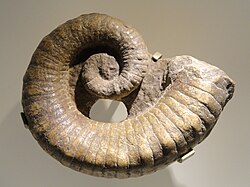
Picture of Aphetoceras
- Source
- Wikipedia/Commons
- Credit
- Daderot
- Licence
- CC0
- Commercial use
- the licence allows it
No 3D scan of Aphetoceras was found in MorphoSource and Sketchfab.
Smithsonian Open Access was not reached for this taxon, so this list is what the others held rather than everything there is.
The description on this site
- Source
- Wikipedia, “Aphetoceras”
- Licence
- CC BY-SA 4.0
This is what the site found, which is not the same as what exists.
Keep going
What may have been alongside itEstonioceratidae through timeFormations of the OrdovicianThe world it lived on
Occurrence data from the Paleobiology Database, CC BY 4.0. Hyatt 1894