Aythya nyroca
The ferruginous duck, also known as the ferruginous pochard, common white-eye or white-eyed pochard, is a medium-sized diving duck native to the Palearctic. The scientific name is derived from the Ancient Greek word, αἴθυιᾰ, an unknown seabird mentioned by authors including Hesychius and Aristotle, and the Russian word, нырок, the Russian word for pochard, which occurs in the bird's Russian common name.

Francis Franklin · CC BY-SA 3.0 · via Wikipedia/Commons. May be a photograph of a specimen, or an artist’s reconstruction — an interpretation of a skeleton, since colour and soft tissue are almost never preserved.
On record
Recorded, not inferred- Also called
- ferruginous pochardPBDB
- Sits inside
- AythyaPBDB
- Diet
- herbivorePBDB, for Anatinae
- Life habit
- volantPBDB, for Anatinae
- Motility
- actively mobilePBDB, for Theropoda
- Environment
- freshwaterPBDB, for Anatinae
- Mass
- 583 gWikidata
Time the record covers
At most 1.8 million years on record.
Every occurrence read is dated to somewhere between 1.8 Mya and 11.7 ka, and nothing in the dating separates them, so that window is what the record shows rather than a span.
6 occurrences of Aythya nyroca on record, most of them in the Pleistocene. The Paleobiology Database records this as a living group. Bar height is expected occurrences, not a count: each fossil is spread across the span it is dated to, so a tall narrow bar means tight dating and a low wide one means loose.
When
6 occurrences- Pleistocene100%
These are dates about fossils, not the animal: the record can only begin after it arose and end before it died out, so either end may reach further. Shares are expected occurrences: a fossil dated to a span is counted partly in each period it straddles. More on what this infers.
Aythya nyroca and its relatives
PleistoceneWhere Aythya nyroca and its relatives were recorded in the Pleistocene.
Found in the same rock
112 taxa- Anas platyrhynchos6 sites
- Aythya fuligula4 sites
- Anas crecca3 sites
- Anatidae3 sites
- Fulica atra3 sites
- Mareca strepera3 sites
- Microtus3 sites
- Spatula clypeata3 sites
- Anas2 sites
- Anser albifrons2 sites
- Arvicola2 sites
- Aythya ferina2 sites
- Columba palumbus2 sites
- Crex crex2 sites
- Crocidura2 sites
- Emys orbicularis2 sites
- Haliaeetus albicilla2 sites
- Mauremys rivulata2 sites
- Palaeoloxodon antiquus2 sites
- Perdix perdix2 sites
- Picus canus2 sites
- Plegadis falcinellus2 sites
- Rallus aquaticus2 sites
- Tachybaptus ruficollis2 sites
The Paleobiology Database records 6 sites for Aythya nyroca, and this reads all of them. The number is how many of those sites it was catalogued from too. The 24 sharing the most are listed.
This is not a list of everything alive at the time. It is only what has come out of the same ground as this animal and been written down.
Entered from
5 references- The ornithological remains from Marathousa 1 (Middle Pleistocene; Megalopolis Basin, Greece)2
- A new Middle Pleistocene bird assemblage from Cava di Breccia di Casal Selce (Ponte Galeria, Rome, Italy)1
- The fossil bird associations from the early Middle Pleistocene of the Ragusa province (SE Sicily, Italy)1
- Bird remains from Curata and Bordu Mare caves (Romania)1
- Huescar-1 (Granada, Espana): Avance de la lista de aves y consiguientes conjeturas sobre paleoambiente y paleogeografia1
Each of the 6 occurrences read was entered from one of these publications, ordered by how many each accounts for. This is not a search for papers mentioning the name. Entries link to doi.org where the Paleobiology Database holds an identifier, and to its own record where it does not. Relayed as the Paleobiology Database holds them, not checked against what they resolve to.
Media and terms
Media content1
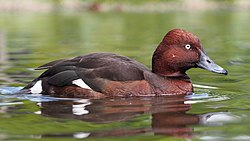
Picture of Aythya nyroca
- Source
- Wikipedia/Commons
- Credit
- Francis Franklin
- Licence
- CC BY-SA 3.0
- Commercial use
- the licence allows it
No 3D scan of Aythya nyroca was found in MorphoSource and Sketchfab.
Smithsonian Open Access was not reached for this taxon, so this list is what the others held rather than everything there is.
The description on this site
- Licence
- CC BY-SA 4.0
This is what the site found, which is not the same as what exists.
Keep going
What may have been alongside itAythya through timeFormations of the PleistoceneThe world it lived on
Occurrence data from the Paleobiology Database, CC BY 4.0. (Güldenstädt 1770)