Bursera
Bursera is a genus with about 100 described species of flowering shrubs and trees varying in size up to 25 m (82 ft) high. It is the type genus for Burseraceae. The trees are native to the Americas, from the southern United States south through to northern Argentina, in tropical and warm temperate forest habitats. It is named after the 17th-century Danish botanist Joachim Burser.

Uncredited · CC BY-SA 3.0 · via Wikipedia/Commons. May be a photograph of a specimen, or an artist’s reconstruction — an interpretation of a skeleton, since colour and soft tissue are almost never preserved.
On record
Recorded, not inferred- Sits inside
- BurseraceaePBDB
- Diet
- "photoautotroph"PBDB, for Angiospermae
Time the record covers
At least 33 million years on record.
The record covers at least 33.9 Mya to 11.7 ka. No occurrence read is dated outside 37.71 Mya to 0 Mya.
13 occurrences of Bursera on record. The Paleobiology Database records this as a living group. Bar height is expected occurrences, not a count: each fossil is spread across the span it is dated to, so a tall narrow bar means tight dating and a low wide one means loose.
When
13 occurrencesThese are dates about fossils, not the animal: the record can only begin after it arose and end before it died out, so either end may reach further. Shares are expected occurrences: a fossil dated to a span is counted partly in each period it straddles. More on what this infers.
Found in
2 formations
Loading coastlines…
The named rock units Bursera has been recovered from, largest first. Drawn where the rock is now, not where it formed. 9 occurrences have no formation on record, which is common for older literature.
Found in the same rock
315 taxa- Carya8 sites
- Rhamnites6 sites
- Viburnum6 sites
- Dicotyledoneae5 sites
- Dryophyllum5 sites
- Dryopteris5 sites
- Eugenia5 sites
- Pugetia longifolia5 sites
- Typha lesquereuxi5 sites
- Acer florissanti4 sites
- Athyana4 sites
- Castanea4 sites
- Cedrela4 sites
- Cedrelospermum4 sites
- Cercis parvifolia4 sites
- Cercocarpus4 sites
- Chamaecyparis4 sites
- Cladrastis4 sites
- Cotinus fraterna4 sites
- Crataegus4 sites
- Fabaceae4 sites
- Fagopsis longifolia4 sites
- Goweria cf. dilleri4 sites
- Koelreuteria4 sites
The Paleobiology Database records 13 sites for Bursera, and this reads all of them. The number is how many of those sites it was catalogued from too. The 24 sharing the most are listed.
This is not a list of everything alive at the time. It is only what has come out of the same ground as this animal and been written down.
Entered from
5 references- Paleoecological and Floristic Heterogeneity in the Plant-Fossil Record - An Analysis Based on the Eocene of Washington5
- Fossil Plants of the Florissant Beds of Colorado4
- Fossil flora from the Himalayan foot-hills of Darjeeling District, West Bengal and its palaeoecological and phytogeographical significance2
- Exceptionally well preserved late Quaternary plant and vertebrate fossils from a blue hole on Abaco, The Bahamas1
- A Miocene flora from the western border of the Mohave desert1
Each of the 13 occurrences read was entered from one of these publications, ordered by how many each accounts for. This is not a search for papers mentioning the name. Entries link to doi.org where the Paleobiology Database holds an identifier, and to its own record where it does not. Relayed as the Paleobiology Database holds them, not checked against what they resolve to.
Media and terms
Media content2
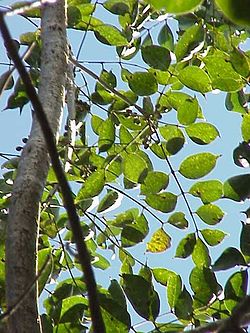
Picture of Bursera
- Source
- Wikipedia/Commons
- Credit
- nobody named on the record
- Licence
- CC BY-SA 3.0
- Commercial use
- the licence allows it
CT scan
- Source
- MorphoSource
- Licence
- not stated by the source
- Commercial use
- cannot be read from the licence given — check the record
- Specimen
- Bursera simaruba · 64443
The description on this site
- Source
- Wikipedia, “Bursera”
- Licence
- CC BY-SA 4.0
This is what the site found, which is not the same as what exists.
Keep going
What may have been alongside itBurseraceae through timeThe world it lived on
Occurrence data from the Paleobiology Database, CC BY 4.0. Jacquin 1760