Carcinus
Carcinus is a genus of crabs, which includes Carcinus maenas, an important invasive species, and C. aestuarii, a species endemic to the Mediterranean Sea.

Hans Hillewaert · CC BY-SA 4.0 · via Wikipedia/Commons. May be a photograph of a specimen, or an artist’s reconstruction — an interpretation of a skeleton, since colour and soft tissue are almost never preserved.
On record
Recorded, not inferred- Sits inside
- CarcininaePBDB
- Diet
- carnivorePBDB, for Decapoda
- Life habit
- semi-infaunalPBDB, for Portunoidea
- Motility
- actively mobilePBDB, for Malacostraca
- Vision
- well-developedPBDB, for Malacostraca
Time the record covers
At least 33 million years on record.
The record covers at least 33.9 Mya to 11.7 ka. No occurrence read is dated outside 56 Mya to 0 Mya.
12 occurrences of Carcinus on record, most of them in the Pleistocene. The Paleobiology Database records this as a living group. Bar height is expected occurrences, not a count: each fossil is spread across the span it is dated to, so a tall narrow bar means tight dating and a low wide one means loose.
When
12 occurrences- Eocene17%
- Pliocene13%
- Pleistocene37%
- Holocene33%
These are dates about fossils, not the animal: the record can only begin after it arose and end before it died out, so either end may reach further. Shares are expected occurrences: a fossil dated to a span is counted partly in each period it straddles. More on what this infers.
Carcinus and its relatives
PleistoceneWhere Carcinus and its relatives were recorded in the Pleistocene.
Found in the same rock
108 taxa- Alectoris rufa2 sites
- Canis familiaris2 sites
- Capra hircus2 sites
- Cerastoderma edule2 sites
- Decapoda2 sites
- Mytilus edulis2 sites
- Oryctolagus cuniculus2 sites
- Ostrea edulis2 sites
- Ovis aries2 sites
- Patella2 sites
- Pollicipes pollicipes2 sites
- Scrobicularia2 sites
- Sepia2 sites
- Sus2 sites
- Turritella2 sites
- Venus2 sites
- Acantocardia sp.1 site
- aff. Candidula sp.1 site
- Amyclina1 site
- Anomia ephippium1 site
- Anser1 site
- Arctica islandica1 site
- Athene noctua1 site
- Balanus1 site
The Paleobiology Database records 9 sites for Carcinus, and this reads all of them. The number is how many of those sites it was catalogued from too. The 24 sharing the most are listed.
This is not a list of everything alive at the time. It is only what has come out of the same ground as this animal and been written down.
Entered from
8 references- Humans and marine resource interaction reappraised: Archaeofauna remains during the late Pleistocene and Holocene in Cantabrian Spain4
- The fossil stalk-eyed Crustacea of the Pacific slope of North America2
- New report of decapod and isopod crustaceans from the Lower-Middle Pleistocene of Montalbano Jonico, Matera (Basilicata, southern Italy)1
- Animal remains from 17th century Carnide, Lisbon, Portugal.1
- A fauna da Idade do Ferro e da Época Romana de Monte Molião (Lagos, Algarve): continuidades e rupturas na dieta alimentar1
- Decapod crustacean fauna from the Pliocene and Pleistocene of Arda, Stirone and Enza Rivers (Piacenza, Parma and Reggio Emilia Provinces, N Italy)1
- Brachyuran and anomuran fauna from the Cenozoic of Piedmont (NW Italy)1
- Recherches sur le Neogene et le Quaternaire marins de la cote Atlantique du Maroc1
Each of the 12 occurrences read was entered from one of these publications, ordered by how many each accounts for. This is not a search for papers mentioning the name. Entries link to doi.org where the Paleobiology Database holds an identifier, and to its own record where it does not. Relayed as the Paleobiology Database holds them, not checked against what they resolve to.
Media and terms
Media content2

Picture of Carcinus
- Source
- Wikipedia/Commons
- Credit
- Hans Hillewaert
- Licence
- CC BY-SA 4.0
- Commercial use
- the licence allows it
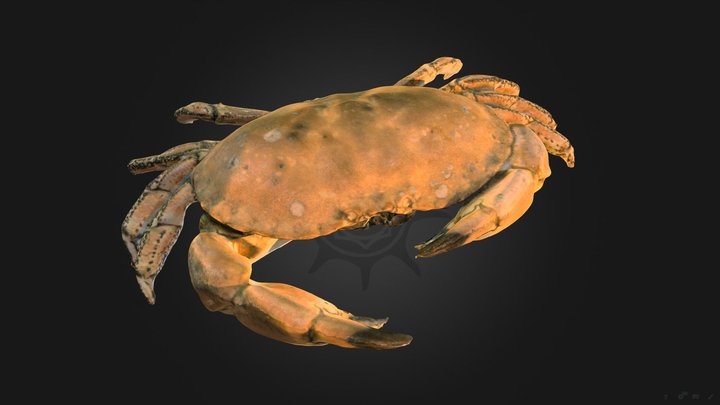
3D model
- Source
- Sketchfab
- Credit
- darwinmuseum.ru
- Licence
- CC0 Public Domain
- Commercial use
- the licence allows it
Smithsonian Open Access and MorphoSource were not reached for this taxon, so this list is what the others held rather than everything there is.
The description on this site
- Source
- Wikipedia, “Carcinus”
- Licence
- CC BY-SA 4.0
This is what the site found, which is not the same as what exists.
Keep going
What may have been alongside itCarcininae through timeFormations of the PleistoceneThe world it lived on
Occurrence data from the Paleobiology Database, CC BY 4.0. Leach 1814