Centropomidae
Centropomus is a genus of predominantly marine fish comprising the family Centropomidae. The type species is Centropomus undecimalis, the common snook. Commonly known as snooks or róbalos, the Centropomus species are native to tropical and subtropical waters of the western Atlantic and eastern Pacific Oceans.

Uncredited · Public Domain · via Wikipedia/Commons. May be a photograph of a specimen, or an artist’s reconstruction — an interpretation of a skeleton, since colour and soft tissue are almost never preserved.
On record
Recorded, not inferred- Sits inside
- CarangariaPBDB
- Motility
- actively mobilePBDB, for Osteichthyes
Time the record covers
At least 55 million years on record.
The record covers at least 56 Mya to 11.7 ka. No occurrence read is dated outside 59.24 Mya to 0 Mya.
132 occurrences of Centropomidae on record, most of them in the Miocene. The Paleobiology Database records this as a living group. Bar height is expected occurrences, not a count: each fossil is spread across the span it is dated to, so a tall narrow bar means tight dating and a low wide one means loose.
When
132 occurrencesThese are dates about fossils, not the animal: the record can only begin after it arose and end before it died out, so either end may reach further. Shares are expected occurrences: a fossil dated to a span is counted partly in each period it straddles. More on what this infers.
Found in
30 formations
- Koobi Fora Formation · Omo Group20
- Nkondo Formation · Albertine Group20
- Warwire Formation · Albertine Group10
- Nyaburogo Formation · Albertine Group6
- Oluka Formation · Albertine Group6
- Beglia Formation5
Loading coastlines…
The named rock units Centropomidae has been recovered from, largest first. Drawn where the rock is now, not where it formed. 6 further formations hold fewer occurrences each and are not listed. 25 occurrences have no formation on record, which is common for older literature.
Centropomidae and its relatives
MioceneWhere Centropomidae and its relatives were recorded in the Miocene.
Found in the same rock
1,508 taxa- Lates niloticus72 sites
- Synodontis45 sites
- Lates44 sites
- Clarias35 sites
- Hydrocynus34 sites
- Polypterus34 sites
- Bunocharax sp.31 sites
- Protopterus31 sites
- Chrysichthys29 sites
- Crocodylus26 sites
- Trionyx26 sites
- Geochelone25 sites
- Euthecodon brumpti23 sites
- Crocodylus niloticus22 sites
- Suidae20 sites
- Cichlidae19 sites
- Gymnarchus19 sites
- Clariidae18 sites
- Lanistes18 sites
- Barbus15 sites
- Bagrus14 sites
- Characidae14 sites
- Hyperopisus sp.14 sites
- Hippopotamus amphibius13 sites
The Paleobiology Database records 128 sites for Centropomidae, and this reads all of them. The number is how many of those sites it was catalogued from too. The 24 sharing the most are listed.
This is not a list of everything alive at the time. It is only what has come out of the same ground as this animal and been written down.
Entered from
60 references- Fish remains from Late Pleistocene and Holocene archaeological sites near Khashm el Girba,Sudan13
- Koobi Fora Research Project The Fossil Ungulates: Proboscidea, Perissodactyla, Suidae8
- Palaeovegetation (fossil plants) of the Albertine rift valley5
- Hippopotamidae,Mammalia,Artiodactyla from the Western Rift,Lake Albert Basin,Uganda;preliminary study5
- Fossil proboscideans,Mammalia, from the Western Rift,Uganda5
- Extinct large Colobines from the Plio-Pleistocene of Africa5
- Lothagam: the dawn of humanity in eastern Africa4
- Intoduction: Paleontological and Geological Research in the Manonga Valley, Tanzania4
- Equidae of the Albertine rift valley,Uganda4
- Palaeobiology of the Albertine rift valley,Uganda-Zaire4
- Lakeside cemeteries in the Sahara: 5000 years of Holocene population and environmental change3
- Fresh water chelonians from the western rift, Uganda3
Each of the 132 occurrences read was entered from one of these publications, ordered by how many each accounts for. This is not a search for papers mentioning the name. 48 further references are not listed. Entries link to doi.org where the Paleobiology Database holds an identifier, and to its own record where it does not. Relayed as the Paleobiology Database holds them, not checked against what they resolve to.
Media and terms
Media content1
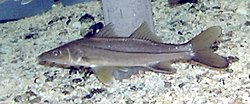
Picture of Centropomidae
- Source
- Wikipedia/Commons
- Credit
- nobody named on the record
- Licence
- Public Domain
- Commercial use
- the licence allows it
No 3D scan of Centropomidae was found in Sketchfab.
Smithsonian Open Access and MorphoSource were not reached for this taxon, so this list is what the others held rather than everything there is.
The description on this site
- Source
- Wikipedia, “Centropomus”
- Licence
- CC BY-SA 4.0
This is what the site found, which is not the same as what exists.
Keep going
What may have been alongside itCarangaria through timeFormations of the MioceneThe world it lived on
Occurrence data from the Paleobiology Database, CC BY 4.0. Poey 1868