Chamaeleo
Chamaeleo is a genus of chameleons in the family Chamaeleonidae. Most species of the genus Chamaeleo are found in sub-Saharan Africa, but a few species are also present in northern Africa, southern Europe, and southern Asia east to India and Sri Lanka.

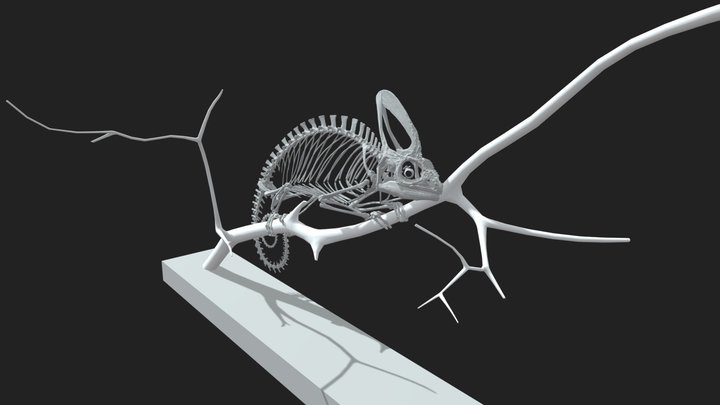
BS Thurner Hof · Public Domain · via Wikipedia/Commons. May be a photograph of a specimen, or an artist’s reconstruction — an interpretation of a skeleton, since colour and soft tissue are almost never preserved.
On record
Recorded, not inferred- Sits inside
- ChamaeleonidaePBDB
- Motility
- actively mobilePBDB, for Osteichthyes
- Environment
- terrestrialPBDB, for Amniota
Time the record covers
At least 16 million years on record.
The record covers at least 16.9 Mya to 11.7 ka. No occurrence read is dated outside 20.45 Mya to 0 Mya.
19 occurrences of Chamaeleo on record, most of them in the Miocene. The Paleobiology Database records this as a living group. Bar height is expected occurrences, not a count: each fossil is spread across the span it is dated to, so a tall narrow bar means tight dating and a low wide one means loose.
When
19 occurrences- Miocene79%
- Pleistocene11%
- Holocene11%
These are dates about fossils, not the animal: the record can only begin after it arose and end before it died out, so either end may reach further. Shares are expected occurrences: a fossil dated to a span is counted partly in each period it straddles. More on what this infers.
Found in
4 formations
- Upper Freshwater Molasse Formation · Molasse Group4
- Brackwater Molasse Formation · Molasse Group2
- Most Formation1
- Ville Formation1
Loading coastlines…
The named rock units Chamaeleo has been recovered from, largest first. Drawn where the rock is now, not where it formed. 11 occurrences have no formation on record, which is common for older literature.
Chamaeleo and its relatives
MioceneWhere Chamaeleo and its relatives were recorded in the Miocene.
Found in the same rock
463 taxa- Lacerta8 sites
- Ophisaurus8 sites
- Testudo7 sites
- Albanerpeton inexpectatum6 sites
- Colubrinae6 sites
- Lacertidae6 sites
- Soricidae6 sites
- Democricetodon mutilus5 sites
- Eumyarion weinfurteri5 sites
- Heteroxerus5 sites
- Pseudopus5 sites
- Scincidae5 sites
- Squamata5 sites
- Talpidae5 sites
- Anchitherium aurelianense4 sites
- Anguidae4 sites
- Blackia miocaenica4 sites
- Chamaeleonidae4 sites
- Chelotriton4 sites
- Chiroptera4 sites
- Colubroidea4 sites
- Democricetodon minor gracilis4 sites
- Eumyarion bifidus4 sites
- Gekkonidae4 sites
The Paleobiology Database records 16 sites for Chamaeleo, and this reads all of them. The number is how many of those sites it was catalogued from too. The 24 sharing the most are listed.
This is not a list of everything alive at the time. It is only what has come out of the same ground as this animal and been written down.
Entered from
13 references- Holocene vertebrate assemblages provide the first evidence for the presence of the barn owl (Tytonidae, Tyto alba) on Socotra Island (Yemen)2
- The microvertebrates of Qesem Cave: A comparison of the two concentrations2
- A revision of chamaeleonids from the Lower Miocene of the Czech Republic with description of a new species of Chamaeleo (Squamata, Chamaeleonidae)2
- Stratigraphy and mammal faunas of the Brackwassermolasse in the surroundings of Ulm (Southwest Germany)2
- Neue Ergebnisse zur Stratigraphie der mittleren Serie der Oberen Süßwassermolasse Bayerns (New results on the stratigraphy of the middle series of upper Freshwater Molasse, Bavaria)2
- Chamaeleo caroliquarti (Chamaeleonidae, Sauria): a new species from the Lower Miocene of Central Europe2
- Amphibian and reptilian fauna from the early Miocene of Echzell, Germany1
- Fossil squamate faunas from the Neogene of Hambach (northwestern Germany)1
- Early Miocene herpetofaunas from the Greek localities of Aliveri and Karydia – bridging a gap in the knowledge of amphibians and reptiles from the early Neogene of southeastern Europe1
- Snakes from Griesbeckerzell (Langhian, Early Badenian), North Alpine Foreland Basin (Germany), with comments on the evolution of snake faunas in Central Europe during the Miocene Climatic Optimum1
- Ectothermic vertebrates (Actinopterygii, Allocaudata, Urodela, Anura, Crocodylia, Squamata) from the Miocene of Sandelzhausen (Germany, Bavaria) and their implications for environment reconstruction and palaeoclimate1
- Biostratigraphy and sedimentology of the Fluviatile Untere Serie (Early and Middle Miocene) in the central part of the North Alpine Foreland Basin: implications for palaeoenvironment and climate1
Each of the 19 occurrences read was entered from one of these publications, ordered by how many each accounts for. This is not a search for papers mentioning the name. 1 further reference is not listed. Entries link to doi.org where the Paleobiology Database holds an identifier, and to its own record where it does not. Relayed as the Paleobiology Database holds them, not checked against what they resolve to.
Media and terms
Media content3

Picture of Chamaeleo
- Source
- Wikipedia/Commons
- Credit
- BS Thurner Hof
- Licence
- Public Domain
- Commercial use
- the licence allows it
CT scan
- Source
- MorphoSource
- Licence
- In Copyright
- Commercial use
- cannot be read from the licence given — check the record
- Specimen
- Chamaeleo chamaeleon · MVZ:Herp:MVZ:Herp:236480
The description on this site
- Source
- Wikipedia, “Chamaeleo”
- Licence
- CC BY-SA 4.0
This is what the site found, which is not the same as what exists.
Keep going
What may have been alongside itChamaeleonidae through timeFormations of the MioceneThe world it lived on
Occurrence data from the Paleobiology Database, CC BY 4.0. Laurenti 1768