Charadriiformes
Charadriiformes is a diverse order of small to medium-large birds. It includes about 390 species and has members in all parts of the world. Most charadriiform birds live near water and eat invertebrates or other small animals; however, some are pelagic (seabirds), others frequent deserts, and a few are found in dense forest. Members of this group can also collectively be referred to as shorebirds.

MathKnight · CC BY-SA 4.0 · via Wikipedia/Commons. May be a photograph of a specimen, or an artist’s reconstruction — an interpretation of a skeleton, since colour and soft tissue are almost never preserved.
On record
Recorded, not inferred- Also called
- shorebirdPBDB
- Sits inside
- AvesPBDB
- Diet
- carnivorePBDB, for Coelurosauria
- Life habit
- ground dwelling, solitaryPBDB, for Theropoda
- Motility
- actively mobilePBDB, for Theropoda
- Environment
- marinePBDB
Time the record covers
At least 72 million years on record.
The record covers at least 72.2 Mya to 11.7 ka. No occurrence read is dated outside 83.6 Mya to 0 Mya.
1,949 occurrences of Charadriiformes on record. The Paleobiology Database records this as a living group. Bar height is expected occurrences, not a count: each fossil is spread across the span it is dated to, so a tall narrow bar means tight dating and a low wide one means loose.
When
1,949 occurrences- Late Cretaceous2%
- Paleoceneunder 1%
- Eocene1%
- Oligocene1%
- Miocene7%
- Pliocene7%
- Pleistocene40%
- Holocene43%
These are dates about fossils, not the animal: the record can only begin after it arose and end before it died out, so either end may reach further. Shares are expected occurrences: a fossil dated to a span is counted partly in each period it straddles. More on what this infers.
Found in
100 formations
- San Diego Formation82
- Yorktown Formation · Chesapeake Group33
- Bannockburn Formation · Manuherikia Group17
- Indusial Limestone Formation17
- Monterey Formation15
- Tamiami Formation14
Loading coastlines…
The named rock units Charadriiformes has been recovered from, largest first. Drawn where the rock is now, not where it formed. 76 further formations hold fewer occurrences each and are not listed. 1,548 occurrences have no formation on record, which is common for older literature.
Found in the same rock
3,480 taxa- Pinguinus impennis104 sites
- Aves14 sites
- Uria aalge13 sites
- Anatidae12 sites
- Balaenopteridae11 sites
- Miocepphus mcclungi11 sites
- Morus bassanus11 sites
- Otodus megalodon11 sites
- Ardenna grisea10 sites
- Carcharodon hastalis10 sites
- Cetacea10 sites
- Equus10 sites
- Odontoceti10 sites
- Passeriformes10 sites
- Accipitridae9 sites
- Meleagris gallopavo9 sites
- Mysticeti9 sites
- Phocidae9 sites
- Alca torda8 sites
- Anas platyrhynchos8 sites
- Bufo8 sites
- Ectopistes migratorius8 sites
- Larus8 sites
- Myliobatis8 sites
The Paleobiology Database records 850 sites for Charadriiformes, and this reads 240 of them. Of that, one read hit the database's own return limit, so every count below is a floor rather than a total. The number is how many of those sites it was catalogued from too. The 24 sharing the most are listed.
This is not a list of everything alive at the time. It is only what has come out of the same ground as this animal and been written down.
Entered from
379 references- Prehistoric human impacts on California birds: evidence from the Emeryville shellmoumd avifauna101
- Fossil birds of the San Diego Formation, Late Pliocene, Blancan, San Diego County, California68
- Distribution and provenance of fossil avifauna on San Miguel Island65
- Extinction, biogeography, and human exploitation of birds on Tikopia and Anuta, Polynesian outliers in the Solomon Islands57
- Terminal Pleistocene–Holocene Avifauna of San Miguel and Santa Rosa Islands: Identifications of Previously Unidentified Avian Remains Recovered from Fossil Sites and Prehistoric Cave Deposits54
- The fossil birds of Henderson Island, Pitcairn Group: natural turnover and human impact, a synopsis42
- Tigriornis leucolopha39
- Biogeography and prehistoric exploitation of birds from Fais Island, Yap State, Federated States of Micronesia32
- Ecologia di un'estinzione Alca impenne32
- Polar bear fossil and archaeological records from the Pleistocene and Holocene in relation to sea ice extent and open water polynyas30
- Pleistocene seabirds from Shiriya, northeast Japan: systematics and oceanographic context30
- A remarkable fossil and archaeological avifauna from Marfells Beach, Lake Grassmere, South Island, New Zealand30
Each of the 1,949 occurrences read was entered from one of these publications, ordered by how many each accounts for. This is not a search for papers mentioning the name. 367 further references are not listed. Entries link to doi.org where the Paleobiology Database holds an identifier, and to its own record where it does not. Relayed as the Paleobiology Database holds them, not checked against what they resolve to.
Media and terms
Media content1
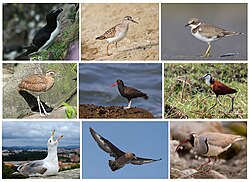
Picture of Charadriiformes
- Source
- Wikipedia/Commons
- Credit
- MathKnight
- Licence
- CC BY-SA 4.0
- Commercial use
- the licence allows it
No 3D scan of Charadriiformes was found in Sketchfab.
Smithsonian Open Access and MorphoSource were not reached for this taxon, so this list is what the others held rather than everything there is.
The description on this site
- Licence
- CC BY-SA 4.0
This is what the site found, which is not the same as what exists.
Keep going
What may have been alongside itAves through timeThe world it lived on
Occurrence data from the Paleobiology Database, CC BY 4.0. (Huxley 1867)