Phocidae
The earless seals, also known as phocids or true seals, are one of the three main groups of mammals within the seal lineage, Pinnipedia. All true seals are members of the family Phocidae. They are sometimes called crawling seals to distinguish them from the fur seals and sea lions of the family Otariidae. Seals live in the oceans of both hemispheres and, with the exception of the more tropical monk seals, are mostly confined to polar, subpolar, and temperate climates. The Baikal seal is the only species of exclusively freshwater seal.

Marcel Burkhard · CC BY-SA 2.0 de · via Wikipedia/Commons. May be a photograph of a specimen, or an artist’s reconstruction — an interpretation of a skeleton, since colour and soft tissue are almost never preserved.
On record
Recorded, not inferred- Also called
- sealPBDB
- Sits inside
- PinnipediaPBDB
- Diet
- piscivore, carnivorePBDB
- Life habit
- amphibiousPBDB, for Pinnipedia
- Motility
- actively mobilePBDB, for Osteichthyes
- Environment
- marinePBDB, for Pinnipedia
Time the record covers
At least 37 million years on record.
The record covers at least 37.71 Mya to 11.7 ka. No occurrence read is dated outside 41.03 Mya to 0 Mya.
982 occurrences of Phocidae on record. The Paleobiology Database records this as a living group. Bar height is expected occurrences, not a count: each fossil is spread across the span it is dated to, so a tall narrow bar means tight dating and a low wide one means loose.
When
982 occurrencesThese are dates about fossils, not the animal: the record can only begin after it arose and end before it died out, so either end may reach further. Shares are expected occurrences: a fossil dated to a span is counted partly in each period it straddles. More on what this infers.
Found in
83 formations
- Calvert Formation · Chesapeake Group34
- Pisco Formation25
- Bahía Inglesa Formation22
- Yorktown Formation · Chesapeake Group20
- Varswater Formation10
- Diest Formation10
Loading coastlines…
The named rock units Phocidae has been recovered from, largest first. Drawn where the rock is now, not where it formed. 59 further formations hold fewer occurrences each and are not listed. 702 occurrences have no formation on record, which is common for older literature.
Found in the same rock
2,521 taxa- Erignathus barbatus23 sites
- Leptophoca lenis23 sites
- Cetacea20 sites
- Mysticeti20 sites
- Odontoceti19 sites
- Otodus megalodon18 sites
- Balaenopteridae17 sites
- Phoca15 sites
- Carcharodon hastalis14 sites
- Physeteridae14 sites
- Delphinidae13 sites
- Equus13 sites
- Monachinae13 sites
- Osteichthyes13 sites
- Pagophilus groenlandica13 sites
- Ziphiidae13 sites
- Myliobatis12 sites
- Cetotheriidae11 sites
- Monachopsis pontica11 sites
- Aves10 sites
- Halichoerus grypus10 sites
- Hipparion10 sites
- Homiphoca capensis10 sites
- Spheniscidae10 sites
The Paleobiology Database records 678 sites for Phocidae, and this reads 240 of them. The number is how many of those sites it was catalogued from too. The 24 sharing the most are listed.
This is not a list of everything alive at the time. It is only what has come out of the same ground as this animal and been written down.
Entered from
312 references- New information on the natural history, distribution, and skull size of the extinct (?) West Indian monk seal, Monachus tropicalis69
- Morphology and systematics of Miocene Phocinae (Mammalia: Carnivora) from Paratethys and the North Atlantic region66
- Polar bear fossil and archaeological records from the Pleistocene and Holocene in relation to sea ice extent and open water polynyas44
- Where were the northern elephant seals? Holocene archaeology and biogeography of Mirounga angustirostris27
- The evolution of Arctic marine mammals20
- Appendix 1. The zooarchaeology of Peary Land and adjacent areas18
- Living in the narrows: subsistence economy and culture change in Labrador Inuit society during the Contact Period16
- The Northernmost Ruins of the Globe15
- Les phoques fossiles du bassin d'Anvers14
- Holocene environmental changes and the seal (Phocidae) fauna of the Baltic Sea: coming, going and staying12
- Archaeology of St. Lawrence Island, Alaska12
- Alaska marine mammal stock assessments11
Each of the 982 occurrences read was entered from one of these publications, ordered by how many each accounts for. This is not a search for papers mentioning the name. 300 further references are not listed. Entries link to doi.org where the Paleobiology Database holds an identifier, and to its own record where it does not. Relayed as the Paleobiology Database holds them, not checked against what they resolve to.
Media and terms
Media content2
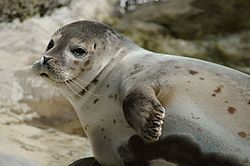
Picture of Phocidae
- Source
- Wikipedia/Commons
- Credit
- Marcel Burkhard
- Licence
- CC BY-SA 2.0 de
- Commercial use
- the licence allows it
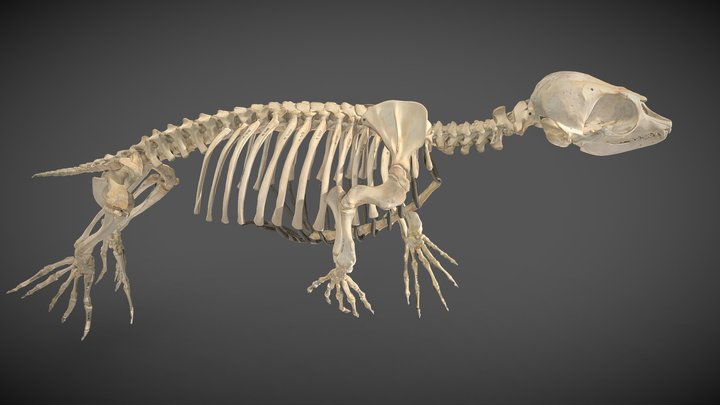
3D model
- Source
- Sketchfab
- Licence
- CC Attribution-NonCommercial-NoDerivs
- Commercial use
- the licence does not allow it
Smithsonian Open Access was not reached for this taxon, so this list is what the others held rather than everything there is.
The description on this site
- Licence
- CC BY-SA 4.0
This is what the site found, which is not the same as what exists.
Keep going
What may have been alongside itPinnipedia through timeThe world it lived on
Occurrence data from the Paleobiology Database, CC BY 4.0. Gray 1821