Charadriiformes
Searched as Charadriiformes indet.. The Paleobiology Database treats Charadriiformes as the accepted name.
Charadriiformes is a diverse order of small to medium-large birds. It includes about 390 species and has members in all parts of the world. Most charadriiform birds live near water and eat invertebrates or other small animals; however, some are pelagic (seabirds), others frequent deserts, and a few are found in dense forest. Members of this group can also collectively be referred to as shorebirds.

MathKnight · CC BY-SA 4.0 · via Wikipedia/Commons. May be a photograph of a specimen, or an artist’s reconstruction — an interpretation of a skeleton, since colour and soft tissue are almost never preserved.
On record
Recorded, not inferred- Also called
- shorebirdPBDB
- Sits inside
- AvesPBDB
- Diet
- carnivorePBDB, for Coelurosauria
- Life habit
- ground dwelling, solitaryPBDB, for Theropoda
- Motility
- actively mobilePBDB, for Theropoda
- Environment
- marinePBDB
Time the record covers
At least 65 million years on record.
The record covers at least 66 Mya to 11.7 ka. No occurrence read is dated outside 72.2 Mya to 0 Mya.
28 occurrences of Charadriiformes on record, most of them in the Pleistocene. The Paleobiology Database records this as a living group. Bar height is expected occurrences, not a count: each fossil is spread across the span it is dated to, so a tall narrow bar means tight dating and a low wide one means loose.
When
28 occurrences- Late Cretaceous14%
- Eocene11%
- Miocene25%
- Pleistocene39%
- Holocene11%
These are dates about fossils, not the animal: the record can only begin after it arose and end before it died out, so either end may reach further. Shares are expected occurrences: a fossil dated to a span is counted partly in each period it straddles. More on what this infers.
Found in
10 formations
- Bannockburn Formation · Manuherikia Group4
- Lance Formation2
- Allen Formation · Malargüe Group1
- Hell Creek Formation1
- La Meseta Formation1
- Buchak Formation1
Loading coastlines…
The named rock units Charadriiformes has been recovered from, largest first. Drawn where the rock is now, not where it formed. 14 occurrences have no formation on record, which is common for older literature.
Charadriiformes and its relatives
PleistoceneWhere Charadriiformes and its relatives were recorded in the Pleistocene.
Found in the same rock
3,480 taxa- Pinguinus impennis104 sites
- Aves14 sites
- Uria aalge13 sites
- Anatidae12 sites
- Balaenopteridae11 sites
- Miocepphus mcclungi11 sites
- Morus bassanus11 sites
- Otodus megalodon11 sites
- Ardenna grisea10 sites
- Carcharodon hastalis10 sites
- Cetacea10 sites
- Equus10 sites
- Odontoceti10 sites
- Passeriformes10 sites
- Accipitridae9 sites
- Meleagris gallopavo9 sites
- Mysticeti9 sites
- Phocidae9 sites
- Alca torda8 sites
- Anas platyrhynchos8 sites
- Bufo8 sites
- Ectopistes migratorius8 sites
- Larus8 sites
- Myliobatis8 sites
The Paleobiology Database records 850 sites for Charadriiformes, and this reads 240 of them. Of that, one read hit the database's own return limit, so every count below is a floor rather than a total. The number is how many of those sites it was catalogued from too. The 24 sharing the most are listed.
This is not a list of everything alive at the time. It is only what has come out of the same ground as this animal and been written down.
Entered from
21 references- Miocene waterfowl and other birds from central Otago, New Zealand4
- The Mesozoic radiation of Neornithes4
- Late Pleistocene birds from Binagada (Azerbaijan) in collection of the National Museum of Natural History (Kyiv, Ukraine)2
- Taphonomy of two Holocene penguin taphocoenoses in Potter Peninsula, South Shetland Islands, Antarctica1
- Birds from Sime del Elefante, Atapuerca, Spain: palaeoecological implications in the oldest human bearing levels of the Iberian Peninsula1
- First record of avian extinctions from the Late Pleistocene and Holocene of Timor Leste1
- Late Pleistocene fossil birds from Buso Doppio del Broion Cave (North-Eastern Italy): implications for palaeoecology, palaeoenvironment and palaeoclimate1
- The bird assemblage from the Middle Palaeolithic level I of Arbreda Cave: A taphonomic story1
- Exploitation of a seasonal resource: bird hunting during the late Natufian at Shubayqa 11
- The world’s smallest owl, the earliest unambiguous charadriiform bird, and other avian remains from the early Eocene Nanjemoy Formation of Virginia (USA)1
- New fossil bird remains from the Chichinales Formation (Early Miocene) of northern Patagonia, Argentina1
- A New Pleistocene bird assemblage from the Southern Pampas (Buenos Aires, Argentina)1
Each of the 28 occurrences read was entered from one of these publications, ordered by how many each accounts for. This is not a search for papers mentioning the name. 9 further references are not listed. Entries link to doi.org where the Paleobiology Database holds an identifier, and to its own record where it does not. Relayed as the Paleobiology Database holds them, not checked against what they resolve to.
Media and terms
Media content1
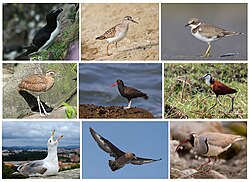
Picture of Charadriiformes
- Source
- Wikipedia/Commons
- Credit
- MathKnight
- Licence
- CC BY-SA 4.0
- Commercial use
- the licence allows it
No 3D scan of Charadriiformes was found in MorphoSource and Sketchfab.
Smithsonian Open Access was not reached for this taxon, so this list is what the others held rather than everything there is.
The description on this site
- Licence
- CC BY-SA 4.0
This is what the site found, which is not the same as what exists.
Keep going
What may have been alongside itAves through timeFormations of the PleistoceneThe world it lived on
Occurrence data from the Paleobiology Database, CC BY 4.0. (Huxley 1867)