Cingulata
Cingulata, part of the superorder Xenarthra, is an order of armored New World placental mammals. The armadillos, whose species are split between the families Dasypodidae and Chlamyphoridae, are the only surviving members of the order. Two groups of cingulates much larger than extant armadillos existed until recently: pampatheriids, which reached weights of up to 200 kg (440 lb) and chlamyphorid glyptodonts, which attained masses of 2,000 kg (4,400 lb) or more.

Hunadam Tomfriedel derivative work: WolfmanSF · CC BY-SA 4.0 · via Wikipedia/Commons. May be a photograph of a specimen, or an artist’s reconstruction — an interpretation of a skeleton, since colour and soft tissue are almost never preserved.
On record
Recorded, not inferred- Sits inside
- XenarthraPBDB
- Diet
- omnivorePBDB, for Xenarthra
- Life habit
- ground dwellingPBDB, for Xenarthra
- Motility
- actively mobilePBDB, for Osteichthyes
- Environment
- terrestrialPBDB, for Eutheria
Time the record covers
At least 55 million years on record.
The record covers at least 56 Mya to 11.7 ka. No occurrence read is dated outside 57 Mya to 0 Mya.
2,149 occurrences of Cingulata on record, most of them in the Pleistocene. The Paleobiology Database records this as a living group. Bar height is expected occurrences, not a count: each fossil is spread across the span it is dated to, so a tall narrow bar means tight dating and a low wide one means loose.
When
2,149 occurrencesThese are dates about fossils, not the animal: the record can only begin after it arose and end before it died out, so either end may reach further. Shares are expected occurrences: a fossil dated to a span is counted partly in each period it straddles. More on what this infers.
Found in
181 formations
- Cerro Azul Formation153
- Santa Cruz Formation147
- Sarmiento Formation109
- Monte Hermoso Formation57
- Andalhuala Formation31
- Chiquimil Formation30
Loading coastlines…
The named rock units Cingulata has been recovered from, largest first. Drawn where the rock is now, not where it formed. 157 further formations hold fewer occurrences each and are not listed. 683 occurrences have no formation on record, which is common for older literature.
Cingulata and its relatives
PleistoceneWhere Cingulata and its relatives were recorded in the Pleistocene.
Found in the same rock
2,086 taxa- Equus71 sites
- Dasypus bellus52 sites
- Odocoileus virginianus51 sites
- Hemiauchenia macrocephala33 sites
- Holmesina septentrionalis29 sites
- Glyptotherium texanum28 sites
- Sylvilagus floridanus24 sites
- Sylvilagus23 sites
- Holmesina floridanus22 sites
- Scalopus aquaticus22 sites
- Geomys pinetis21 sites
- Panthera onca21 sites
- Procyon lotor21 sites
- Camelops20 sites
- Gomphotheriidae20 sites
- Lynx rufus19 sites
- Paramylodon harlani19 sites
- Platygonus19 sites
- Tapirus19 sites
- Glyptodon18 sites
- Sigmodon hispidus18 sites
- Mammut americanum17 sites
- Neofiber alleni17 sites
- Aenocyon dirus16 sites
The Paleobiology Database records 790 sites for Cingulata, and this reads 240 of them. The number is how many of those sites it was catalogued from too. The 24 sharing the most are listed.
This is not a list of everything alive at the time. It is only what has come out of the same ground as this animal and been written down.
Entered from
486 references- Paleobiology of Santacrucian glyptodonts and armadillos (Xenarthra, Cingulata)61
- Dasypodidae (Xenarthra, Cingulata) de la Formación Cerro Azul (Mioceno tardío) de la provincia de La Pampa, Argentina54
- Xenarthrans of the collection of Santiago Roth from the Pampean Region of Argentina (Pleistocene), in Zurich, Switzerland45
- Cronobioestratigrafía del Mioceno tardío – Plioceno temprano, Puerta de Corral Quemado y Villavil, provincia de Catamarca, Argentina42
- The Eocene to Pleistocene vertebrates of Bolivia and their stratigraphic context: a review37
- Nuevos registros de Dasypodidae (Xenarthra) del Mioceno tardío de la provincia de La Pampa, Argentina35
- The phylogenetic and biostratigraphic significance of new armadillos (Mammalia, Xenarthra, Dasypodidae, Euphractinae) from the Tinguirirican (early Oligocene) of Chile32
- Late Cenozoic vertebrates from the Southern Pampean region: systematic and bio-chronostratigraphic update30
- Advances in the understanding of Neogene mammalian fauna in the Pampean region (central Argentina) through revising “biozone” hypotheses based on new dates and biochronological analyses29
- Reassesment of the Pliocene-Pleistocene continental time scale of Southern South America. Correlation of the type Chapadmalalan with Bolivian sections29
- Overview of the geology and vertebrate biochronology of the Leisey Shell Pit Local Fauna, Hillsborough County, Florida27
- Los Xenarthra de Gran Barranca: Más de 20 Ma de historia26
Each of the 2,149 occurrences read was entered from one of these publications, ordered by how many each accounts for. This is not a search for papers mentioning the name. 474 further references are not listed. Entries link to doi.org where the Paleobiology Database holds an identifier, and to its own record where it does not. Relayed as the Paleobiology Database holds them, not checked against what they resolve to.
Media and terms
Media content2
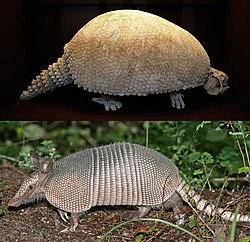
Picture of Cingulata
- Source
- Wikipedia/Commons
- Credit
- Hunadam Tomfriedel derivative work: WolfmanSF
- Licence
- CC BY-SA 4.0
- Commercial use
- the licence allows it
CT scan
- Source
- MorphoSource
- Credit
- No Organization
- Licence
- not stated by the source
- Commercial use
- cannot be read from the licence given — check the record
- Specimen
- Scolopendra cingulata · none:none
Smithsonian Open Access was not reached for this taxon, so this list is what the others held rather than everything there is.
The description on this site
- Source
- Wikipedia, “Cingulata”
- Licence
- CC BY-SA 4.0
This is what the site found, which is not the same as what exists.
Keep going
What may have been alongside itXenarthra through timeFormations of the PleistoceneThe world it lived on
Occurrence data from the Paleobiology Database, CC BY 4.0. (Illiger 1811)