Coelodonta
Coelodonta is an extinct genus of Eurasian rhinoceroses that lived from about 3.7 million years to 14,000 years ago, between the Pliocene and Pleistocene epochs. It is best known from the type species, the woolly rhinoceros, which ranged throughout northern Eurasia during the Pleistocene. The earliest known species, Coelodonta thibetana, lived in Tibet during the Pliocene, with the genus spreading to the rest of Eurasia during the Pleistocene.

W0zny · CC BY-SA 3.0 · via Wikipedia/Commons. May be a photograph of a specimen, or an artist’s reconstruction — an interpretation of a skeleton, since colour and soft tissue are almost never preserved.
On record
Recorded, not inferred- Also called
- wooly rhinoPBDB
- Sits inside
- RhinocerotiniPBDB
- Diet
- browserPBDB, for Rhinocerotidae
- Life habit
- ground dwellingPBDB, for Rhinocerotidae
- Motility
- actively mobilePBDB, for Osteichthyes
- Environment
- terrestrialPBDB, for Eutheria
Time the record covers
At least 3.4 million years on record.
The record covers at least 3.55 Mya to 129 ka. No occurrence read is dated outside 7.246 Mya to 0 Mya.
37 occurrences of Coelodonta on record, most of them in the Pleistocene. Bar height is expected occurrences, not a count: each fossil is spread across the span it is dated to, so a tall narrow bar means tight dating and a low wide one means loose.
When
37 occurrences- Mioceneunder 1%
- Pliocene10%
- Pleistocene89%
- Holoceneunder 1%
These are dates about fossils, not the animal: the record can only begin after it arose and end before it died out, so either end may reach further. Shares are expected occurrences: a fossil dated to a span is counted partly in each period it straddles. More on what this infers.
Found in
5 formations
- Oberer Travertin I Formation1
- Nagrota Formation · Siwalik Group1
- Tatrot Formation1
- Zanda Formation1
- Guxiangtun Formation1
Loading coastlines…
The named rock units Coelodonta has been recovered from, largest first. Drawn where the rock is now, not where it formed. 32 occurrences have no formation on record, which is common for older literature.
Coelodonta and its relatives
PleistoceneWhere Coelodonta and its relatives were recorded in the Pleistocene.
Found in the same rock
324 taxa- Mammuthus primigenius15 sites
- Equus11 sites
- Rangifer tarandus11 sites
- Bison8 sites
- Canis lupus8 sites
- Equus caballus8 sites
- Ochotona8 sites
- Bison priscus7 sites
- Cervus elaphus7 sites
- Citellus7 sites
- Cervus6 sites
- Allactaga5 sites
- Equus sanmeniensis5 sites
- Marmota5 sites
- Megaloceros giganteus5 sites
- Microtus5 sites
- Ursus5 sites
- Crocuta4 sites
- Crocuta crocuta spelaea4 sites
- Felis4 sites
- Gazella4 sites
- Megaloceros4 sites
- Spirocerus wongi4 sites
- Sus scrofa4 sites
The Paleobiology Database records 37 sites for Coelodonta, and this reads all of them. The number is how many of those sites it was catalogued from too. The 24 sharing the most are listed.
This is not a list of everything alive at the time. It is only what has come out of the same ground as this animal and been written down.
Entered from
26 references- Woolly rhinoceras from the Scottish Pleistocene4
- Die jungpleistozänen Säugetierfaunen aus dem Travertingebiet von Taubach-Weimar-Ehringsdorf (The Early Plestocene mammalian fauna from the travetin-area of Taubach-Weimar-Ehringsdorf)4
- The Kor & Bot collection revisited, with a biostratigraphic interpretation of the Early Pleistocene Oosterschelde Fauna (Oosterschelde Estuary, the Netherlands)2
- Mittelpleistozane Saugetierfaunen aus Mitteleuropa - der Versuch einer biostratigraphischen Zuordnung2
- Two new species of fossil Megaceros from North China2
- The Late Cenozoic Faunistic complexes of Transbaikalia with special reference to the micromammalia2
- Quartär-Aufschlüsse bei Ariendorf am unteren Mittelrhein (Quaternary exposures at Ariendorf on the lower Middle Rhine)2
- New carnivoran remains from the Early Pleistocene Shanshenmiaozui site in Nihewan Basin, northern China1
- Out of Tibet: Pliocene woolly rhino suggests high-plateau origin of Ice Age megaherbivores1
- The Eurogeul—first report of the palaeontological, palynological and archaeological investigations of this part of the North Sea1
- Siwalik mammals of the Jammu Sub-Himalaya, India: an appraisal of their diversity and habitats.1
- Early Pleistocene equids (Mammalia, Perissodactyla) of Nalaikha, Mongolia, and the emergence of modern Equus Linnaeus, 17581
Each of the 37 occurrences read was entered from one of these publications, ordered by how many each accounts for. This is not a search for papers mentioning the name. 14 further references are not listed. Entries link to doi.org where the Paleobiology Database holds an identifier, and to its own record where it does not. Relayed as the Paleobiology Database holds them, not checked against what they resolve to.
Media and terms
Media content3

Picture of Coelodonta
- Source
- Wikipedia/Commons
- Credit
- W0zny
- Licence
- CC BY-SA 3.0
- Commercial use
- the licence allows it
Structured light scan
- Source
- MorphoSource
- Licence
- In Copyright
- Commercial use
- cannot be read from the licence given — check the record
- Specimen
- Coelodonta antiquitatis · RBINS-Scientific Heritage:Vert:8151-RH58
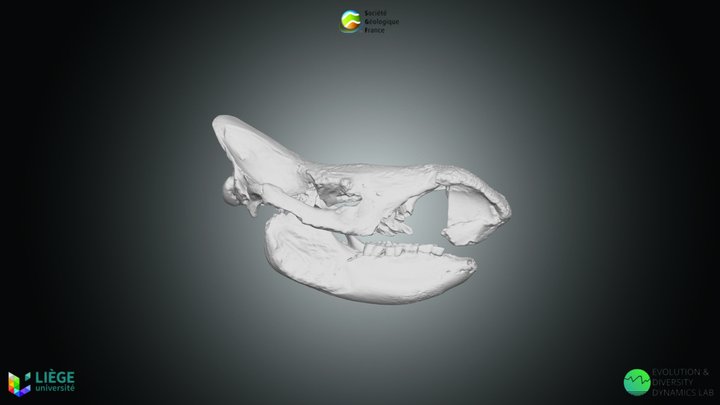
3D model
- Source
- Sketchfab
- Licence
- CC Attribution-NonCommercial-ShareAlike
- Commercial use
- the licence does not allow it
The description on this site
- Source
- Wikipedia, “Coelodonta”
- Licence
- CC BY-SA 4.0
This is what the site found, which is not the same as what exists.
Keep going
What may have been alongside itRhinocerotini through timeFormations of the PleistoceneThe world it lived on
Occurrence data from the Paleobiology Database, CC BY 4.0. Bronn 1831