Crocodylidae
Searched as Crocodile indet.. The Paleobiology Database treats Crocodylidae as the accepted name.
No picture of Crocodylidae was found. Wikidata and iDigBio were searched and had none. Wikipedia has a picture filed under this name, but nothing tied it to Crocodylidae itself, so it was not used. Smithsonian Open Access did not answer, so this is what the others held rather than everything there is. GBIF was asked, and what came back is not recorded: nothing, or a picture this site could not tie to Crocodylidae, or no answer at all. This entry cannot say which.
On record
Recorded, not inferred- Also called
- crocodilePBDB
- Sits inside
- CrocodyloideaPBDB
- Diet
- carnivorePBDB, for Crocodylia
- Motility
- actively mobilePBDB, for Osteichthyes
- Environment
- marinePBDB, for Mesoeucrocodylia
Time the record covers
At least 137 million years on record.
The record covers at least 170.9 Mya to 33.9 Mya. No occurrence read is dated outside 174.7 Mya to 27.3 Mya.
2 occurrences of Crocodylidae on record, most of them in the Middle Jurassic. The Paleobiology Database records this as a living group, and the chart stops with its fossils rather than at the present. Bar height is expected occurrences, not a count: each fossil is spread across the span it is dated to, so a tall narrow bar means tight dating and a low wide one means loose.
When
2 occurrences- Middle Jurassic50%
- Oligocene50%
These are dates about fossils, not the animal: the record can only begin after it arose and end before it died out, so either end may reach further. Shares are expected occurrences: a fossil dated to a span is counted partly in each period it straddles. More on what this infers.
Found in
1 formation
Loading coastlines…
The named rock units Crocodylidae has been recovered from, largest first. Drawn where the rock is now, not where it formed. 1 occurrence has no formation on record, which is common for older literature.
Crocodylidae and its relatives
Middle JurassicWhere Crocodylidae and its relatives were recorded in the Middle Jurassic.
Found in the same rock
2,625 taxa- Crocodylus103 sites
- Trionychidae56 sites
- Alcelaphini43 sites
- Clarias43 sites
- Osteichthyes41 sites
- Trionyx39 sites
- Crocodylus niloticus37 sites
- Equus37 sites
- Bovidae34 sites
- Polypterus34 sites
- Hipparion33 sites
- Euthecodon brumpti32 sites
- Gazella32 sites
- Mammalia32 sites
- Geochelone31 sites
- Aves30 sites
- Reptilia29 sites
- Palaeoloxodon recki27 sites
- Protopterus27 sites
- Suidae26 sites
- Lates25 sites
- Theropithecus oswaldi24 sites
- Reduncini23 sites
- Amphibia22 sites
The Paleobiology Database records 427 sites for Crocodylidae, and this reads 240 of them. The number is how many of those sites it was catalogued from too. The 24 sharing the most are listed.
This is not a list of everything alive at the time. It is only what has come out of the same ground as this animal and been written down.
Entered from
2 references- Large Mammals from the Rupelian of Oman – Recent Finds1
- Le passage Aalénien-Bajocien près de Rumelange: la série biostratigraphique dans le Bassin d'Eschsur- Alzette (Grand-Duché de Luxembourg)1
Each of the 2 occurrences read was entered from one of these publications, ordered by how many each accounts for. This is not a search for papers mentioning the name. Entries link to doi.org where the Paleobiology Database holds an identifier, and to its own record where it does not. Relayed as the Paleobiology Database holds them, not checked against what they resolve to.
Media and terms
Media content1
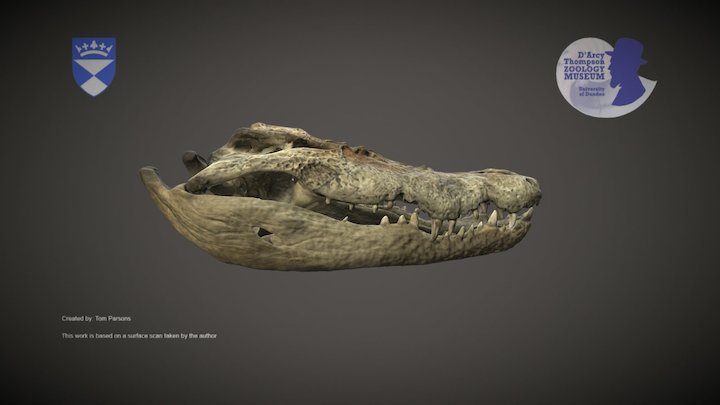
3D model
- Source
- Sketchfab
- Licence
- CC Attribution-NonCommercial-ShareAlike
- Commercial use
- the licence does not allow it
No picture of Crocodylidae was found. Wikidata and iDigBio were searched and had none.
Wikipedia has a picture filed under this name, but nothing tied it to Crocodylidae itself, so it was not used.
Smithsonian Open Access did not answer, so this is what the others held rather than everything there is.
GBIF was asked, and what came back is not recorded: nothing, or a picture this site could not tie to Crocodylidae, or no answer at all. This entry cannot say which.
Smithsonian Open Access and MorphoSource were not reached for this taxon, so this list is what the others held rather than everything there is.
This is what the site found, which is not the same as what exists.
Keep going
What may have been alongside itCrocodyloidea through timeFormations of the Middle JurassicThe world it lived on
Occurrence data from the Paleobiology Database, CC BY 4.0. (Cuvier 1807)