Cryptoclididae
Cryptoclididae is a family of medium-sized plesiosaurs that existed from the Middle Jurassic to the Early Cretaceous. They had long necks, broad and short skulls and densely packed teeth. They fed on small soft-bodied preys such as small fish and crustaceans. The earliest members of the family appeared during the early Bajocian, and they represented the dominant group of long-necked plesiosaurs during the latter half of the Jurassic.

Dmitry Bogdanov · CC BY 3.0 · via Wikipedia/Commons. May be a photograph of a specimen, or an artist’s reconstruction — an interpretation of a skeleton, since colour and soft tissue are almost never preserved.
On record
Recorded, not inferred- Sits inside
- PlesiosauroideaPBDB
- Diet
- carnivorePBDB, for Plesiosauria
- Life habit
- aquatic, depth=surfacePBDB, for Plesiosauria
- Motility
- actively mobilePBDB, for Plesiosauria
- Environment
- marinePBDB, for Plesiosauria
Time the record covers
At least 45 million years on record.
The record covers at least 165.3 Mya to 119.57 Mya. No occurrence read is dated outside 184.2 Mya to 113.2 Mya.
72 occurrences of Cryptoclididae on record, most of them in the Late Jurassic. Bar height is expected occurrences, not a count: each fossil is spread across the span it is dated to, so a tall narrow bar means tight dating and a low wide one means loose.
When
72 occurrences- Early Jurassicunder 1%
- Middle Jurassic37%
- Late Jurassic59%
- Early Cretaceous3%
These are dates about fossils, not the animal: the record can only begin after it arose and end before it died out, so either end may reach further. Shares are expected occurrences: a fossil dated to a span is counted partly in each period it straddles. More on what this infers.
Found in
13 formations
- Oxford Clay Formation · Ancholme Group25
- Kimmeridge Clay Formation · Ancholme Group10
- Sundance Formation9
- Agardhfjellet Formation7
- Portland Stone Formation · Portland Group4
- Jagua Formation2
Loading coastlines…
The named rock units Cryptoclididae has been recovered from, largest first. Drawn where the rock is now, not where it formed. 7 occurrences have no formation on record, which is common for older literature.
Cryptoclididae and its relatives
Late JurassicWhere Cryptoclididae and its relatives were recorded in the Late Jurassic.
Found in the same rock
175 taxa- Colymbosaurus trochanterius11 sites
- Plesiosauria10 sites
- Cryptoclidus8 sites
- Muraenosaurus leedsii7 sites
- Metriorhynchidae6 sites
- Cryptoclidus eurymerus5 sites
- Ichthyosauria5 sites
- Ichthyosaurus5 sites
- Liopleurodon ferox5 sites
- Pantosaurus striatus5 sites
- Peloneustes philarchus5 sites
- Pliosauridae5 sites
- Pliosaurus4 sites
- Reptilia4 sites
- Thalattosuchus superciliosus4 sites
- Colymbosaurus svalbardensis3 sites
- Crocodylia3 sites
- Cryptoclidus richardsoni3 sites
- Dakosaurus3 sites
- Lepidotus macrocheirus3 sites
- Ophthalmosaurus icenicus3 sites
- Pliosaurus brachydeirus3 sites
- Pterosauria3 sites
- Sauropoda3 sites
The Paleobiology Database records 54 sites for Cryptoclididae, and this reads all of them. The number is how many of those sites it was catalogued from too. The 24 sharing the most are listed.
This is not a list of everything alive at the time. It is only what has come out of the same ground as this animal and been written down.
Entered from
44 references- The English Upper Jurassic Plesiosauroidea (Reptilia) and a review of the phylogeny and classification of the Plesiosauria9
- The Mesozoic reptiles of Dorset. Part two5
- Phillips, 18715
- Current taxonomic status of the plesiosaur Pantosaurus striatus from the Upper Jurassic Sundance Formation, Wyoming4
- Redescription and taxonomic clarification of ‘Tricleidus’ svalbardensis based on new material from the Agardhfjellet Formation (Middle Volgian)3
- Alfred Leeds fossil vertebrate collection of the National Museum of Ireland - Natural History3
- El registro fósil de plesiosaurios (Sauropterigia) en Chile2
- Two new species of long-necked plesiosaurians (Reptilia: Sauropterygia) from the Upper Jurassic (Middle Volgian) Agardhfjellet Formation of central Spitsbergen2
- First Callovian plesiosaurs from the Neuquen Basin, Argentina2
- The stratigraphic distribution and preservation of fossil vertebrates in the Oxford Clay of England2
- Beiträge zur Kenntnis der Organisation und der Anpassungserscheinungen des genus Metriorhynchus2
- The Nature of the Shoulder Girdle and Clavicular Arch in Sauropterygia2
Each of the 72 occurrences read was entered from one of these publications, ordered by how many each accounts for. This is not a search for papers mentioning the name. 31 further references are not listed. Entries link to doi.org where the Paleobiology Database holds an identifier, and to its own record where it does not. Relayed as the Paleobiology Database holds them, not checked against what they resolve to.
Media and terms
Media content1
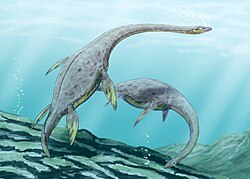
Picture of Cryptoclididae
- Source
- Wikipedia/Commons
- Credit
- Dmitry Bogdanov
- Licence
- CC BY 3.0
- Commercial use
- the licence allows it
No 3D scan of Cryptoclididae was found in MorphoSource and Sketchfab.
Smithsonian Open Access was not reached for this taxon, so this list is what the others held rather than everything there is.
The description on this site
- Licence
- CC BY-SA 4.0
This is what the site found, which is not the same as what exists.
Keep going
What may have been alongside itPlesiosauroidea through timeFormations of the Late JurassicThe world it lived on
Occurrence data from the Paleobiology Database, CC BY 4.0. Williston 1925