Pliosaurus
Pliosaurus is the type genus of the pliosaurs, one of the major group of the plesiosaurs, an extinct group of aquatic marine reptiles. It lived from the Upper Jurassic to the Lower Cretaceous in what is now Europe and South America. The first known fossil consists of a partial skeleton of an immature specimen collected by William Buckland in Market Rasen, England. Although initially mentioned in a 1824 paper by William Daniel Conybeare, it was not until 1841 that it was first formally described by Richard Owen as belonging to a new species of Plesiosaurus, before being given its own genus by the same author later that year. The genus name Pliosaurus means "more lizard", Owen naming the taxon of because its appearance being more reminiscent of crocodilians than to Plesiosaurus. While many species have been assigned to Pliosaurus in the past, only six are firmly recognised as valid since a 2013 paper. Two additional species from Argentina were named in 2014 and 2018, but their assignment to the genus has not been fully confirmed in subsequent classifications.

Radim Holiš · CC BY-SA 3.0 cz · via Wikipedia/Commons. May be a photograph of a specimen, or an artist’s reconstruction — an interpretation of a skeleton, since colour and soft tissue are almost never preserved.
On record
Recorded, not inferred- Sits inside
- ThalassophoneaPBDB
- Diet
- carnivorePBDB, for Pliosauroidea
- Life habit
- nektonicPBDB, for Pliosauroidea
- Motility
- actively mobilePBDB, for Pliosauroidea
- Environment
- marinePBDB, for Pliosauroidea
- Length
- 12 mWikidata
Time the record covers
At least 89 million years on record.
The record covers at least 161.5 Mya to 72.2 Mya. No occurrence read is dated outside 201.4 Mya to 66 Mya.
57 occurrences of Pliosaurus on record, most of them in the Late Jurassic. Bar height is expected occurrences, not a count: each fossil is spread across the span it is dated to, so a tall narrow bar means tight dating and a low wide one means loose.
When
57 occurrencesThese are dates about fossils, not the animal: the record can only begin after it arose and end before it died out, so either end may reach further. Shares are expected occurrences: a fossil dated to a span is counted partly in each period it straddles. More on what this infers.
Found in
14 formations
- Kimmeridge Clay Formation · Ancholme Group31
- Coral Rag Formation · Corallian Group3
- Oxford Clay Formation · Ancholme Group2
- Agardhfjellet Formation2
- Vaca Muerta Formation2
- Faringdon Sand Formation · Lower Greensand Group1
Loading coastlines…
The named rock units Pliosaurus has been recovered from, largest first. Drawn where the rock is now, not where it formed. 8 occurrences have no formation on record, which is common for older literature.
Pliosaurus and its relatives
Late JurassicWhere Pliosaurus and its relatives were recorded in the Late Jurassic.
Found in the same rock
162 taxa- Thalassophonea5 sites
- Dakosaurus4 sites
- Metriorhynchidae4 sites
- Plesiosauria4 sites
- Steneosaurus3 sites
- Theropoda3 sites
- Asteracanthus ornatissimus2 sites
- Cimoliasaurus2 sites
- Colymbosaurus2 sites
- Colymbosaurus trochanterius2 sites
- Ichthyosaurus2 sites
- Iguanodon2 sites
- Liopleurodon ferox2 sites
- Lucina2 sites
- Megalosaurus bucklandii2 sites
- Metriorhynchus2 sites
- Metriorhynchus moreli2 sites
- Muraenosaurus leedsii2 sites
- Ophthalmosaurus2 sites
- Ophthalmosaurus icenicus2 sites
- Peloneustes philarchus2 sites
- Plesiosauroidea2 sites
- Plesiosaurus2 sites
- Pliosauridae2 sites
The Paleobiology Database records 49 sites for Pliosaurus, and this reads all of them. The number is how many of those sites it was catalogued from too. The 24 sharing the most are listed.
This is not a list of everything alive at the time. It is only what has come out of the same ground as this animal and been written down.
Entered from
26 references- Lydekker, 188912
- A giant pliosaurid skull from the Late Jurassic of England9
- Report on British fossil reptiles, part II4
- A Catalogue of Fossil Vertebrates in the Royal Scottish Museum, Edinburgh. Part Four / Amphibia & Reptilia3
- Phillips, 18713
- A new species of Pliosaurus (Sauropterygia: Plesiosauria) from the Middle Volgian of central Spitsbergen, Norway2
- A new species of Kimmeridgian pliosaur (Reptilia; Sauropterygia) and its bearing on the nomenclature of Liopleurodon macromerus2
- The Mesozoic reptiles of Dorset. Part two2
- Two new pliosaurs from the lower Volgian tier of the Volga region (right bank)2
- Owen, 18412
- A new species of Pliosaurus (Sauropterygia, Plesiosauria) from the Upper Jurassic of northwestern Patagonia, Argentina1
- Reptilia from the Portland Stone (Upper Jurassic) of England: a preliminary survey of the material and the literature1
Each of the 57 occurrences read was entered from one of these publications, ordered by how many each accounts for. This is not a search for papers mentioning the name. 14 further references are not listed. Entries link to doi.org where the Paleobiology Database holds an identifier, and to its own record where it does not. Relayed as the Paleobiology Database holds them, not checked against what they resolve to.
Media and terms
Media content3

Picture of Pliosaurus
- Source
- Wikipedia/Commons
- Credit
- Radim Holiš
- Licence
- CC BY-SA 3.0 cz
- Commercial use
- the licence allows it
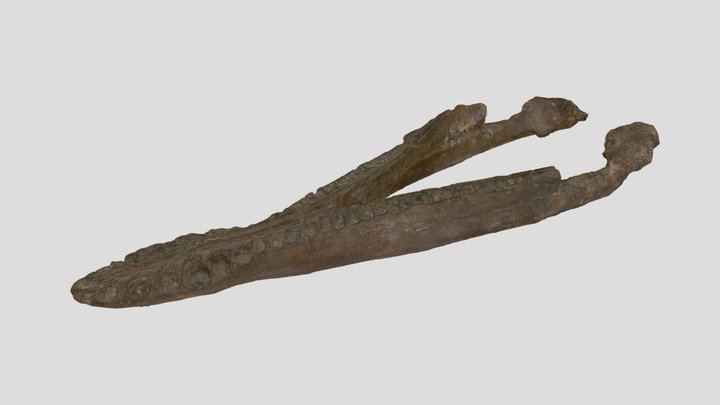
Laser scan
- Source
- MorphoSource
- Licence
- not stated by the source
- Commercial use
- cannot be read from the licence given — check the record
- Specimen
- Pliosaurus sp. · camsm: J29552
The description on this site
- Source
- Wikipedia, “Pliosaurus”
- Licence
- CC BY-SA 4.0
This is what the site found, which is not the same as what exists.
Keep going
What may have been alongside itThalassophonea through timeFormations of the Late JurassicThe world it lived on
Occurrence data from the Paleobiology Database, CC BY 4.0. (Owen 1841)