Discinidae
Discinidae is a family in the brachiopod superfamily Discinoidea. Unlike most brachiopods, which have uniformly calcitic or phosphatic shells, modern-day discinids incorporate tablets of silica into their valves. These are covered with vesicles into which the siliceous tablets are cemented, much like a closely packed mosaic, and held together with apatite. These vesicles eventually degrade, but nevertheless still leave an imprint on the shell itself. It has been suggested that this siliceous biomineralisation might also have occurred amongst some of the earliest Paleozoic brachiopods because similar patterns of shell imprints have been observed amongst them too.

British Museum · Public Domain · via Wikipedia/Commons. May be a photograph of a specimen, or an artist’s reconstruction — an interpretation of a skeleton, since colour and soft tissue are almost never preserved.
On record
Recorded, not inferred- Sits inside
- DiscinoideaPBDB
- Diet
- suspension feederPBDB, for Lingulida
- Life habit
- low-level epifaunalPBDB, for Lingulida
- Motility
- stationary, attachedPBDB, for Lingulida
- Vision
- blindPBDB, for Lingulata
- Environment
- marinePBDB, for Lophophorata
Time the record covers
At least 476 million years on record.
The record covers at least 477.1 Mya to 774 ka. No occurrence read is dated outside 486.85 Mya to 129 ka.
1,286 occurrences of Discinidae on record, most of them in the Carboniferous. The Paleobiology Database records this as a living group, and the chart stops with its fossils rather than at the present. Bar height is expected occurrences, not a count: each fossil is spread across the span it is dated to, so a tall narrow bar means tight dating and a low wide one means loose.
When
1,286 occurrences- Ordovician16%
- Silurian10%
- Devonian19%
- Carboniferous20%
- Permian16%
- Early Triassic3%
- Middle Triassic2%
- Late Triassicunder 1%
- Early Jurassic2%
- Middle Jurassicunder 1%
- Late Jurassic3%
- Early Cretaceousunder 1%
- Late Cretaceous2%
- Paleoceneunder 1%
- Eoceneunder 1%
- Oligocene1%
- Miocene3%
- Plioceneunder 1%
- Pleistoceneunder 1%
These are dates about fossils, not the animal: the record can only begin after it arose and end before it died out, so either end may reach further. Shares are expected occurrences: a fossil dated to a span is counted partly in each period it straddles. More on what this infers.
Found in
477 formations
- Phosphoria Formation33
- Kap Leslie Formation27
- Moscow Formation · Hamilton Group27
- Second Abden Shale Formation26
- Graham Formation · Cisco Group25
- Longtan Formation25
Loading coastlines…
The named rock units Discinidae has been recovered from, largest first. Drawn where the rock is now, not where it formed. 453 further formations hold fewer occurrences each and are not listed. 156 occurrences have no formation on record, which is common for older literature.
Discinidae and its relatives
CarboniferousWhere Discinidae and its relatives were recorded in the Carboniferous.
Found in the same rock
1,776 taxa- Orbiculoidea153 sites
- Lingula54 sites
- Crinoidea45 sites
- Ammonoidea32 sites
- Bivalvia32 sites
- Orbiculoidea nitida30 sites
- Camptonectes28 sites
- Entolium orbiculare26 sites
- Eomarginifera longispinus25 sites
- Camarotoechia24 sites
- Palaeoneilo24 sites
- Astarte23 sites
- Aviculopecten22 sites
- Buchia mosquensis22 sites
- Isognomon22 sites
- Orbiculoidea missouriensis22 sites
- Paraparchites22 sites
- Schizophoria22 sites
- Schuchertella21 sites
- Crurithyris urei20 sites
- Pinna20 sites
- Pleuromya20 sites
- Actinopteria19 sites
- Belemnitida19 sites
The Paleobiology Database records 1,142 sites for Discinidae, and this reads 240 of them. The number is how many of those sites it was catalogued from too. The 24 sharing the most are listed.
This is not a list of everything alive at the time. It is only what has come out of the same ground as this animal and been written down.
Entered from
450 references- Biostratigraphy of the Phosphoria, Park City, and Shedhorn Formations; Geology of Permian Rocks in the Western Phosphate Field38
- The Malvinokaffric realm in the Devonian of Brazil32
- The paleoecology of a Lower Carboniferous marine transgression27
- Stratigraphy and Paleontology of the Uppermost Pennsylvanian and Lowermost Permian Rocks in Kansas24
- Middle Ordovician phosphatic inarticulate brachiopods from Västergötland and Dalarna, Sweden21
- Genesis and environmental significance of Upper Cretaceous shell concentrations from the Cauvery Basin, southern India20
- Faunas from the Upper Silurian (Upper Ludlovian) in the Ludlow-Much Wenlock District, England19
- A new Changhsingian (Late Permian) brachiopod fauna from the Zhongzhai section (South China), Part 2: Lingulida, Orthida, Orthotetida and Spiriferida17
- The paleoecology of the Cenomanian-Turonian (Cretaceous) stage boundary extinctions at Black Mesa, Arizona16
- Pennsylvanian Invertebrate Faunas of Southeastern Kansas16
- Taxonomy and biostratigraphy of Ordovician brachiopods from northeastern Ny Friesland, Spitsbergen13
- Desmoinesian Brachiopoda and Mollusca from southwest Missouri13
Each of the 1,286 occurrences read was entered from one of these publications, ordered by how many each accounts for. This is not a search for papers mentioning the name. 438 further references are not listed. Entries link to doi.org where the Paleobiology Database holds an identifier, and to its own record where it does not. Relayed as the Paleobiology Database holds them, not checked against what they resolve to.
Media and terms
Media content1
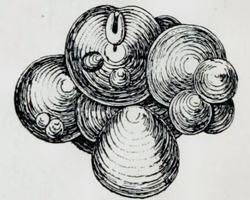
Picture of Discinidae
- Source
- Wikipedia/Commons
- Credit
- British Museum
- Licence
- Public Domain
- Commercial use
- the licence allows it
No 3D scan of Discinidae was found in MorphoSource and Sketchfab.
Smithsonian Open Access was not reached for this taxon, so this list is what the others held rather than everything there is.
The description on this site
- Source
- Wikipedia, “Discinidae”
- Licence
- CC BY-SA 4.0
This is what the site found, which is not the same as what exists.
Keep going
What may have been alongside itDiscinoidea through timeFormations of the CarboniferousThe world it lived on
Occurrence data from the Paleobiology Database, CC BY 4.0. Gray 1840