Hoplites
Hoplites is a genus of ammonite that lived from the Early Albian to the beginning of the Middle Albian. Its fossils have been found in Europe, Transcaspia and Mexico. Shell has compressed, rectangular till depressed and trapezoidal whorl section. There are strong umbilical bullae from which, prominent ribs are branching and these are interrupted on venter. Ends of ribs on the venter are prominent and can be both alternate or opposite. Some species have zigzagging ribs and these ribs ends usually thickened, or they can be raised into ventrolateral tubercles. These tubercles are mostly oblique clavi.

Apokryltaros at English Wikipedia · CC BY 2.5 · via Wikipedia/Commons. May be a photograph of a specimen, or an artist’s reconstruction — an interpretation of a skeleton, since colour and soft tissue are almost never preserved.
On record
Recorded, not inferred- Sits inside
- HoplitinaePBDB
- Diet
- carnivorePBDB, for Ammonoidea
- Life habit
- nektonicPBDB, for Ammonoidea
- Motility
- fast-movingPBDB, for Ammonoidea
- Vision
- well-developedPBDB, for Cephalopoda
- Environment
- marinePBDB, for Cephalopoda
Time the record covers
At least 47 million years on record.
The record covers at least 137.05 Mya to 89.8 Mya. No occurrence read is dated outside 149.2 Mya to 83.6 Mya.
72 occurrences of Hoplites on record, most of them in the Early Cretaceous. Bar height is expected occurrences, not a count: each fossil is spread across the span it is dated to, so a tall narrow bar means tight dating and a low wide one means loose.
When
72 occurrences- Late Jurassicunder 1%
- Early Cretaceous97%
- Late Cretaceous3%
These are dates about fossils, not the animal: the record can only begin after it arose and end before it died out, so either end may reach further. Shares are expected occurrences: a fossil dated to a span is counted partly in each period it straddles. More on what this infers.
Found in
15 formations
- Grès verts helvétiques Formation17
- Carolinefjellet Formation12
- Folkestone Formation · Lower Greensand Group7
- Punta del Cobre Formation6
- Quintuco Formation3
- Mogilno Formation1
Loading coastlines…
The named rock units Hoplites has been recovered from, largest first. Drawn where the rock is now, not where it formed. 17 occurrences have no formation on record, which is common for older literature.
Hoplites and its relatives
Early CretaceousWhere Hoplites and its relatives were recorded in the Early Cretaceous.
Found in the same rock
282 taxa- Douvilleiceras10 sites
- Birostrina8 sites
- Desmoceras (Desmoceras) latidorsatum8 sites
- Gastropoda8 sites
- Grycia sablei8 sites
- Lyelliceras8 sites
- Grycia whittingtoni6 sites
- Hemiaster6 sites
- Protanisoceras6 sites
- Beudanticeras4 sites
- Dentalium4 sites
- Natica4 sites
- Otohoplites4 sites
- Phylloceras4 sites
- Arca3 sites
- Brachiopoda3 sites
- Delphinella subchaperi3 sites
- Dimorphoplites3 sites
- Fimbria3 sites
- Holaster3 sites
- Leymeriella3 sites
- Puzosia3 sites
- Roberticeras albense3 sites
- Acanthodiscus radiatus2 sites
The Paleobiology Database records 58 sites for Hoplites, and this reads all of them. The number is how many of those sites it was catalogued from too. The 24 sharing the most are listed.
This is not a list of everything alive at the time. It is only what has come out of the same ground as this animal and been written down.
Entered from
26 references- Les grès verts helvétiques (Aptien moyen-Albien supérieur) de Haute-Savoie, Valais et Vaud (Alpes occidentales franco-suisses)19
- Ammonite faunas and stratigraphy of Lower Cretaceous (Albian) rocks in southern Spitsbergen12
- The stratigraphical palaeontology of the Lower Greensand7
- Carta Los Loros, Región de Atacama, Servicio Nacional de Geología y Minería, Carta Geológica de Chile, Serie Geología Básica, No 92, 53 p, 1 mapa escala 1:100.000, Santiago5
- The lower Valanginian ammonite fauna of Puerta Quintuco, Argentina – with description of the new genus Quintucoceras3
- A new mid-Cretaceous hermit crab (Crustacea, Anomura) from Central Russia sheds new light on paguroid evolution3
- Genus Delphinella (Ammonoidea) from the Berriasian of the Crimean Mountains2
- On the presence of a sauropod dinosaur (Saurischia) in the Albian of Aube (France)2
- Excursions géologiques dans le Bassin de Paris. Deuxième Série: Ile-de-France tertiaire, auréoles crétacées et jurassiques [Geological excursions in the Paris Basin. Second series: Tertiary Ile-de-France, Jurassic and Cretaceous rings]2
- New Albian ammonite faunas from Semelenberg (Alpstein, Switzerland) and their paleoecology1
- A new species of Diaulax Bell, 1863 (Brachyura: Dialucidae) in the Early Cretaceous of the Rosablanca Formation, Colombia1
- A Lower Cretaceous ichthyosaur graveyard in deep marine slope channel deposits at Torres del Paine National Park, southern Chile1
Each of the 72 occurrences read was entered from one of these publications, ordered by how many each accounts for. This is not a search for papers mentioning the name. 14 further references are not listed. Entries link to doi.org where the Paleobiology Database holds an identifier, and to its own record where it does not. Relayed as the Paleobiology Database holds them, not checked against what they resolve to.
Media and terms
Media content3
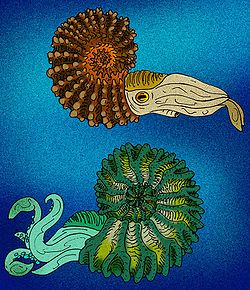
Picture of Hoplites
- Source
- Wikipedia/Commons
- Credit
- Apokryltaros at English Wikipedia
- Licence
- CC BY 2.5
- Commercial use
- the licence allows it
CT scan
- Source
- MorphoSource
- Licence
- not stated by the source
- Commercial use
- cannot be read from the licence given — check the record
- Specimen
- Charybdis hoplites · NHMUK:zoo:2025.2075
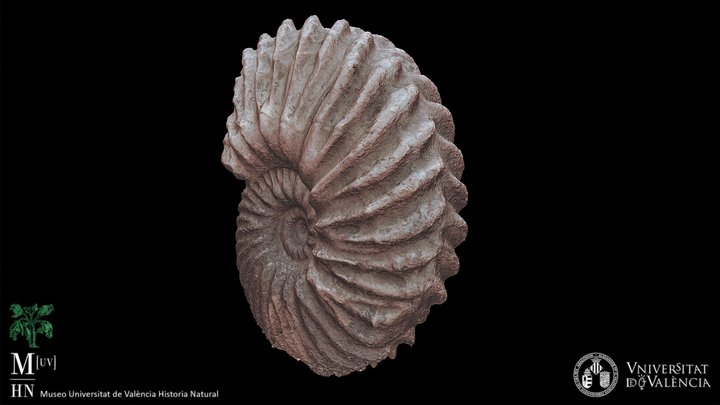
3D model
- Source
- Sketchfab
- Licence
- CC Attribution
- Commercial use
- cannot be read from the licence given — check the record
Smithsonian Open Access was not reached for this taxon, so this list is what the others held rather than everything there is.
The description on this site
- Licence
- CC BY-SA 4.0
This is what the site found, which is not the same as what exists.
Keep going
What may have been alongside itHoplitinae through timeFormations of the Early CretaceousThe world it lived on
Occurrence data from the Paleobiology Database, CC BY 4.0.