Elaphrosaurinae
Noasauridae is an extinct family of theropod dinosaurs belonging to the group Ceratosauria. They were closely related to the short-armed abelisaurids, although most noasaurids had much more traditional body types generally similar to other theropods. Their heads, on the other hand, had unusual adaptations depending on the subfamily. 'Traditional' noasaurids, sometimes grouped in the subfamily Noasaurinae, had sharp teeth which splayed outwards from a downturned lower jaw.

Eduard Solà · CC BY-SA 3.0 · via Wikipedia/Commons. May be a photograph of a specimen, or an artist’s reconstruction — an interpretation of a skeleton, since colour and soft tissue are almost never preserved.
On record
Recorded, not inferred- Sits inside
- NoasauridaePBDB
- Diet
- carnivorePBDB, for Theropoda
- Life habit
- ground dwelling, solitaryPBDB, for Theropoda
- Motility
- actively mobilePBDB, for Theropoda
- Environment
- terrestrialPBDB, for Theropoda
Time the record covers
At least 54 million years on record.
The record covers at least 154.8 Mya to 100.5 Mya. No occurrence read is dated outside 161.5 Mya to 93.9 Mya.
8 occurrences of Elaphrosaurinae on record, most of them in the Late Jurassic. Bar height is expected occurrences, not a count: each fossil is spread across the span it is dated to, so a tall narrow bar means tight dating and a low wide one means loose.
When
8 occurrencesThese are dates about fossils, not the animal: the record can only begin after it arose and end before it died out, so either end may reach further. Shares are expected occurrences: a fossil dated to a span is counted partly in each period it straddles. More on what this infers.
Found in
4 formations
Loading coastlines…
The named rock units Elaphrosaurinae has been recovered from, largest first. Drawn where the rock is now, not where it formed. 1 occurrence has no formation on record, which is common for older literature.
Elaphrosaurinae and its relatives
Late JurassicWhere Elaphrosaurinae and its relatives were recorded in the Late Jurassic.
Found in the same rock
52 taxa- Theropoda4 sites
- Limusaurus inextricabilis3 sites
- Ornithischia3 sites
- Actinopterygii2 sites
- Diplodocidae2 sites
- Elaphrosaurus2 sites
- Elaphrosaurus bambergi2 sites
- Giraffatitan brancai2 sites
- Pterosauria2 sites
- Sauropoda2 sites
- Testudines2 sites
- Allosaurus1 site
- Apatosaurus1 site
- Atlascopcosaurus loadsi1 site
- Australovenator wintonensis1 site
- Barosaurus1 site
- Bernissartia1 site
- Bishops1 site
- Camarasaurus1 site
- Camptosaurus1 site
- Crocodyliformes1 site
- Dicraeosaurus hansemanni1 site
- Diluvicursor pickeringi1 site
- Dinosauria1 site
The Paleobiology Database records 8 sites for Elaphrosaurinae, and this reads all of them. The number is how many of those sites it was catalogued from too. The 24 sharing the most are listed.
This is not a list of everything alive at the time. It is only what has come out of the same ground as this animal and been written down.
Entered from
7 references- Dinosaur death pits from the Jurassic of China2
- First elaphrosaurine theropod dinosaur (Ceratosauria: Noasauridae) from Australia—a cervical vertebra from the Early Cretaceous of Victoria1
- A Jurassic ceratosaur from China helps clarify avian digital homologies1
- Paleoecological analysis of the vertebrate fauna of the Morrison Formation (Upper Jurassic), Rocky Mountain region, U.S.A.1
- Sur les dinosauriens du Continental Intercalaire des Kem-Kem de la Daoura [On the dinosaurs from the Continental Intercalaire of the Kem Kem of the Doura]1
- Die Coelurosaurier und Theropoden der Tendaguru-Schichten Deutsch-Ostafrikas [The coelurosaurs and theropods of the Tendaguru Formation of German East Africa]1
- Ueber Elaphrosaurus bambergi und die Megalosaurier aus den Tendaguru-Schichten Deutsch-Ostafrikas [On Elaphrosaurus bambergi and the megalosaurs of the Tendaguru Formation of German East Africa]1
Each of the 8 occurrences read was entered from one of these publications, ordered by how many each accounts for. This is not a search for papers mentioning the name. Entries link to doi.org where the Paleobiology Database holds an identifier, and to its own record where it does not. Relayed as the Paleobiology Database holds them, not checked against what they resolve to.
Media and terms
Media content1
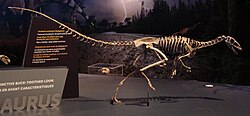
Picture of Elaphrosaurinae
- Source
- Wikipedia/Commons
- Credit
- Eduard Solà
- Licence
- CC BY-SA 3.0
- Commercial use
- the licence allows it
No 3D scan of Elaphrosaurinae was found in Sketchfab.
Smithsonian Open Access and MorphoSource were not reached for this taxon, so this list is what the others held rather than everything there is.
The description on this site
- Source
- Wikipedia, “Noasauridae”
- Licence
- CC BY-SA 4.0
This is what the site found, which is not the same as what exists.
Keep going
What may have been alongside itNoasauridae through timeFormations of the Late JurassicThe world it lived on
Occurrence data from the Paleobiology Database, CC BY 4.0. Rauhut and Carrano 2016