Eodelphis
Eodelphis, from eo- (dawn) and [Di]delphis, thus meaning "dawn opossum", is a genus of stagodontid metatherians from the Late Cretaceous of North America, with distinctive crushing dentition. Named species include E. browni and the more advanced E. cutleri. Both come from the Late Campanian of Dinosaur Provincial Park, Alberta. Specimens are also known from the Judith River Formation of Montana. E. cutleri is related to the Maastrichtian genus Didelphodon as indicated by its enlarged premolars and more robust jaw. Eodelphis was probably an aquatic predator like its relative Didelphodon, and may have weighed about 0.6 kg (1.3 lb), making it one of the largest mammals of its time.

Matthew, William Diller, 1871-1930. Brown, Barnum. Wortman, Jacob Lawson. · Public Domain · via Wikipedia/Commons. May be a photograph of a specimen, or an artist’s reconstruction — an interpretation of a skeleton, since colour and soft tissue are almost never preserved.
On record
Recorded, not inferred- Sits inside
- StagodontidaePBDB
- Diet
- carnivore, durophagePBDB, for Stagodontidae
- Life habit
- scansorialPBDB, for Theria
- Motility
- actively mobilePBDB, for Osteichthyes
- Environment
- terrestrialPBDB, for Stagodontidae
Time the record covers
At least 71 million years on record.
The record covers at least 83.6 Mya to 11.63 Mya. No occurrence read is dated outside 85.7 Mya to 7.246 Mya.
24 occurrences of Eodelphis on record, most of them in the Late Cretaceous. Bar height is expected occurrences, not a count: each fossil is spread across the span it is dated to, so a tall narrow bar means tight dating and a low wide one means loose.
When
24 occurrencesThese are dates about fossils, not the animal: the record can only begin after it arose and end before it died out, so either end may reach further. Shares are expected occurrences: a fossil dated to a span is counted partly in each period it straddles. More on what this infers.
Found in
10 formations
- Judith River Formation · Montana Group7
- Oldman Formation · Belly River Group6
- Milk River Formation2
- St. Mary River Formation1
- Dinosaur Park Formation · Belly River Group1
- Foremost Formation · Belly River Group1
Loading coastlines…
The named rock units Eodelphis has been recovered from, largest first. Drawn where the rock is now, not where it formed. 2 occurrences have no formation on record, which is common for older literature.
Eodelphis and its relatives
Late CretaceousWhere Eodelphis and its relatives were recorded in the Late Cretaceous.
Found in the same rock
279 taxa- Meniscoessus major7 sites
- Alphadon halleyi6 sites
- Ankylosauridae6 sites
- Champsosaurus6 sites
- Filikomys primaevus6 sites
- Gypsonictops lewisi6 sites
- Hadrosauridae6 sites
- Mesodma6 sites
- Turgidodon praesagus6 sites
- Anura5 sites
- Belonostomus longirostris5 sites
- Cimolodon5 sites
- Crocodylia5 sites
- Myledaphus bipartitus5 sites
- Richardoestesia gilmorei5 sites
- Teleostei5 sites
- Theropoda5 sites
- Adocus4 sites
- Amiidae4 sites
- Baenidae4 sites
- Cimolestes4 sites
- Cimolomys clarki4 sites
- Dromaeosauridae4 sites
- Lepisosteus occidentalis4 sites
The Paleobiology Database records 23 sites for Eodelphis, and this reads all of them. The number is how many of those sites it was catalogued from too. The 24 sharing the most are listed.
This is not a list of everything alive at the time. It is only what has come out of the same ground as this animal and been written down.
Entered from
17 references- Mammalian fauna of the Judith River Formation (Late Cretaceous, Judithian), northcentral Montana4
- Cretaceous mammals of Alberta3
- Vertebrate palaeocommunities of the lower Judith River Group (Campanian) of southeastern Alberta, Canada, as interpreted from vertebrate microfossil assemblages2
- Marsupial mammals from the early Campanian Milk River Formation, Alberta, Canada2
- Filling the Bearpaw gap: evidence for palaeoenvironment-driven taxon distribution in a diverse, non-marine ecosystem from the late Campanian of west-central Alberta, Canada1
- Preliminary report on the mammals form Lane's Little Jaw Site Quarry: a latest Cretaceous (earliest Puercan?) local fauna, Hell Creek Formation, southeastern Montana1
- Synonymies and reidentifications of North American fossil mammals1
- Alberta's dinosaurs and other fossil vertebrates: Judith River and Edmonton groups (Campanian-Maastrichtian)1
- Stratigraphic distribution of fossil vertebrates in the Judith River Formation (Upper Cretaceous) of Wheatland and Golden Valley counties, south-central Montana1
- The vertebrate fauna from the Judith River Formation (Late Cretaceous) of Wheatland and Golden Valley counties, Montana1
- Preliminary report on Late Cretaceous mammals of the Kaiparowits Plateau, southern Utah1
- The therian mammalian fauna (Campanian) of Quarry 1, Fossil Forest study area, San Juan Basin, New Mexico1
Each of the 24 occurrences read was entered from one of these publications, ordered by how many each accounts for. This is not a search for papers mentioning the name. 5 further references are not listed. Entries link to doi.org where the Paleobiology Database holds an identifier, and to its own record where it does not. Relayed as the Paleobiology Database holds them, not checked against what they resolve to.
Media and terms
Media content1
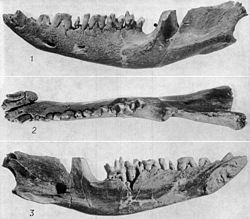
Picture of Eodelphis
- Source
- Wikipedia/Commons
- Credit
- Matthew, William Diller, 1871-1930. Brown, Barnum. Wortman, Jacob Lawson.
- Licence
- Public Domain
- Commercial use
- the licence allows it
No 3D scan was found. Smithsonian Open Access, MorphoSource and Sketchfab were all searched.
The description on this site
- Source
- Wikipedia, “Eodelphis”
- Licence
- CC BY-SA 4.0
This is what the site found, which is not the same as what exists.
Keep going
What may have been alongside itStagodontidae through timeFormations of the Late CretaceousThe world it lived on
Occurrence data from the Paleobiology Database, CC BY 4.0. Matthew 1916