Eucidaris
Eucidaris is a genus of cidaroid sea urchins known as slate pencil urchins. They are characterised by a moderately thick test, a usually monocyclic apical disc, perforate and non-crenulate tubercles and nearly straight ambulacra with horizontal pore pairs. The primary spines are few and widely spaced, stout with blunt flat tips and beaded ornamentation and the secondary spines are short and apressed. They originated in the Miocene and extant members of the genus are found in the tropical Indo-Pacific Ocean, East Pacific, Atlantic Ocean and Caribbean Sea.

Nhobgood ( talk ) Nick Hobgood · CC BY-SA 3.0 · via Wikipedia/Commons. May be a photograph of a specimen, or an artist’s reconstruction — an interpretation of a skeleton, since colour and soft tissue are almost never preserved.
On record
Recorded, not inferred- Sits inside
- StereocidarinaePBDB
- Diet
- grazer, omnivorePBDB, for Cidaroida
- Life habit
- low-level epifaunalPBDB, for Cidaroida
- Motility
- slow-movingPBDB, for Cidaroida
- Vision
- limitedPBDB, for Echinoidea
- Environment
- marinePBDB, for Cidaroida
Time the record covers
At least 51 million years on record.
The record covers at least 52 Mya to 129 ka. No occurrence read is dated outside 56 Mya to 11.7 ka.
47 occurrences of Eucidaris on record, most of them in the Miocene. The Paleobiology Database records this as a living group. Bar height is expected occurrences, not a count: each fossil is spread across the span it is dated to, so a tall narrow bar means tight dating and a low wide one means loose.
When
47 occurrences- Eocene19%
- Miocene32%
- Pliocene23%
- Pleistocene26%
These are dates about fossils, not the animal: the record can only begin after it arose and end before it died out, so either end may reach further. Shares are expected occurrences: a fossil dated to a span is counted partly in each period it straddles. More on what this infers.
Found in
16 formations
- Discovery Point Formation8
- Te Whanga Limestone Formation · Kekerione Group6
- Pico Formation5
- Tumaio Limestone Formation · Tioriori Group2
- Monterey Formation2
- Tamiami Formation1
Loading coastlines…
The named rock units Eucidaris has been recovered from, largest first. Drawn where the rock is now, not where it formed. 13 occurrences have no formation on record, which is common for older literature.
Eucidaris and its relatives
MioceneWhere Eucidaris and its relatives were recorded in the Miocene.
Found in the same rock
514 taxa- Agathistoma eiseni6 sites
- Hipponix6 sites
- Notostrea6 sites
- Pocillopora guadalupensis6 sites
- Apatopygus5 sites
- Caesia californiana5 sites
- Chlorostoma gallina5 sites
- Fissurella volcano5 sites
- Lottia limatula5 sites
- Lyropecten crassicardo5 sites
- Pusio humerosus5 sites
- Tetraclita squamosa5 sites
- Turritella cooperi5 sites
- Argopecten invalidus4 sites
- Chlamys4 sites
- Crassadoma gigantea4 sites
- Dallocardia quadragenarium4 sites
- Glossaulax reclusiana4 sites
- Here excavata4 sites
- Littorina (Neritrema) keenae4 sites
- Lyropecten catalinae4 sites
- Myrakeena veatchii4 sites
- Norrisia norrisii4 sites
- Panopea abrupta4 sites
The Paleobiology Database records 40 sites for Eucidaris, and this reads all of them. The number is how many of those sites it was catalogued from too. The 24 sharing the most are listed.
This is not a list of everything alive at the time. It is only what has come out of the same ground as this animal and been written down.
Entered from
21 references- Cretaceous-Cenozoic geology and biostratigraphy of the Chatham Islands, New Zealand9
- Invertebrate megafossils of Pleistocene (Sangamon Interglacial) age from Isla de Guadalupe, Baja California, Mexico9
- Late Pliocene megafossils of the Pico Formation, Newhall area, Los Angeles County, Southern California4
- Paleoenvironmental implications of fossiliferous Miocene and Pliocene strata on San Clemente Island, California4
- I cidaroidi (Echinoidea) del Miocene inferiore-medio dell'Emilia-Romagna e di San Marino2
- Paleontology and stratigraphy of the Miocene Saddleback Valley Limestone, Orange County, Southern California2
- Ecospace variability along a carbonate platform at the northern boundary of the Miocene reef belt (Upper Langhian, Austria)2
- Geology of Lau, Fiji2
- Palaeoecology and taphonomy of spatangoid-dominated echinoid assemblages: A case study from the Early-Middle Miocene of Sardinia, Italy1
- Palaeoecology, taphonomy, and preservation of a lower Pliocene shell bed (coquina) froma volcanic oceanic island (Santa Maria Island, Azores)1
- Middle Miocene coralgal facies at Maksymivka near Ternopil (Ukraine): a preliminary account1
- New information on molluscan paleontology and depositional environments of the Upper Pliocene Pico Formation, Valencia area, Los Angeles County, southern California1
Each of the 47 occurrences read was entered from one of these publications, ordered by how many each accounts for. This is not a search for papers mentioning the name. 9 further references are not listed. Entries link to doi.org where the Paleobiology Database holds an identifier, and to its own record where it does not. Relayed as the Paleobiology Database holds them, not checked against what they resolve to.
Media and terms
Media content2

Picture of Eucidaris
- Source
- Wikipedia/Commons
- Credit
- Nhobgood ( talk ) Nick Hobgood
- Licence
- CC BY-SA 3.0
- Commercial use
- the licence allows it
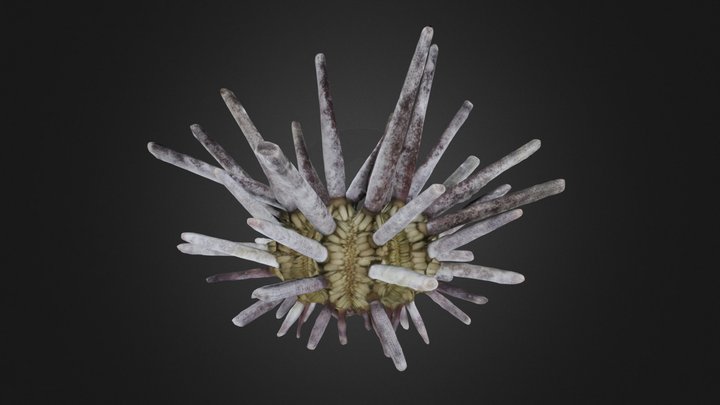
3D model
- Source
- Sketchfab
- Licence
- CC0 Public Domain
- Commercial use
- the licence allows it
Smithsonian Open Access and MorphoSource were not reached for this taxon, so this list is what the others held rather than everything there is.
The description on this site
- Source
- Wikipedia, “Eucidaris”
- Licence
- CC BY-SA 4.0
This is what the site found, which is not the same as what exists.
Keep going
What may have been alongside itStereocidarinae through timeFormations of the MioceneThe world it lived on
Occurrence data from the Paleobiology Database, CC BY 4.0.