Eudimorphodon
Eudimorphodon is an extinct genus of pterosaur that was discovered in 1973 by Mario Pandolfi in the town of Cene, Italy and described the same year by Rocco Zambelli. The nearly complete skeleton was retrieved from shale deposited during the Late Triassic, making Eudimorphodon one of the oldest pterosaurs known. It had a wingspan of about 100 centimeters (3.3 ft). Eudimorphodon is known from several skeletons, including juvenile specimens.

Tommy from Arad · CC BY 2.0 · via Wikipedia/Commons. May be a photograph of a specimen, or an artist’s reconstruction — an interpretation of a skeleton, since colour and soft tissue are almost never preserved.
On record
Recorded, not inferred- Sits inside
- CampylognathoididaePBDB
- Diet
- piscivorePBDB, for Pterosauria
- Life habit
- volantPBDB, for Pterosauria
- Motility
- actively mobilePBDB, for Osteichthyes
- Environment
- marinePBDB, for Pterosauria
Time the record covers
At least 5.4 million years on record.
The record covers at least 211.18 Mya to 205.7 Mya. No occurrence read is dated outside 227.3 Mya to 201.4 Mya.
13 occurrences of Eudimorphodon on record, most of them in the Late Triassic. Bar height is expected occurrences, not a count: each fossil is spread across the span it is dated to, so a tall narrow bar means tight dating and a low wide one means loose.
When
13 occurrences- Late Triassic100%
These are dates about fossils, not the animal: the record can only begin after it arose and end before it died out, so either end may reach further. Shares are expected occurrences: a fossil dated to a span is counted partly in each period it straddles. More on what this infers.
Found in
5 formations
- Dolomia di Forni Formation4
- Klettgau Formation2
- Zorzino Limestone Formation2
- Grès à Avicula contorta Formation1
- Argilliti di Riva di Solto Formation1
Loading coastlines…
The named rock units Eudimorphodon has been recovered from, largest first. Drawn where the rock is now, not where it formed. 3 occurrences have no formation on record, which is common for older literature.
Eudimorphodon and its relatives
Late TriassicWhere Eudimorphodon and its relatives were recorded in the Late Triassic.
Found in the same rock
156 taxa- Sargodon tomicus5 sites
- Mystriosuchinae4 sites
- Nemacanthus monilifer4 sites
- Saurichthys4 sites
- Thomasia antiqua4 sites
- Archosauria3 sites
- Archosauriformes3 sites
- Dusa longipes3 sites
- Morganucodontidae3 sites
- Theropoda3 sites
- Tricuspes tuebingensis3 sites
- Archaeopalinurus levis2 sites
- Ceratodus parvus2 sites
- Dapedium2 sites
- Granuloperculatipollis2 sites
- Haramiyidae2 sites
- Hybodus2 sites
- Lissodus lepagei2 sites
- Lissodus minimus2 sites
- Morganucodon2 sites
- Plagiosaurus2 sites
- Pseudodalatias barnstonensis2 sites
- Pseudotriconodon wildi2 sites
- Pterosauria2 sites
The Paleobiology Database records 13 sites for Eudimorphodon, and this reads all of them. The number is how many of those sites it was catalogued from too. The 24 sharing the most are listed.
This is not a list of everything alive at the time. It is only what has come out of the same ground as this animal and been written down.
Entered from
11 references- A review of the Triassic pterosaur record2
- Rhaeto-Liassic mammals from Switzerland and West Germany2
- An Eudimorphodon (Diapsida, Pterosauria) specimen from the Norian (Late Triassic) of north-eastern Italy1
- Reptiles terrestres (Lepidosauromorpha et Traversodontidae) du Trias superieur de Medernach (G.-D. de Luxembourg) [Terrestrial reptiles (Lepidosauromorpha and Traversodontidae) from the Upper Triassic of Medernach (G. D. of Luxembourg)]1
- Late Triassic vertebrates from Syren (Luxembourg)1
- Reptilian, therapsid and mammalian teeth from the Upper Triassic of Varangéville (northeastern France)1
- Archosauriform teeth from the Upper Triassic of Saint-Nicolas-de-Port (northeastern France)1
- A new pterosaur (Reptilia, Pterosauria) from the Norian (Late Triassic) of Friuli (northeastern Italy). Preliminary note1
- A juvenile specimen of Eudimorphodon ranzii Zambelli (Reptilia, Pterosauria) from the Upper Triassic (Norian) of Bergamo1
- An isolated sternum of Eudimorphodon (Reptilia, Pterosauria) from the Norian (Late Triassic) of the Bergamo Prealps (Lombardy, northern Italy)1
- Eudimorphodon ranzii gen. nov., sp. nov., uno pterosauro Triassico1
Each of the 13 occurrences read was entered from one of these publications, ordered by how many each accounts for. This is not a search for papers mentioning the name. Entries link to doi.org where the Paleobiology Database holds an identifier, and to its own record where it does not. Relayed as the Paleobiology Database holds them, not checked against what they resolve to.
Media and terms
Media content2

Picture of Eudimorphodon
- Source
- Wikipedia/Commons
- Credit
- Tommy from Arad
- Licence
- CC BY 2.0
- Commercial use
- the licence allows it
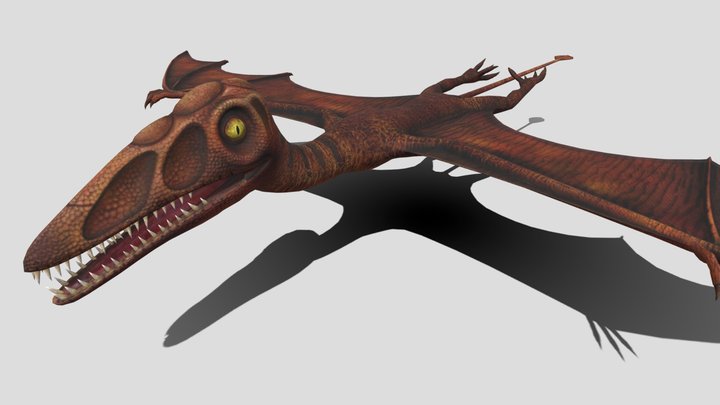
3D model
- Source
- Sketchfab
- Credit
- Jurassic Radassic
- Licence
- CC Attribution
- Commercial use
- cannot be read from the licence given — check the record
The description on this site
- Licence
- CC BY-SA 4.0
This is what the site found, which is not the same as what exists.
Keep going
What may have been alongside itCampylognathoididae through timeFormations of the Late TriassicThe world it lived on
Occurrence data from the Paleobiology Database, CC BY 4.0. Zambelli 1973