Exocoetidae
The Exocoetidae are a family of saltwater ray-finned fish in the order Beloniformes, known colloquially as flying fish or flying cod, with about 64 species in seven genera. While they do not "fly" in the same way a bird does, flying fish can make powerful leaps out of the water where their long, wing-like paired fins act as aerofoils to generate lift and enable prolonged gliding for considerable distances above the water surface. The main reason for this behavior is thought to be to escape from underwater predators, which include swordfish, mackerel, tuna, and marlin, among others, though their periods of flight expose them to attack by aerial predators such as frigatebirds.

David Starr Jordan and Barton Warren Evermann · Public Domain · via Wikipedia/Commons. May be a photograph of a specimen, or an artist’s reconstruction — an interpretation of a skeleton, since colour and soft tissue are almost never preserved.
On record
Recorded, not inferred- Sits inside
- BelonoideiPBDB
- Diet
- omnivorePBDB, for Beloniformes
- Life habit
- nektonicPBDB, for Beloniformes
- Motility
- actively mobilePBDB, for Beloniformes
Time the record covers
At least 48 million years on record.
The record covers at least 48.07 Mya to 11.7 ka. No occurrence read is dated outside 56 Mya to 0 Mya.
7 occurrences of Exocoetidae on record, most of them in the Eocene. The Paleobiology Database records this as a living group. Bar height is expected occurrences, not a count: each fossil is spread across the span it is dated to, so a tall narrow bar means tight dating and a low wide one means loose.
When
7 occurrencesThese are dates about fossils, not the animal: the record can only begin after it arose and end before it died out, so either end may reach further. Shares are expected occurrences: a fossil dated to a span is counted partly in each period it straddles. More on what this infers.
Found in
3 formations
Loading coastlines…
The named rock units Exocoetidae has been recovered from, largest first. Drawn where the rock is now, not where it formed. 4 occurrences have no formation on record, which is common for older literature.
Exocoetidae and its relatives
EoceneWhere Exocoetidae and its relatives were recorded in the Eocene.
Found in the same rock
334 taxa- Acanthuridae2 sites
- Apogonidae2 sites
- Balistidae2 sites
- Bothidae2 sites
- Carangidae2 sites
- Cetoscarus2 sites
- Chelonioidea2 sites
- Diodontidae2 sites
- Fregata2 sites
- Gallus gallus2 sites
- Hipposcarus2 sites
- Holocentridae2 sites
- Laridae2 sites
- Monotaxis2 sites
- Naso2 sites
- Ostraciidae2 sites
- Procellariidae2 sites
- Rattus exulans2 sites
- Scaridae2 sites
- Scarinae2 sites
- Scarus2 sites
- Serranidae2 sites
- Siganidae2 sites
- Sula2 sites
The Paleobiology Database records 5 sites for Exocoetidae, and this reads all of them. The number is how many of those sites it was catalogued from too. The 24 sharing the most are listed.
This is not a list of everything alive at the time. It is only what has come out of the same ground as this animal and been written down.
Entered from
5 references- The systematic composition of the Eocene actinopterygian fish fauna from Monte Bolca, northern Italy, as known to date2
- Life on the edge: prehistoric settlement and economy on Utrōk Atoll, northern Marshall Islands2
- Early Pliocene otolith assemblages from the outer-shelf environment reveal the establishment of mesopelagic fish fauna over 3 million years ago in southwestern Taiwan1
- Otolithen aus dem Unter-Pliozän von Süd-Sizilien und aus der Toscana1
- Some typical Upper Eocene fish scales from California1
Each of the 7 occurrences read was entered from one of these publications, ordered by how many each accounts for. This is not a search for papers mentioning the name. Entries link to doi.org where the Paleobiology Database holds an identifier, and to its own record where it does not. Relayed as the Paleobiology Database holds them, not checked against what they resolve to.
Media and terms
Media content2

Picture of Exocoetidae
- Source
- Wikipedia/Commons
- Credit
- David Starr Jordan and Barton Warren Evermann
- Licence
- Public Domain
- Commercial use
- the licence allows it
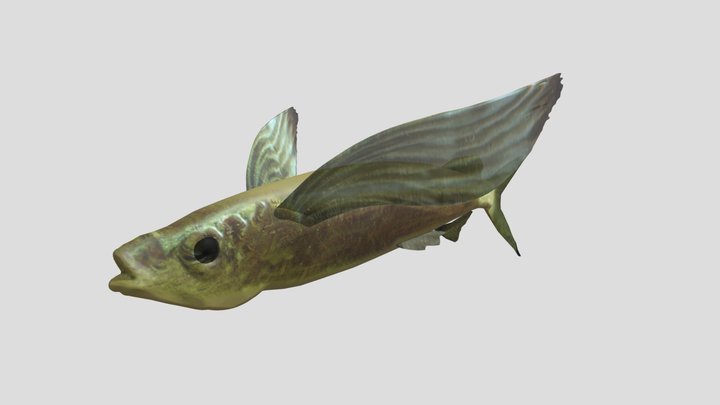
3D model
- Source
- Sketchfab
- Credit
- victorberdugo1
- Licence
- CC Attribution
- Commercial use
- cannot be read from the licence given — check the record
Smithsonian Open Access was not reached for this taxon, so this list is what the others held rather than everything there is.
The description on this site
- Source
- Wikipedia, “Flying fish”
- Licence
- CC BY-SA 4.0
This is what the site found, which is not the same as what exists.
Keep going
What may have been alongside itBelonoidei through timeFormations of the EoceneThe world it lived on
Occurrence data from the Paleobiology Database, CC BY 4.0. Risso 1827