Falco peregrinus
The peregrine falcon, also referred to simply as the peregrine, is a bird of prey (raptor) in the family Falconidae known for its speed. A large, crow-sized falcon, it has a blue-grey back, barred white underparts and a black head. As is typical for bird-eating (avivore) raptors, peregrine falcons are sexually dimorphic, with females being considerably larger than males. Historically, the bird has also been known as the "black-cheeked falcon" in Australia and the "duck hawk" in North America.

Mykola Swarnyk · CC BY-SA 3.0 · via Wikipedia/Commons. May be a photograph of a specimen, or an artist’s reconstruction — an interpretation of a skeleton, since colour and soft tissue are almost never preserved.
On record
Recorded, not inferred- Also called
- Peregrine falconPBDB
- Sits inside
- FalcoPBDB
- Diet
- carnivorePBDB, for Falconidae
- Life habit
- volantPBDB, for Falconidae
- Motility
- actively mobilePBDB, for Theropoda
- Environment
- terrestrialPBDB, for Falconidae
Time the record covers
At least 762 thousand years on record.
The record covers at least 774 ka to 11.7 ka. No occurrence read is dated outside 2.58 Mya to 0 Mya.
29 occurrences of Falco peregrinus on record, most of them in the Pleistocene. The Paleobiology Database records this as a living group. Bar height is expected occurrences, not a count: each fossil is spread across the span it is dated to, so a tall narrow bar means tight dating and a low wide one means loose.
When
29 occurrences- Pleistocene76%
- Holocene24%
These are dates about fossils, not the animal: the record can only begin after it arose and end before it died out, so either end may reach further. Shares are expected occurrences: a fossil dated to a span is counted partly in each period it straddles. More on what this infers.
Found in
2 formations
Loading coastlines…
The named rock units Falco peregrinus has been recovered from, largest first. Drawn where the rock is now, not where it formed. 27 occurrences have no formation on record, which is common for older literature.
Falco peregrinus and its relatives
PleistoceneWhere Falco peregrinus and its relatives were recorded in the Pleistocene.
Found in the same rock
876 taxa- Tyto alba20 sites
- Corvus brachyrhynchos13 sites
- Anas platyrhynchos11 sites
- Corvus corax11 sites
- Falco sparverius11 sites
- Athene cunicularia10 sites
- Branta canadensis10 sites
- Buteo10 sites
- Buteo jamaicensis10 sites
- Spatula clypeata10 sites
- Ardea herodias9 sites
- Cathartes aura9 sites
- Numenius americanus9 sites
- Zenaida macroura9 sites
- Aenocyon dirus8 sites
- Antigone canadensis8 sites
- Bubo virginianus8 sites
- Charadrius vociferus8 sites
- Coragyps occidentalis8 sites
- Podilymbus podiceps8 sites
- Accipiter cooperii7 sites
- Anas7 sites
- Anser caerulescens7 sites
- Aquila chrysaetos7 sites
The Paleobiology Database records 29 sites for Falco peregrinus, and this reads all of them. The number is how many of those sites it was catalogued from too. The 24 sharing the most are listed.
This is not a list of everything alive at the time. It is only what has come out of the same ground as this animal and been written down.
Entered from
24 references- Prehistoric human impacts on California birds: evidence from the Emeryville shellmoumd avifauna4
- Early Pleistocene birds from Pirro Nord (Puglia, southern Italy)2
- The Quaternary avifauna of Crete, Greece2
- Late Pleistocene birds from Binagada (Azerbaijan) in collection of the National Museum of Natural History (Kyiv, Ukraine)1
- The diversity and biogeography of late Pleistocene birds from the lowland Neotropics1
- Distribution and provenance of fossil avifauna on San Miguel Island1
- Biostratigraphy of amphibians, reptiles, birds and mammals in Corsica and the role of man in the Holocene faunal turnover1
- Taphonomy of a late Pleistocene carnivore den, Dade County, Florida1
- Fossil birds from late Quaternary deposits in New Caledonia1
- Reconstruction of mid Wisconsinan environments in southern New Mexico1
- Pleistocene and prehistoric birds of south-west Britain1
- The non-passerine Pleistocene avifauna of the Talara Tar Seeps, northwestern Peru1
Each of the 29 occurrences read was entered from one of these publications, ordered by how many each accounts for. This is not a search for papers mentioning the name. 12 further references are not listed. Entries link to doi.org where the Paleobiology Database holds an identifier, and to its own record where it does not. Relayed as the Paleobiology Database holds them, not checked against what they resolve to.
Media and terms
Media content3

Picture of Falco peregrinus
- Source
- Wikipedia/Commons
- Credit
- Mykola Swarnyk
- Licence
- CC BY-SA 3.0
- Commercial use
- the licence allows it
CT scan
- Source
- MorphoSource
- Licence
- not stated by the source
- Commercial use
- cannot be read from the licence given — check the record
- Specimen
- Falco peregrinus · l-jz:JZ:111
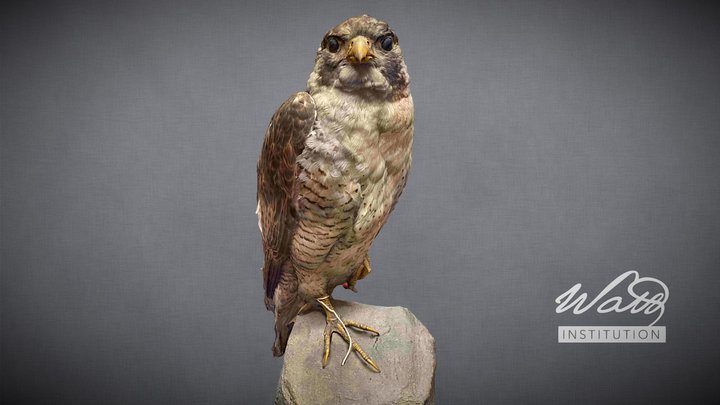
3D model
- Source
- Sketchfab
- Credit
- The Watt Institution
- Licence
- CC Attribution
- Commercial use
- cannot be read from the licence given — check the record
Smithsonian Open Access was not reached for this taxon, so this list is what the others held rather than everything there is.
The description on this site
- Licence
- CC BY-SA 4.0
This is what the site found, which is not the same as what exists.
Keep going
What may have been alongside itFalco through timeFormations of the PleistoceneThe world it lived on
Occurrence data from the Paleobiology Database, CC BY 4.0. (Tunstall 1771)