Glossata
Glossata is a suborder of the Lepidoptera, containing all members that have a coilable proboscis; i.e., it includes all butterflies and the vast majority of moth species. The only non-Glossatan moths are in the suborders Aglossata, Heterobathmiina, and Zeugloptera.

Atudu · CC BY-SA 4.0 · via Wikipedia/Commons. May be a photograph of a specimen, or an artist’s reconstruction — an interpretation of a skeleton, since colour and soft tissue are almost never preserved.
On record
Recorded, not inferred- Sits inside
- AngiospermivoraPBDB
- Motility
- actively mobilePBDB, for Arthropoda
- Environment
- terrestrialPBDB, for Insecta
Time the record covers
At least 201 million years on record.
The record covers at least 201.4 Mya to 11.7 ka. No occurrence read is dated outside 205.7 Mya to 0 Mya.
273 occurrences of Glossata on record, most of them in the Eocene. The Paleobiology Database records this as a living group. Bar height is expected occurrences, not a count: each fossil is spread across the span it is dated to, so a tall narrow bar means tight dating and a low wide one means loose.
When
273 occurrences- Late Triassicunder 1%
- Early Jurassicunder 1%
- Late Jurassicunder 1%
- Early Cretaceous1%
- Late Cretaceous9%
- Eocene50%
- Oligocene10%
- Miocene18%
- Pliocene4%
- Pleistocene3%
- Holocene2%
These are dates about fossils, not the animal: the record can only begin after it arose and end before it died out, so either end may reach further. Shares are expected occurrences: a fossil dated to a span is counted partly in each period it straddles. More on what this infers.
Found in
31 formations
- Florissant Formation18
- Bouldnor Formation · Solent Group12
- Niveau du gypse d'Aix Formation8
- Tremembé Formation7
- Green River Formation5
- Campagne-Calavon Formation5
Loading coastlines…
The named rock units Glossata has been recovered from, largest first. Drawn where the rock is now, not where it formed. 7 further formations hold fewer occurrences each and are not listed. 182 occurrences have no formation on record, which is common for older literature.
Glossata and its relatives
EoceneWhere Glossata and its relatives were recorded in the Eocene.
Found in the same rock
4,545 taxa- Curculionidae10 sites
- Formicidae10 sites
- Lepidoptera8 sites
- Acrididae6 sites
- Araneae6 sites
- Coleoptera6 sites
- Entimini6 sites
- Forcipomyia (Forcipomyia)6 sites
- Balticoroma serafinorum5 sites
- Bibio5 sites
- Brachycera5 sites
- Brachypogon (Isohelea)5 sites
- Carabidae5 sites
- Dasyhelea5 sites
- Forcipomyia5 sites
- Forcipomyia (Lasiohelea)5 sites
- Gesomyrmex hoernesi5 sites
- Ichneumonidae5 sites
- Plagiodera lyelliana5 sites
- Plecia bucklandi5 sites
- Prenolepis henschei5 sites
- Staphylinidae5 sites
- Yantaromyrmex geinitzi5 sites
- Aeshnidae4 sites
The Paleobiology Database records 131 sites for Glossata, and this reads all of them. Of that, one read hit the database's own return limit, so every count below is a floor rather than a total. The number is how many of those sites it was catalogued from too. The 24 sharing the most are listed.
This is not a list of everything alive at the time. It is only what has come out of the same ground as this animal and been written down.
Entered from
120 references- Paleontologiya cheshukerylykh i voprosy filogenii otrayada Papilionida19
- Bernstein-Lepidopteren19
- Kuznetsov, 194116
- New Moth-Like Lepidoptera from the Baltic Amber14
- Bernstein-Lepidopteren (aus der Sammlung Bachofen-Echt)11
- New taxa of extant and fossil primitive moths in South-East Asia and their biogeographic significance (Lepidoptera, Micropterigidae, Agathiphagidae, Lophocoronidae)10
- Fossil Insects from the Bembridge Marls, Palaeogene of the Isle of Wight, Southern England7
- Über die bisher im Pliozän von Willershausen gefundenen Schmetterlings und Raupenreste7
- Heer, 18497
- The fossil butterflies of Florissant6
- First records of species of Gelechioidae from Bitterfeld amber (Insecta, Lepidoptera) and notes on two gelechioid species from Baltic amber5
- Studies on the Lepidoptera from fossil resins part I. General remarks and descriptions of new genera and species of the families Tineidae and Oecophoridae from the Baltic amber4
Each of the 273 occurrences read was entered from one of these publications, ordered by how many each accounts for. This is not a search for papers mentioning the name. 108 further references are not listed. Entries link to doi.org where the Paleobiology Database holds an identifier, and to its own record where it does not. Relayed as the Paleobiology Database holds them, not checked against what they resolve to.
Media and terms
Media content1
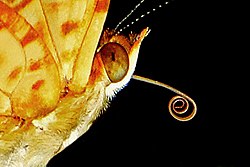
Picture of Glossata
- Source
- Wikipedia/Commons
- Credit
- Atudu
- Licence
- CC BY-SA 4.0
- Commercial use
- the licence allows it
No 3D scan of Glossata was found in Sketchfab.
Smithsonian Open Access and MorphoSource were not reached for this taxon, so this list is what the others held rather than everything there is.
The description on this site
- Source
- Wikipedia, “Glossata”
- Licence
- CC BY-SA 4.0
This is what the site found, which is not the same as what exists.
Keep going
What may have been alongside itAngiospermivora through timeFormations of the EoceneThe world it lived on
Occurrence data from the Paleobiology Database, CC BY 4.0. (Fabricius 1775)