Grus americana
The whooping crane is an endangered crane species, native to North America, named for its "whooping" calls. Along with the sandhill crane, it is one of only two crane species native to North America, and it is also the tallest North American bird species, with an estimated 22–30+ year life expectancy in the wild. After being pushed to the brink of extinction by unregulated hunting and loss of habitat that left just 21 wild cranes by 1941, the whooping crane made a partial recovery through conservation efforts. The total number of cranes in the surviving migratory population, plus three reintroduced flocks and in-captivity, is just over 830 birds as of 2025. This includes about 560 individuals in the remnant population that migrates between coastal Texas, USA, and the Northwest Territories, Canada, which is termed the "Aransas-Wood Buffalo Population" after the protected areas that anchor the population's wintering and breeding ranges, respectively. Additionally, there are about 140 individuals in two reintroduced populations breeding in Wisconsin and Louisiana, USA, and an additional 130 individuals in captivity.

Uncredited · via Wikipedia/Commons. May be a photograph of a specimen, or an artist’s reconstruction — an interpretation of a skeleton, since colour and soft tissue are almost never preserved.
On record
Recorded, not inferred- Also called
- Whooping cranePBDB
- Sits inside
- GrusPBDB
- Diet
- carnivorePBDB, for Coelurosauria
- Life habit
- ground dwelling, solitaryPBDB, for Theropoda
- Motility
- actively mobilePBDB, for Theropoda
- Environment
- terrestrialPBDB, for Theropoda
- Mass
- 7.5 kgWikidata
Time the record covers
At least 3.4 million years on record.
The record covers at least 3.6 Mya to 129 ka. No occurrence read is dated outside 5.333 Mya to 11.7 ka.
16 occurrences of Grus americana on record, most of them in the Pleistocene. The Paleobiology Database records this as a living group. Bar height is expected occurrences, not a count: each fossil is spread across the span it is dated to, so a tall narrow bar means tight dating and a low wide one means loose.
When
16 occurrences- Pliocene6%
- Pleistocene94%
These are dates about fossils, not the animal: the record can only begin after it arose and end before it died out, so either end may reach further. Shares are expected occurrences: a fossil dated to a span is counted partly in each period it straddles. More on what this infers.
Found in
2 formations
- Yorktown Formation · Chesapeake Group1
- Vanheim Formation1
Loading coastlines…
The named rock units Grus americana has been recovered from, largest first. Drawn where the rock is now, not where it formed. 14 occurrences have no formation on record, which is common for older literature.
Grus americana and its relatives
PleistoceneWhere Grus americana and its relatives were recorded in the Pleistocene.
Found in the same rock
899 taxa- Antigone canadensis8 sites
- Buteo jamaicensis8 sites
- Ardea herodias6 sites
- Podilymbus podiceps6 sites
- Branta canadensis5 sites
- Buteo5 sites
- Caracara cheriway5 sites
- Cathartes aura5 sites
- Ciconia maltha5 sites
- Equus5 sites
- Gymnogyps californianus5 sites
- Haliaeetus leucocephalus5 sites
- Mammut americanum5 sites
- Oraristrix brea5 sites
- Paramylodon harlani5 sites
- Procyon lotor5 sites
- Tapirus5 sites
- Teratornis merriami5 sites
- Accipiter cooperii4 sites
- Agelaius phoeniceus4 sites
- Anas platyrhynchos4 sites
- Ardea alba4 sites
- Athene cunicularia4 sites
- Bubo virginianus4 sites
The Paleobiology Database records 16 sites for Grus americana, and this reads all of them. The number is how many of those sites it was catalogued from too. The 24 sharing the most are listed.
This is not a list of everything alive at the time. It is only what has come out of the same ground as this animal and been written down.
Entered from
10 references- A review of the cranes (Aves: Gruidae) of Rancho La Brea, with the description of a new species5
- Notes on fossil and subfossil birds2
- The avifauna of the Pleistocene in Florida2
- Miocene and Pliocene birds from the Lee Creek Mine, North Carolina1
- Avian community, climate, and sea-level changes in the Plio-Pleistocene of the Florida Peninsula1
- A late Pleistocene (Wisconsinan) avifauna from West Palm Beach, Florida1
- A whooping crane from the late Pleistocene of Kansas1
- A whooping crane from the Pleistocene of North America1
- The fossil avifauna of Itchtucknee River, Florida1
- The fossil Birds of California1
Each of the 16 occurrences read was entered from one of these publications, ordered by how many each accounts for. This is not a search for papers mentioning the name. Entries link to doi.org where the Paleobiology Database holds an identifier, and to its own record where it does not. Relayed as the Paleobiology Database holds them, not checked against what they resolve to.
Media and terms
Media content1
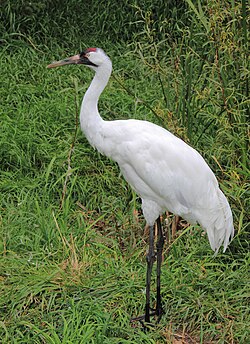
Picture of Grus americana
- Source
- Wikipedia/Commons
- Credit
- nobody named on the record
- Licence
- not stated by the source
- Commercial use
- cannot be read from the licence given — check the record
No 3D scan of Grus americana was found in MorphoSource and Sketchfab.
Smithsonian Open Access was not reached for this taxon, so this list is what the others held rather than everything there is.
The description on this site
- Licence
- CC BY-SA 4.0
This is what the site found, which is not the same as what exists.
Keep going
What may have been alongside itGrus through timeFormations of the PleistoceneThe world it lived on
Occurrence data from the Paleobiology Database, CC BY 4.0. (Linnaeus 1758)