Gulella sp.
Gulella is a genus of very small air-breathing land snails, terrestrial pulmonate gastropod mollusks in the family Streptaxidae.

F. Welter Schultes · Public Domain · via Wikipedia/Commons. May be a photograph of a specimen, or an artist’s reconstruction — an interpretation of a skeleton, since colour and soft tissue are almost never preserved.
Time the record covers
At least 10 million years on record.
The record covers at least 15.98 Mya to 5.333 Mya. No occurrence read is dated outside 23.04 Mya to 11.7 ka.
9 occurrences of Gulella sp. on record, most of them in the Miocene. Bar height is expected occurrences, not a count: each fossil is spread across the span it is dated to, so a tall narrow bar means tight dating and a low wide one means loose.
When
9 occurrences- Miocene89%
- Pliocene6%
- Pleistocene5%
These are dates about fossils, not the animal: the record can only begin after it arose and end before it died out, so either end may reach further. Shares are expected occurrences: a fossil dated to a span is counted partly in each period it straddles. More on what this infers.
Found in
2 formations
Loading coastlines…
The named rock units Gulella sp. has been recovered from, largest first. Drawn where the rock is now, not where it formed. 5 occurrences have no formation on record, which is common for older literature.
Gulella sp. and its relatives
MioceneWhere Gulella sp. and its relatives were recorded in the Miocene.
Found in the same rock
154 taxa- Diamantomys luederitzi6 sites
- Limicolaria6 sites
- Carnivora5 sites
- Tayloria sp.5 sites
- Burtoa sp.4 sites
- Gonaxis sp.4 sites
- Homorus sp.4 sites
- Ophidia4 sites
- Rodentia4 sites
- Siamotragulus songhorensis4 sites
- Trochonanina sp.4 sites
- Afrocricetodon songhori3 sites
- Afrohyrax championi3 sites
- Amphechinus3 sites
- Dicerorhinus3 sites
- Edouardia sp.3 sites
- Insectivora3 sites
- Krapfiella sp.3 sites
- Maizania3 sites
- Megapedetes3 sites
- Paranomalurus3 sites
- Paraphiomys3 sites
- Trochozonites3 sites
- Walangania africanus3 sites
The Paleobiology Database records 9 sites for Gulella sp., and this reads all of them. The number is how many of those sites it was catalogued from too. The 24 sharing the most are listed.
This is not a list of everything alive at the time. It is only what has come out of the same ground as this animal and been written down.
Entered from
6 references- The Tinderet Miocene sequence in Kenya3
- Nouvelles decouvertes dans le Miocene inferiur de Napak, Ouganda Oriental [New discoveries in lower Miocene strata at Napak, Eastern Uganda]2
- First African record of the Miocene Asian mouse-deer Siamotragulus (Mammalia, Ruminantia, Tragulidae): implications for the phylogeny and evolutionary history of the advanced selenodont tragulids1
- New Higher Primate Fossils from the Middle Miocene Deposits at Majiwa and Kaloma, Western Kenya1
- Fossil Mammal Locality on Mount Elgon, Eastern Uganda1
- The Pleistocene Fauna and Flora of Kharga Oasis,Egypt1
Each of the 9 occurrences read was entered from one of these publications, ordered by how many each accounts for. This is not a search for papers mentioning the name. Entries link to doi.org where the Paleobiology Database holds an identifier, and to its own record where it does not. Relayed as the Paleobiology Database holds them, not checked against what they resolve to.
Media and terms
Media content1
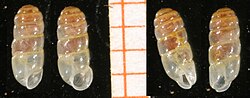
Picture of Gulella sp.
- Source
- Wikipedia/Commons
- Credit
- F. Welter Schultes
- Licence
- Public Domain
- Commercial use
- the licence allows it
No 3D scan of Gulella sp. was found in MorphoSource and Sketchfab.
Smithsonian Open Access was not reached for this taxon, so this list is what the others held rather than everything there is.
The description on this site
- Source
- Wikipedia, “Gulella”
- Licence
- CC BY-SA 4.0
This is what the site found, which is not the same as what exists.
Keep going
What may have been alongside itFormations of the MioceneThe world it lived on
Occurrence data from the Paleobiology Database, CC BY 4.0.