Halictidae
Halictidae is the second-largest family of bees with nearly 4,500 species. They are commonly called sweat bees, as they are often attracted to perspiration. Halictid species are an extremely diverse group that can vary greatly in appearance. These bees occur all over the world and are found on every continent except Antarctica. Usually dark-colored and often metallic, halictids are found in various sizes, colors and patterns. Several species are all or partly green and a few are red, purple, or blue. A number of them have yellow markings, especially the males, which commonly have yellow faces, a pattern widespread among the various families of bees. The family is one of many with short tongues and is best distinguished by the arcuate basal vein found on the wing. Females in this family tend to be larger than the males. They are the group for which the term eusocial was coined by entomologist Suzanne Batra.

Didier Descouens · CC BY-SA 4.0 · via Wikipedia/Commons. May be a photograph of a specimen, or an artist’s reconstruction — an interpretation of a skeleton, since colour and soft tissue are almost never preserved.
On record
Recorded, not inferred- Also called
- sweat beePBDB
- Sits inside
- AnthophilaPBDB
- Motility
- actively mobilePBDB, for Arthropoda
- Environment
- terrestrialPBDB, for Insecta
Time the record covers
At least 40 million years on record.
The record covers at least 48.07 Mya to 7.246 Mya. No occurrence read is dated outside 56 Mya to 5.333 Mya.
32 occurrences of Halictidae on record, most of them in the Miocene. The Paleobiology Database records this as a living group, and the chart stops with its fossils rather than at the present. Bar height is expected occurrences, not a count: each fossil is spread across the span it is dated to, so a tall narrow bar means tight dating and a low wide one means loose.
When
32 occurrencesThese are dates about fossils, not the animal: the record can only begin after it arose and end before it died out, so either end may reach further. Shares are expected occurrences: a fossil dated to a span is counted partly in each period it straddles. More on what this infers.
Found in
5 formations
- Florissant Formation6
- Randeck Maar Formation2
- Tranquille Formation · Kamloops Group1
- Klondike Mountain Formation1
- Upper Freshwater-Molasse Formation1
Loading coastlines…
The named rock units Halictidae has been recovered from, largest first. Drawn where the rock is now, not where it formed. 21 occurrences have no formation on record, which is common for older literature.
Halictidae and its relatives
MioceneWhere Halictidae and its relatives were recorded in the Miocene.
Found in the same rock
1,365 taxa- Apidae3 sites
- Braconidae3 sites
- Formicidae3 sites
- Ichneumonidae3 sites
- Pachymerina3 sites
- Tenthredinidae3 sites
- Vespidae3 sites
- Acrididae2 sites
- Aculeata2 sites
- Anthonomus (Anthomorphus) cruraluma2 sites
- Apis2 sites
- Apis (Cascapis) armbrusteri2 sites
- Araneae2 sites
- Archeatelura sturmi2 sites
- Bradysia exoleta2 sites
- Caenocholax brodzinskyi2 sites
- Caenocholax dominicensis2 sites
- Calopterygoidea2 sites
- Carabidae2 sites
- Caulophilus ashei2 sites
- Chilicola (Hylaeosoma) gracilis2 sites
- Cimbicidae2 sites
- Coleoptera2 sites
- Coniopteryx antiquua2 sites
The Paleobiology Database records 18 sites for Halictidae, and this reads all of them. The number is how many of those sites it was catalogued from too. The 24 sharing the most are listed.
This is not a list of everything alive at the time. It is only what has come out of the same ground as this animal and been written down.
Entered from
24 references- Two new halictine bees in Miocene amber from the Dominican Republic (Hymenoptera, Halictidae)3
- Fossil halictine bees from the Upper Miocene of Murat, France (Hymenoptera: Halictidae)2
- Modernisation of the Hymenoptera: ants, bees, wasps, and sawflies of the early Eocene Okanagan Highlands of western North America2
- Halictine bees from the Eocene-Oligocene boundary of Florissant, Colorado (Hymenoptera: Halictidae)2
- Classification of the bee tribe Augochlorini (Hymenoptera: Halictidae)2
- New augochlorine bees (Hymenoptera: Halictidae) in Dominican amber, with a brief review of fossil Halictidae2
- Fossil Hymenoptera from Florissant, Colorado2
- A macrocephalic halictine bee from the middle Miocene of Öhningen, Germany (Hymenoptera: Halictidae)1
- A male of the bee genus Agapostemon in Dominican amber (Hymenoptera: Halictidae)1
- A Miocene halictine bee from Rubielos de Mora Basin, Spain (Hymenoptera: Halictidae)1
- An Early Eocene bee (Hymenoptera: Halictidae) from Quilchena, British columbia1
- New Palaeogene bees from Europe and Asia1
Each of the 32 occurrences read was entered from one of these publications, ordered by how many each accounts for. This is not a search for papers mentioning the name. 12 further references are not listed. Entries link to doi.org where the Paleobiology Database holds an identifier, and to its own record where it does not. Relayed as the Paleobiology Database holds them, not checked against what they resolve to.
Media and terms
Media content1
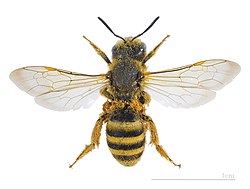
Picture of Halictidae
- Source
- Wikipedia/Commons
- Credit
- Didier Descouens
- Licence
- CC BY-SA 4.0
- Commercial use
- the licence allows it
No 3D scan of Halictidae was found in MorphoSource and Sketchfab.
Smithsonian Open Access was not reached for this taxon, so this list is what the others held rather than everything there is.
The description on this site
- Source
- Wikipedia, “Halictidae”
- Licence
- CC BY-SA 4.0
This is what the site found, which is not the same as what exists.
Keep going
What may have been alongside itAnthophila through timeFormations of the MioceneThe world it lived on
Occurrence data from the Paleobiology Database, CC BY 4.0. Thomson 1869