Hyaena hyaena
The striped hyena is a species of hyena native to North and East Africa, the Middle East, the Caucasus, Central Asia, and the Indian subcontinent. It is the only extant species in the genus Hyaena. It is listed on the IUCN Red List as near-threatened, as the global population is estimated to be under 10,000 mature individuals which continues to experience deliberate and incidental persecution along with a decrease in its prey base such that it may come close to meeting a continuing decline of 10% over the next three generations.

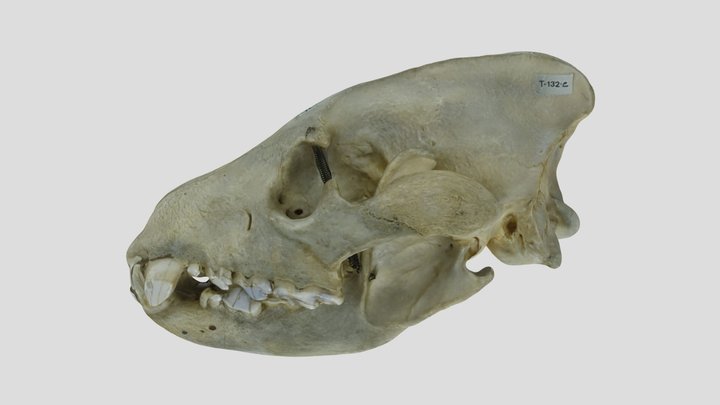
Tisha Mukherjee · CC BY-SA 4.0 · via Wikipedia/Commons. May be a photograph of a specimen, or an artist’s reconstruction — an interpretation of a skeleton, since colour and soft tissue are almost never preserved.
On record
Recorded, not inferred- Also called
- striped hyaenaPBDB
- Sits inside
- HyaenaPBDB
- Diet
- carnivorePBDB, for Hyaena
- Life habit
- ground dwellingPBDB, for Hyaenidae
- Motility
- actively mobilePBDB, for Osteichthyes
- Environment
- terrestrialPBDB, for Eutheria
- Mass
- 700 gWikidata
Time the record covers
At least 2.5 million years on record.
The record covers at least 2.58 Mya to 11.7 ka. No occurrence read is dated outside 5.333 Mya to 0 Mya.
24 occurrences of Hyaena hyaena on record, most of them in the Pleistocene. The Paleobiology Database records this as a living group. Bar height is expected occurrences, not a count: each fossil is spread across the span it is dated to, so a tall narrow bar means tight dating and a low wide one means loose.
When
24 occurrences- Pliocene14%
- Pleistocene65%
- Holocene21%
These are dates about fossils, not the animal: the record can only begin after it arose and end before it died out, so either end may reach further. Shares are expected occurrences: a fossil dated to a span is counted partly in each period it straddles. More on what this infers.
Found in
6 formations
- Nachukui Formation · Omo Group4
- Makapansgat Formation2
- Gabal Silsila Formation1
- Nubia Formation1
- Sterkfontein Formation · Transvaal Group1
- Nubia Formation1
Loading coastlines…
The named rock units Hyaena hyaena has been recovered from, largest first. Drawn where the rock is now, not where it formed. 14 occurrences have no formation on record, which is common for older literature.
Hyaena hyaena and its relatives
PleistoceneWhere Hyaena hyaena and its relatives were recorded in the Pleistocene.
Found in the same rock
359 taxa- Equus12 sites
- Panthera leo10 sites
- Panthera pardus9 sites
- Alcelaphini7 sites
- Canis7 sites
- Crocuta crocuta7 sites
- Giraffa camelopardalis7 sites
- Hystrix cristata7 sites
- Phacochoerus aethiopicus7 sites
- Bos taurus6 sites
- Clarias6 sites
- Equus asinus6 sites
- Gazella6 sites
- Gazella dorcas6 sites
- Hippopotamus amphibius6 sites
- Hippotragus equinus6 sites
- Lepus6 sites
- Lepus capensis6 sites
- Aepyceros melampus5 sites
- Alcelaphus buselaphus5 sites
- Bos primigenius5 sites
- Bovidae5 sites
- Canis aureus5 sites
- Damaliscus5 sites
The Paleobiology Database records 24 sites for Hyaena hyaena, and this reads all of them. The number is how many of those sites it was catalogued from too. The 24 sharing the most are listed.
This is not a list of everything alive at the time. It is only what has come out of the same ground as this animal and been written down.
Entered from
16 references- Stratigraphy and Paleontology of pliocene and Pleistocene Localities West of Lake Turkana, Kenya4
- Wendorf and Schild, 19763
- Plio-Pleistocene mammalian biostratigraphy of Atlantic Morocco2
- The Late Prehistory of the Eastern Sahel2
- A revision of the faunal remains from two central Sudanese sites: Khartoum Hospital and Esh Shaheinab2
- Mittelpleistozane Saugetierfaunen aus Mitteleuropa - der Versuch einer biostratigraphischen Zuordnung1
- Mid-Pleistocene change in large mammal faunas of East Africa1
- The Mousterian site of Jebel Irhoud, Morocco: new data on the fauna and biochronology, and description of a new human fossil1
- Taphonomy, Paleoecology, and Hominids of Lainyamok, Kenya1
- Plio-Pleistocene fossil mammalian microfauna of southern Africa: a preliminary report including descriptions of two new fossil muroid genera (Mammalia: Rodentia)1
- Serengeti: Dynamics of an Ecosystem1
- Re-appraisal of lithostratigraphy of Sterkfontein hominid site1
Each of the 24 occurrences read was entered from one of these publications, ordered by how many each accounts for. This is not a search for papers mentioning the name. 4 further references are not listed. Entries link to doi.org where the Paleobiology Database holds an identifier, and to its own record where it does not. Relayed as the Paleobiology Database holds them, not checked against what they resolve to.
Media and terms
Media content3

Picture of Hyaena hyaena
- Source
- Wikipedia/Commons
- Credit
- Tisha Mukherjee
- Licence
- CC BY-SA 4.0
- Commercial use
- the licence allows it
Laser scan
- Source
- MorphoSource
- Licence
- In Copyright
- Commercial use
- cannot be read from the licence given — check the record
- Specimen
- Hyaena hyaena · nmv:mammalogy:C54580
The description on this site
- Licence
- CC BY-SA 4.0
This is what the site found, which is not the same as what exists.
Keep going
What may have been alongside itHyaena through timeFormations of the PleistoceneThe world it lived on
Occurrence data from the Paleobiology Database, CC BY 4.0. (Linnaeus 1758)