Hydrodamalis gigas
Steller's sea cow is an extinct sirenian described by Georg Wilhelm Steller in 1741. At that time, it was found only around the Commander Islands in the Bering Sea between Alaska and Russia; its range extended across the North Pacific during the Pleistocene epoch, and likely contracted to such an extreme degree due to the glacial cycle. It is possible that indigenous populations interacted with the animal before Europeans. Steller first encountered it on Vitus Bering's Great Northern Expedition when the crew became shipwrecked on Bering Island. Much of what is known about its behavior comes from Steller's observations on the island, documented in his posthumous publication On the Beasts of the Sea. Within 27 years of its discovery by Europeans, the slow-moving and easily caught mammal was hunted into extinction for its meat, fat, and hide.

Daderot · CC0 · via Wikipedia/Commons. May be a photograph of a specimen, or an artist’s reconstruction — an interpretation of a skeleton, since colour and soft tissue are almost never preserved.
On record
Recorded, not inferred- Also called
- Steller's sea cowPBDB
- Sits inside
- HydrodamalisPBDB
- Diet
- herbivorePBDB, for Dugongidae
- Life habit
- aquaticPBDB, for Sirenia
- Motility
- actively mobilePBDB, for Osteichthyes
- Environment
- marinePBDB, for Sirenia
Time the record covers
At least 117 thousand years on record.
The record covers at least 129 ka to 11.7 ka. No occurrence read is dated outside 2.58 Mya to 0 Mya.
14 occurrences of Hydrodamalis gigas on record. Bar height is expected occurrences, not a count: each fossil is spread across the span it is dated to, so a tall narrow bar means tight dating and a low wide one means loose.
When
14 occurrences- Pleistocene43%
- Holocene57%
These are dates about fossils, not the animal: the record can only begin after it arose and end before it died out, so either end may reach further. Shares are expected occurrences: a fossil dated to a span is counted partly in each period it straddles. More on what this infers.
Found in
3 formations
- South Bight II Formation1
- Mandano Formation · Kazusa Group1
- Shimonopporo Formation1
Loading coastlines…
The named rock units Hydrodamalis gigas has been recovered from, largest first. Drawn where the rock is now, not where it formed. 11 occurrences have no formation on record, which is common for older literature.
Found in the same rock
74 taxa- Odobenus rosmarus3 sites
- Echinoidea2 sites
- Mammuthus2 sites
- Mollusca2 sites
- Zalophus californianus2 sites
- Abies1 site
- Aethia psittacula1 site
- Betula1 site
- Bison1 site
- Bolivina1 site
- Buccella1 site
- Buteo lagopus1 site
- Canis lupus tandrarum1 site
- Cassidulina1 site
- Castor canadensis canadensis1 site
- Cetacea1 site
- Chlamys (Chlamys) coatsi1 site
- Chlamys (Chlamys) hanaishiensis amchitkana1 site
- Chlamys (Chlamys) islandica powersi1 site
- Chlamys (Leochlamys) tanassevitschi1 site
- Cibicides lobatulus1 site
- Corvus corax1 site
- Cygnus columbianus1 site
- Elphidiella1 site
The Paleobiology Database records 14 sites for Hydrodamalis gigas, and this reads all of them. The number is how many of those sites it was catalogued from too. The 24 sharing the most are listed.
This is not a list of everything alive at the time. It is only what has come out of the same ground as this animal and been written down.
Entered from
11 references- Dynamics of sea mammal and bird populations of the Bearing Sea region over the last several millennia3
- An annotated list of extant skeletal material of Steller's Sea Cow (Hydrodamalis gigas) (Sirenia: Dugongidae) from the Commander Islands2
- Rewriting the history of an extinction— was a population of Steller’s sea cows (Hydrodamalis gigas) at St Lawrence Island also driven to extinction?1
- Steller's sea-cow (Hydrodamalis gigas) in the Bearing Island, Kamschatka1
- Steller's sea-cow (Sirenia: Hydrodamalis gigas) from the Middle Pleistocene Mandano Formation of the Boso Peninsula, Central Japan1
- A catalogue of late Quaternary Vertebrates from California: Part Two, Mammals1
- Steller's Sea-cow (Hydrodamalis gigas) from the Nopporo Hills in the Ishikari lowland, Hokkaido, Japan1
- Sirenian evolution in the North Pacific Ocean1
- Kangiguksuk: A Cultural Reconstruction of a Sixteenth Century Eskimo Site in Northern Alaska1
- A Hydrodamalis skull fragment from Monterey Bay, California1
- On an almost perfect Skeleton of Rhytina gigas (Rhytina stelleri," Steller's Sea-Cow"), obtained by Mr. Robert Damom, FGS, from the Pleistocene Peat-deposits on Behring's Island1
Each of the 14 occurrences read was entered from one of these publications, ordered by how many each accounts for. This is not a search for papers mentioning the name. Entries link to doi.org where the Paleobiology Database holds an identifier, and to its own record where it does not. Relayed as the Paleobiology Database holds them, not checked against what they resolve to.
Media and terms
Media content2
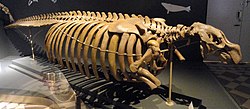
Picture of Hydrodamalis gigas
- Source
- Wikipedia/Commons
- Credit
- Daderot
- Licence
- CC0
- Commercial use
- the licence allows it
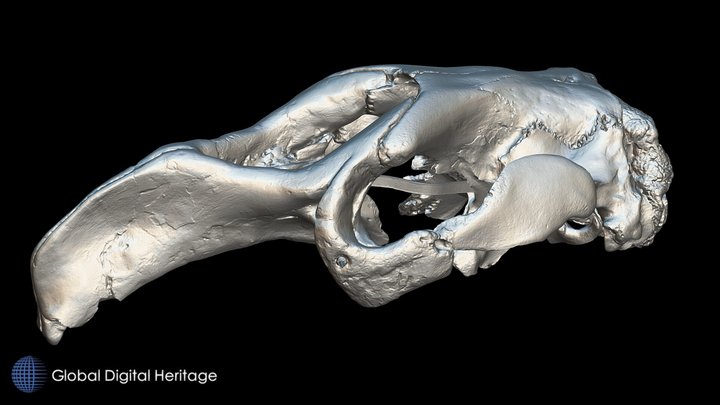
3D model
- Source
- Sketchfab
- Licence
- CC Attribution-NonCommercial
- Commercial use
- the licence does not allow it
Smithsonian Open Access and MorphoSource were not reached for this taxon, so this list is what the others held rather than everything there is.
The description on this site
- Licence
- CC BY-SA 4.0
This is what the site found, which is not the same as what exists.
Keep going
What may have been alongside itHydrodamalis through timeThe world it lived on
Occurrence data from the Paleobiology Database, CC BY 4.0. (Zimmermann 1780)