Cygnus columbianus
The tundra swan is a species of swan which breeds in the arctic, and overwinters in North America, Europe, and Asia. It is the smallest of the Holarctic swans, at 115–150 cm (45–59 in) in length, 168–211 cm (66–83 in) in wingspan and 3.4–9.6 kg (7.5–21.2 lb) in weight. Typically, the plumage of adults is entirely white, with solid black feet, a black beak that has varying amounts of yellow, and a thin streak of pink along the mouthline, although colour variation is common.

Maga-chan · CC BY-SA 2.5 · via Wikipedia/Commons. May be a photograph of a specimen, or an artist’s reconstruction — an interpretation of a skeleton, since colour and soft tissue are almost never preserved.
On record
Recorded, not inferred- Also called
- tundra swanPBDB
- Sits inside
- CygnusPBDB
- Diet
- folivore, granivorePBDB, for Anserinae
- Life habit
- volantPBDB, for Anserinae
- Motility
- actively mobilePBDB, for Theropoda
- Environment
- freshwaterPBDB, for Anserinae
- Mass
- 6.31 kgWikidata
Time the record covers
At least 3.5 million years on record.
The record covers at least 3.6 Mya to 11.7 ka. No occurrence read is dated outside 5.333 Mya to 0 Mya.
17 occurrences of Cygnus columbianus on record, most of them in the Pleistocene. The Paleobiology Database records this as a living group. Bar height is expected occurrences, not a count: each fossil is spread across the span it is dated to, so a tall narrow bar means tight dating and a low wide one means loose.
When
17 occurrences- Pliocene6%
- Pleistocene59%
- Holocene35%
These are dates about fossils, not the animal: the record can only begin after it arose and end before it died out, so either end may reach further. Shares are expected occurrences: a fossil dated to a span is counted partly in each period it straddles. More on what this infers.
Found in
4 formations
- Yorktown Formation · Chesapeake Group1
- Cromer Forest Bed Formation1
- Turlock Lake Formation1
- Manix Formation1
Loading coastlines…
The named rock units Cygnus columbianus has been recovered from, largest first. Drawn where the rock is now, not where it formed. 13 occurrences have no formation on record, which is common for older literature.
Cygnus columbianus and its relatives
PleistoceneWhere Cygnus columbianus and its relatives were recorded in the Pleistocene.
Found in the same rock
861 taxa- Branta canadensis8 sites
- Anas platyrhynchos7 sites
- Haliaeetus leucocephalus6 sites
- Buteo jamaicensis5 sites
- Anas crecca carolinensis4 sites
- Anatidae4 sites
- Anser caerulescens4 sites
- Antigone canadensis4 sites
- Aquila chrysaetos4 sites
- Ardea herodias4 sites
- Cathartes aura4 sites
- Ciconia maltha4 sites
- Corvus corax4 sites
- Equus4 sites
- Fulica americana4 sites
- Gavia arctica4 sites
- Grus americana4 sites
- Larus4 sites
- Mammuthus4 sites
- Mareca americana4 sites
- Meleagris gallopavo4 sites
- Podilymbus podiceps4 sites
- Rangifer tarandus4 sites
- Spatula clypeata4 sites
The Paleobiology Database records 17 sites for Cygnus columbianus, and this reads all of them. The number is how many of those sites it was catalogued from too. The 24 sharing the most are listed.
This is not a list of everything alive at the time. It is only what has come out of the same ground as this animal and been written down.
Entered from
15 references- Birds of the Cromer Forest Bed series of the East Anglian Pleistocene2
- The fossil Birds of California2
- Variability in Thule Inuit Subsistence Economy: A Faunal Analysis of OkRn-1, Banks Island, NWT1
- The mid-Irvingtonian Fairmead Landfill fossil site, Madera County Paleontology Collection, and Fossil Discovery Center of Madera County, California1
- Declining foraging returns from an inexhaustible resource? Abundance indices and beluga whaling in the western Canadian Arctic1
- Miocene and Pliocene birds from the Lee Creek Mine, North Carolina1
- Pleistocene (Rancholabrean) vertebrate faunas from coastal Georgia1
- Ancient Arctic Hunters: Material Culture and Survival Strategy1
- Pleistocene and prehistoric birds of south-west Britain1
- The Camp Cady Local Fauna: Paleoenvironment of the Lake Manix Basin1
- Quaternary vertebrate localities of Virginia and their avian and mammalian fauna1
- Kangiguksuk: A Cultural Reconstruction of a Sixteenth Century Eskimo Site in Northern Alaska1
Each of the 17 occurrences read was entered from one of these publications, ordered by how many each accounts for. This is not a search for papers mentioning the name. 3 further references are not listed. Entries link to doi.org where the Paleobiology Database holds an identifier, and to its own record where it does not. Relayed as the Paleobiology Database holds them, not checked against what they resolve to.
Media and terms
Media content3

Picture of Cygnus columbianus
- Source
- Wikipedia/Commons
- Credit
- Maga-chan
- Licence
- CC BY-SA 2.5
- Commercial use
- the licence allows it
CT scan
- Source
- MorphoSource
- Licence
- In Copyright
- Commercial use
- cannot be read from the licence given — check the record
- Specimen
- Cygnus columbianus · TCWC:Birds:24882
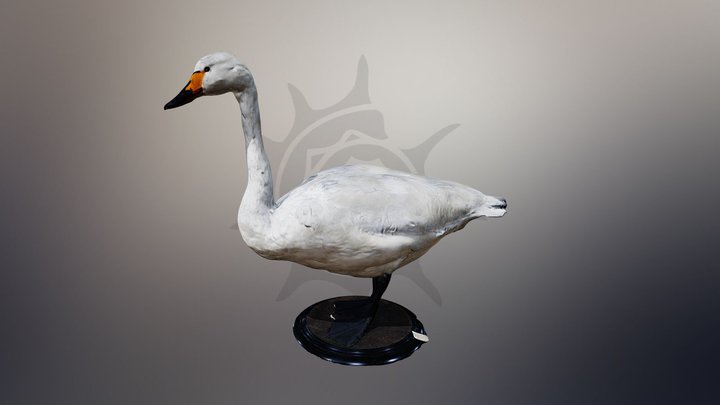
3D model
- Source
- Sketchfab
- Credit
- darwinmuseum.ru
- Licence
- CC Attribution
- Commercial use
- cannot be read from the licence given — check the record
Smithsonian Open Access was not reached for this taxon, so this list is what the others held rather than everything there is.
The description on this site
- Source
- Wikipedia, “Tundra swan”
- Licence
- CC BY-SA 4.0
This is what the site found, which is not the same as what exists.
Keep going
What may have been alongside itCygnus through timeFormations of the PleistoceneThe world it lived on
Occurrence data from the Paleobiology Database, CC BY 4.0. (Ord 1815)