Hypsilophodon
Hypsilophodon is a neornithischian dinosaur genus from the Early Cretaceous period of England. It has traditionally been considered an early member of the group Ornithopoda, but recent research has put this into question.

MWAK · Public Domain · via Wikipedia/Commons. May be a photograph of a specimen, or an artist’s reconstruction — an interpretation of a skeleton, since colour and soft tissue are almost never preserved.
On record
Recorded, not inferred- Sits inside
- HypsilophodontidaePBDB
- Diet
- herbivorePBDB
- Life habit
- ground dwellingPBDB
- Motility
- actively mobilePBDB
- Environment
- terrestrialPBDB
- Length
- 2.3 mWikidata
Time the record covers
At least 17 million years on record.
The record covers at least 143.1 Mya to 125.77 Mya. No occurrence read is dated outside 154.8 Mya to 100.5 Mya.
10 occurrences of Hypsilophodon on record, most of them in the Early Cretaceous. Bar height is expected occurrences, not a count: each fossil is spread across the span it is dated to, so a tall narrow bar means tight dating and a low wide one means loose.
When
10 occurrencesThese are dates about fossils, not the animal: the record can only begin after it arose and end before it died out, so either end may reach further. Shares are expected occurrences: a fossil dated to a span is counted partly in each period it straddles. More on what this infers.
Found in
7 formations
- Wessex Formation · Wealden Group2
- Vectis Formation · Wealden Group1
- Artoles Formation1
- Villar del Arzobispo Formation1
- Lower Bauxite Formation1
- Castrillo de la Reina Formation · Oliván Group1
Loading coastlines…
The named rock units Hypsilophodon has been recovered from, largest first. Drawn where the rock is now, not where it formed. 2 occurrences have no formation on record, which is common for older literature.
Hypsilophodon and its relatives
Early CretaceousWhere Hypsilophodon and its relatives were recorded in the Early Cretaceous.
Found in the same rock
82 taxa- Theropoda4 sites
- Lepidotes3 sites
- Baryonychinae2 sites
- Bernissartia2 sites
- Crocodylia2 sites
- Dinosauria2 sites
- Dromaeosauridae2 sites
- Euornithopoda2 sites
- Gastropoda2 sites
- Goniopholis2 sites
- Hypsilophodontidae2 sites
- Iguanodontoidea2 sites
- Pterodactyloidea2 sites
- Amiidae1 site
- Amiiformes1 site
- Ankylopollexia1 site
- Ankylosauria1 site
- Anura1 site
- Aragosaurus ischiaticus1 site
- Archosauria1 site
- Azhdarchidae1 site
- Bivalvia1 site
- Camarasauridae1 site
- Carnosauria1 site
The Paleobiology Database records 9 sites for Hypsilophodon, and this reads all of them. The number is how many of those sites it was catalogued from too. The 24 sharing the most are listed.
This is not a list of everything alive at the time. It is only what has come out of the same ground as this animal and been written down.
Entered from
10 references- Dinosaurios (Saurischia, Ornithischia) en el Barremiense (Cretácico Inferior) de la península Ibérica [Dinosaurs (Saurischia, Ornithischia) in the Barremian (Lower Cretaceous) of the Iberian peninsula]1
- Dos yacimientos excepcionales con vertebrados continentales del Barremiense (Cretácico Inferior) de Teruel: Vallipón y La Cantalera [Two exceptional localities with continental vertebrates in the Barremian (Lower Cretaceous) of Teruel: Vallipón and La Cantalera]1
- Notes on a camptosaurid dinosaur from the Lower Cretaceous bauxite, Cornet–Romania1
- Smaller dinosaur, Hypsilophodon tooth from Gifu Prefecture1
- Los Arcosaurios (Reptilia) del Jurásico superior – Cretácico inferior de Galve (Teruel, España) [The archosaurs (Reptilia) from the Upper Jurassic–Lower Cretaceous of Galve (Teruel, Spain)]1
- European Jurassic ornithopod dinosaurs of the families Hypsilophodontidae and Camptosauridae1
- The crocodilian Bernissartia in the Wealden of the Isle of Wight1
- The ornithischian dinosaur Hypsilophodon from the Wealden of the Isle of Wight1
- Supplemental note on the anatomy of <i>Hypsilophodon foxii</i>1
- On Hypsilophodon foxii, a new dinosaurian from the Wealden of the Isle of Wight1
Each of the 10 occurrences read was entered from one of these publications, ordered by how many each accounts for. This is not a search for papers mentioning the name. Entries link to doi.org where the Paleobiology Database holds an identifier, and to its own record where it does not. Relayed as the Paleobiology Database holds them, not checked against what they resolve to.
Media and terms
Media content3
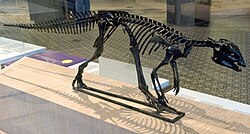
Picture of Hypsilophodon
- Source
- Wikipedia/Commons
- Credit
- MWAK
- Licence
- Public Domain
- Commercial use
- the licence allows it
CT scan
- Source
- MorphoSource
- Licence
- In Copyright
- Commercial use
- cannot be read from the licence given — check the record
- Specimen
- Hypsilophodon foxii · NHMUK:PAL:PV R 196
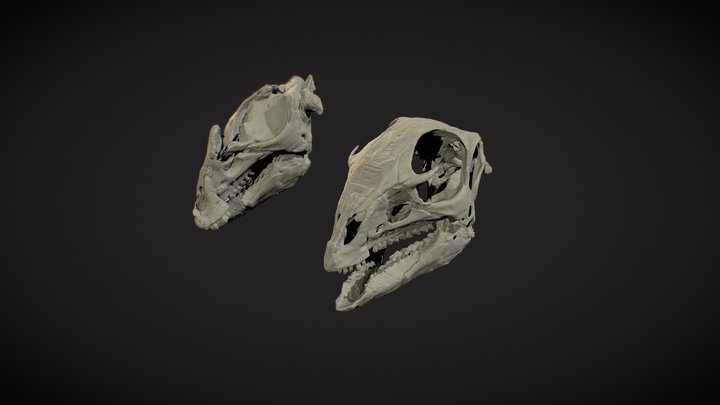
3D model
- Source
- Sketchfab
- Credit
- Pomona Pictures
- Licence
- CC Attribution-NonCommercial-ShareAlike
- Commercial use
- the licence does not allow it
The description on this site
- Licence
- CC BY-SA 4.0
This is what the site found, which is not the same as what exists.
Keep going
What may have been alongside itHypsilophodontidae through timeFormations of the Early CretaceousThe world it lived on
Occurrence data from the Paleobiology Database, CC BY 4.0. Huxley 1870