Isistius
Isistius is a genus of dogfish sharks in the family Dalatiidae. They are commonly known as cookiecutter sharks. Members of the genus are known for their unusual behaviour and dentition.

NOAA Observer Project · Public Domain · via Wikipedia/Commons. May be a photograph of a specimen, or an artist’s reconstruction — an interpretation of a skeleton, since colour and soft tissue are almost never preserved.
On record
Recorded, not inferred- Sits inside
- DalatiidaePBDB
- Diet
- carnivorePBDB, for Squaliformes
- Life habit
- nektonicPBDB, for Squaliformes
- Motility
- actively mobilePBDB, for Squaliformes
Time the record covers
At least 50 million years on record.
The record covers at least 56 Mya to 5.333 Mya. No occurrence read is dated outside 59.24 Mya to 1.8 Mya.
90 occurrences of Isistius on record, most of them in the Eocene. The Paleobiology Database records this as a living group, and the chart stops with its fossils rather than at the present. Bar height is expected occurrences, not a count: each fossil is spread across the span it is dated to, so a tall narrow bar means tight dating and a low wide one means loose.
When
90 occurrences- Paleocene1%
- Eocene59%
- Miocene33%
- Pliocene7%
- Pleistoceneunder 1%
These are dates about fossils, not the animal: the record can only begin after it arose and end before it died out, so either end may reach further. Shares are expected occurrences: a fossil dated to a span is counted partly in each period it straddles. More on what this infers.
Found in
35 formations
- Dongen Formation25
- London Clay Formation4
- Selsey Formation · Bracklesham Group3
- Onzole Formation3
- Neuhofen Formation3
- Joe's River Formation2
Loading coastlines…
The named rock units Isistius has been recovered from, largest first. Drawn where the rock is now, not where it formed. 11 further formations hold fewer occurrences each and are not listed. 19 occurrences have no formation on record, which is common for older literature.
Isistius and its relatives
EoceneWhere Isistius and its relatives were recorded in the Eocene.
Found in the same rock
1,256 taxa- Myliobatis25 sites
- Dasyatis22 sites
- Striatolamia macrota22 sites
- Centrophorus granulosus21 sites
- Squalus21 sites
- Squatina prima20 sites
- Scyliorhinus18 sites
- Hemipristis serra17 sites
- Physogaleus secundus17 sites
- Premontreia (Oxyscyllium) gilberti17 sites
- Carcharhinus priscus16 sites
- Carcharodon hastalis15 sites
- Odontaspis winkleri15 sites
- Carcharhinus14 sites
- Heterodontus vincenti14 sites
- Galeocerdo aduncus13 sites
- Lamniformes13 sites
- Galeorhinus ypresiensis12 sites
- Heterodontus12 sites
- Hypotodus verticalis12 sites
- Jaekelotodus trigonalis12 sites
- Brachycarcharias lerichei11 sites
- Chaenogaleus affinis11 sites
- Squatina11 sites
The Paleobiology Database records 88 sites for Isistius, and this reads all of them. The number is how many of those sites it was catalogued from too. The 24 sharing the most are listed.
This is not a list of everything alive at the time. It is only what has come out of the same ground as this animal and been written down.
Entered from
44 references- Elasmobranch teeth (Vertebrata, Pisces) from the Dongen Formation (Eocene) in The Netherlands25
- Inventaire des Élasmobranches (requins, raies, chimères) des dépôts molassiques du Sud-Luberon (Miocène supérieur)6
- Les Squalidae (Euselachii) miocènes des environs d'Avignon (Vaucluse)5
- The Selsey Division (Bracklesham Group) at Lee-on-the-Solent, Gosport, (Hants)4
- A new deep-sea elasmobranch fauna from the Central Paratethys (Neuhofener Beds, Mitterdorf, near Passau, Germany, Early Miocene, Middle Burdigalian)3
- Casier, 19663
- Chondrichthyan fishes from the Middle Eocene Osinovaya Formation of Rostov Region, Russia2
- Présence des genres Xiphodolamia et Isistius (Chondrichthyes, Elasmobranchii) à l’Éocène du Bassin de Paris2
- Structure and ichthyofauna of the upper part of Eocene sediments in Belogorsk area (Crimea)2
- Nouvelle faunes de sélaciens (Elasmobranchii, Neoselachii) de l'Eocène moyen des Landes (Sud-Ouest, France). Implication dans la connaissance des communautés de sélaciens d'eau profondes2
- Miocene Sharks' teeth from Ecuador2
- Contribution à l'étude des Poissons fossiles des Antiles2
Each of the 90 occurrences read was entered from one of these publications, ordered by how many each accounts for. This is not a search for papers mentioning the name. 32 further references are not listed. Entries link to doi.org where the Paleobiology Database holds an identifier, and to its own record where it does not. Relayed as the Paleobiology Database holds them, not checked against what they resolve to.
Media and terms
Media content3

Picture of Isistius
- Source
- Wikipedia/Commons
- Credit
- NOAA Observer Project
- Licence
- Public Domain
- Commercial use
- the licence allows it
CT scan
- Source
- MorphoSource
- Licence
- not stated by the source
- Commercial use
- cannot be read from the licence given — check the record
- Specimen
- Isistius brasiliensis · UF:Fish:79884
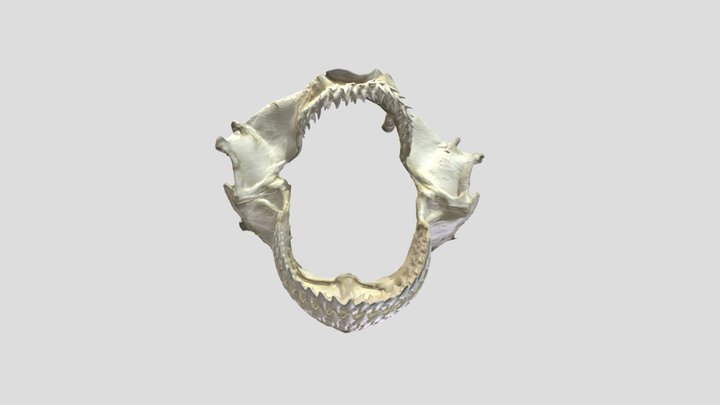
3D model
- Source
- Sketchfab
- Licence
- CC Attribution-NonCommercial
- Commercial use
- the licence does not allow it
Smithsonian Open Access was not reached for this taxon, so this list is what the others held rather than everything there is.
The description on this site
- Source
- Wikipedia, “Isistius”
- Licence
- CC BY-SA 4.0
This is what the site found, which is not the same as what exists.
Keep going
What may have been alongside itDalatiidae through timeFormations of the EoceneThe world it lived on
Occurrence data from the Paleobiology Database, CC BY 4.0. Gill 1864