Lichida
Lichida is an order of typically spiny trilobite that lived from the Furongian to the Devonian period. These trilobites usually have 8–13 thoracic segments. Their exoskeletons often have a grainy texture or have wart or spine-like tubercles. Some species are extraordinarily spiny, having spiny thoracic segments that are as long or longer than the entire body, from cephalon (head) to pygidium (tail). The sections of the pygidia are leaf-like in shape and also typically end in spines.

Apokryltaros at English Wikipedia · CC BY 2.5 · via Wikipedia/Commons. May be a photograph of a specimen, or an artist’s reconstruction — an interpretation of a skeleton, since colour and soft tissue are almost never preserved.
On record
Recorded, not inferred- Sits inside
- TrilobitaPBDB
- Diet
- carnivorePBDB
- Life habit
- low-level epifaunalPBDB, for Trilobita
- Motility
- fast-movingPBDB, for Trilobita
- Environment
- marinePBDB, for Trilobita
Time the record covers
At least 118 million years on record.
The record covers at least 504.5 Mya to 385.9 Mya. No occurrence read is dated outside 506.5 Mya to 382.31 Mya.
1,599 occurrences of Lichida on record, most of them in the Ordovician. Bar height is expected occurrences, not a count: each fossil is spread across the span it is dated to, so a tall narrow bar means tight dating and a low wide one means loose.
When
1,599 occurrences- Cambrian31%
- Ordovician37%
- Silurian22%
- Devonian9%
These are dates about fossils, not the animal: the record can only begin after it arose and end before it died out, so either end may reach further. Shares are expected occurrences: a fossil dated to a span is counted partly in each period it straddles. More on what this infers.
Found in
340 formations
- Huaqiao Formation196
- Kushan Formation111
- Zhumabai Formation54
- Cape Phillips Formation40
- Delorme Formation40
- Boda Limestone Formation40
Loading coastlines…
The named rock units Lichida has been recovered from, largest first. Drawn where the rock is now, not where it formed. 316 further formations hold fewer occurrences each and are not listed. 87 occurrences have no formation on record, which is common for older literature.
Lichida and its relatives
OrdovicianWhere Lichida and its relatives were recorded in the Ordovician.
Found in the same rock
3,028 taxa- Gastropoda38 sites
- Amphilichas36 sites
- Crinoidea35 sites
- Leonaspis30 sites
- Rugosa30 sites
- Stenopareia30 sites
- Bumastus29 sites
- Ceratocephala29 sites
- Bryozoa28 sites
- Howellella27 sites
- Ostracoda26 sites
- Bivalvia25 sites
- Skenidioides25 sites
- Leptaena24 sites
- Calyptaulax23 sites
- Nautiloidea23 sites
- Platylichas23 sites
- Sowerbyella23 sites
- Platystrophia22 sites
- Strophomena22 sites
- Encrinurus21 sites
- Hemiarges21 sites
- Brachiopoda19 sites
- Calymene19 sites
The Paleobiology Database records 829 sites for Lichida, and this reads 240 of them. Of that, one read hit the database's own return limit, so every count below is a floor rather than a total. The number is how many of those sites it was catalogued from too. The 24 sharing the most are listed.
This is not a list of everything alive at the time. It is only what has come out of the same ground as this animal and been written down.
Entered from
344 references- Corynexochida, Lichida and Asaphida177
- Trilobites from the Kushan Formation of north and northeastern China69
- The Trilobites of the Leptæna Limestone in Dalarne60
- Cambrian Malyy Karatau Range, Kazakhstan54
- Early Silurian trilobites of Anticosti Island, Québec, Canada39
- Late Middle Cambrian (Cambrian Series 3) Trilobite Faunas from the Lowermost Part of the Sesong Formation, Korea and Their Correlation with North China32
- Silurian trilobite associations in North America26
- The Asaphus Limestone in northernmost Öland25
- Scottish Silurian trilobites24
- The lichid trilobite Radiolichas in the Silurian of Arctic Canada and Gotland, Sweden22
- Upper Arenig trilobite biostratigraphy and sea-level changes at Lynna River near Volkhov, Russia20
- Silicified Lower Devonian trilobites from New South Wales20
Each of the 1,599 occurrences read was entered from one of these publications, ordered by how many each accounts for. This is not a search for papers mentioning the name. 332 further references are not listed. Entries link to doi.org where the Paleobiology Database holds an identifier, and to its own record where it does not. Relayed as the Paleobiology Database holds them, not checked against what they resolve to.
Media and terms
Media content2

Picture of Lichida
- Source
- Wikipedia/Commons
- Credit
- Apokryltaros at English Wikipedia
- Licence
- CC BY 2.5
- Commercial use
- the licence allows it
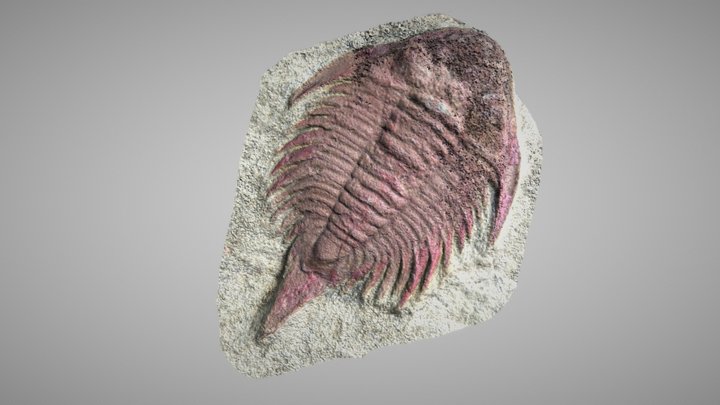
3D model
- Source
- Sketchfab
- Licence
- Free Standard
- Commercial use
- cannot be read from the licence given — check the record
The description on this site
- Source
- Wikipedia, “Lichida”
- Licence
- CC BY-SA 4.0
This is what the site found, which is not the same as what exists.
Keep going
What may have been alongside itTrilobita through timeFormations of the OrdovicianThe world it lived on
Occurrence data from the Paleobiology Database, CC BY 4.0. Moore 1959