Melanitta
The scoters are stocky seaducks in the genus Melanitta. The drakes are mostly black and have swollen bills, the females are brown. They breed in the far north of Europe, Asia, and North America, and winter further south in temperate zones of those continents. They form large flocks on suitable coastal waters. These are tightly packed, and the birds tend to take off together. Their lined nests are built on the ground close to the sea, lakes or rivers, in woodland or tundra. These species dive for crustaceans and molluscs.

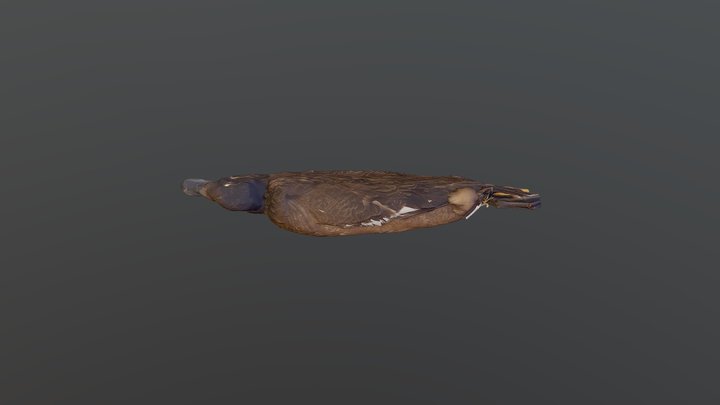
David Menke · Public Domain · via Wikipedia/Commons. May be a photograph of a specimen, or an artist’s reconstruction — an interpretation of a skeleton, since colour and soft tissue are almost never preserved.
On record
Recorded, not inferred- Also called
- scoterPBDB
- Sits inside
- MerginiPBDB
- Diet
- herbivorePBDB, for Anatinae
- Life habit
- volantPBDB, for Anatinae
- Motility
- actively mobilePBDB, for Theropoda
- Environment
- freshwaterPBDB, for Anatinae
Time the record covers
At least 3.5 million years on record.
The record covers at least 3.6 Mya to 11.7 ka. No occurrence read is dated outside 5.333 Mya to 0 Mya.
72 occurrences of Melanitta on record, most of them in the Pleistocene. The Paleobiology Database records this as a living group. Bar height is expected occurrences, not a count: each fossil is spread across the span it is dated to, so a tall narrow bar means tight dating and a low wide one means loose.
When
72 occurrences- Pliocene4%
- Pleistocene53%
- Holocene43%
These are dates about fossils, not the animal: the record can only begin after it arose and end before it died out, so either end may reach further. Shares are expected occurrences: a fossil dated to a span is counted partly in each period it straddles. More on what this infers.
Found in
7 formations
- Yorktown Formation · Chesapeake Group2
- San Pedro Formation2
- Cromer Forest Bed Formation2
- Palos Verdes Sand Formation1
- San Diego Formation1
- Mandano Formation1
Loading coastlines…
The named rock units Melanitta has been recovered from, largest first. Drawn where the rock is now, not where it formed. 62 occurrences have no formation on record, which is common for older literature.
Melanitta and its relatives
PleistoceneWhere Melanitta and its relatives were recorded in the Pleistocene.
Found in the same rock
987 taxa- Phalacrocorax penicillatus25 sites
- Anatinae20 sites
- Anserinae20 sites
- Anas18 sites
- Larus18 sites
- Podiceps nigricollis17 sites
- Anas platyrhynchos16 sites
- Anser caerulescens16 sites
- Numenius americanus16 sites
- Phalacrocorax16 sites
- Phalacrocorax auritus16 sites
- Phalacrocorax pelagicus16 sites
- Branta canadensis15 sites
- Uria aalge15 sites
- Aechmophorus14 sites
- Aythya14 sites
- Corvus brachyrhynchos14 sites
- Corvus corax14 sites
- Gavia immer14 sites
- Limosa fedoa14 sites
- Tyto alba14 sites
- Uria14 sites
- Fulmarus glacialis13 sites
- Gavia stellata13 sites
The Paleobiology Database records 54 sites for Melanitta, and this reads all of them. The number is how many of those sites it was catalogued from too. The 24 sharing the most are listed.
This is not a list of everything alive at the time. It is only what has come out of the same ground as this animal and been written down.
Entered from
26 references- Prehistoric human impacts on California birds: evidence from the Emeryville shellmoumd avifauna25
- Distribution and provenance of fossil avifauna on San Miguel Island8
- Humans and marine resource interaction reappraised: Archaeofauna remains during the late Pleistocene and Holocene in Cantabrian Spain4
- Bird bones from Jettböle I, a site in the Neolithic Åland archipelago in the northern Baltic3
- A late Pleistocene avifauna from San Miguel Island, California3
- A catalogue of late Quaternary vertebrates from California: Part One, nonmarine lower vertebrate and avian taxa3
- Avian fossils from the marine Pleistocene of southern California3
- Seabirds (Aves) from the Pleistocene Kazusa and Shimosa groups, central Japan2
- Pleistocene seabirds from Shiriya, northeast Japan: systematics and oceanographic context2
- Miocene and Pliocene birds from the Lee Creek Mine, North Carolina2
- Animal bones from the Late Weichselian in Norway2
- Terminal Pleistocene–Holocene Avifauna of San Miguel and Santa Rosa Islands: Identifications of Previously Unidentified Avian Remains Recovered from Fossil Sites and Prehistoric Cave Deposits1
Each of the 72 occurrences read was entered from one of these publications, ordered by how many each accounts for. This is not a search for papers mentioning the name. 14 further references are not listed. Entries link to doi.org where the Paleobiology Database holds an identifier, and to its own record where it does not. Relayed as the Paleobiology Database holds them, not checked against what they resolve to.
Media and terms
Media content2

Picture of Melanitta
- Source
- Wikipedia/Commons
- Credit
- David Menke
- Licence
- Public Domain
- Commercial use
- the licence allows it
Smithsonian Open Access and MorphoSource were not reached for this taxon, so this list is what the others held rather than everything there is.
The description on this site
- Source
- Wikipedia, “Scoter”
- Licence
- CC BY-SA 4.0
This is what the site found, which is not the same as what exists.
Keep going
What may have been alongside itMergini through timeFormations of the PleistoceneThe world it lived on
Occurrence data from the Paleobiology Database, CC BY 4.0. Boie 1822