Michelinoceras
Searched as Michelinoceras vindobonense. The Paleobiology Database treats Michelinoceras as the accepted name.
Michelinoceras is the oldest known genus of the Michelinocerida, more commonly known as the Orthocerida, characterized by long, slender, nearly cylindrical orthocones with a circular cross section, long camerae, very long body chambers, and a central or near central tubular siphuncle free of organic deposits. Septal necks are straight; connecting rings cylindrical and thin. Cameral deposits are well developed. A radula has been found in one species, with seven teeth per row. It had ten arms, two of which formed longer tentacles.

Haplochromis · CC BY-SA 3.0 · via Wikipedia/Commons. May be a photograph of a specimen, or an artist’s reconstruction — an interpretation of a skeleton, since colour and soft tissue are almost never preserved.
On record
Recorded, not inferred- Sits inside
- OrthoceratidaePBDB
- Diet
- carnivorePBDB, for Orthocerida
- Life habit
- nektonicPBDB, for Orthocerida
- Motility
- actively mobilePBDB, for Orthocerida
- Vision
- well-developedPBDB, for Cephalopoda
- Environment
- marinePBDB, for Orthocerida
Time the record covers
At most 17 million years on record.
Every occurrence read is dated to somewhere between 346.7 Mya and 330.3 Mya, and nothing in the dating separates them, so that window is what the record shows rather than a span.
2 occurrences of Michelinoceras on record, most of them in the Carboniferous. Bar height is expected occurrences, not a count: each fossil is spread across the span it is dated to, so a tall narrow bar means tight dating and a low wide one means loose.
When
2 occurrences- Carboniferous100%
These are dates about fossils, not the animal: the record can only begin after it arose and end before it died out, so either end may reach further. Shares are expected occurrences: a fossil dated to a span is counted partly in each period it straddles. More on what this infers.
Found in
2 formations
- Miller Creek and Wentworth Station Formation · Windsor Group1
- Murphy Road Formation · Windsor Group1
Loading coastlines…
The named rock units Michelinoceras has been recovered from, largest first. Drawn where the rock is now, not where it formed.
Michelinoceras and its relatives
CarboniferousWhere Michelinoceras and its relatives were recorded in the Carboniferous.
Found in the same rock
1,897 taxa- Orthoceras33 sites
- Sinoceras30 sites
- Crinoidea26 sites
- Nuculites26 sites
- Illaenus24 sites
- Bivalvia23 sites
- Kionoceras23 sites
- Metaspyroceras23 sites
- Gastropoda22 sites
- Diestoceras21 sites
- Manitoulinoceras21 sites
- Endoceras20 sites
- Isorthoceras junceum20 sites
- Craniops19 sites
- Dideroceras19 sites
- Fuchsella amygdalina19 sites
- Hyolithes19 sites
- Ovalocephalus19 sites
- Whitfieldoceras19 sites
- Centrocyrtoceras18 sites
- Lingula18 sites
- Protochonetes ludloviensis18 sites
- Salopina lunata18 sites
- Tentaculites18 sites
The Paleobiology Database records 263 sites for Michelinoceras, and this reads 240 of them. The number is how many of those sites it was catalogued from too. The 24 sharing the most are listed.
This is not a list of everything alive at the time. It is only what has come out of the same ground as this animal and been written down.
Entered from
1 referenceEach of the 2 occurrences read was entered from one of these publications, ordered by how many each accounts for. This is not a search for papers mentioning the name. Each entry links to doi.org. Relayed as the Paleobiology Database holds them, not checked against what they resolve to.
Media and terms
Media content2
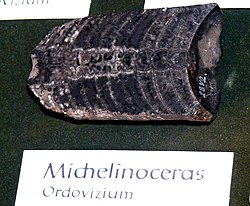
Picture of Michelinoceras
- Source
- Wikipedia/Commons
- Credit
- Haplochromis
- Licence
- CC BY-SA 3.0
- Commercial use
- the licence allows it
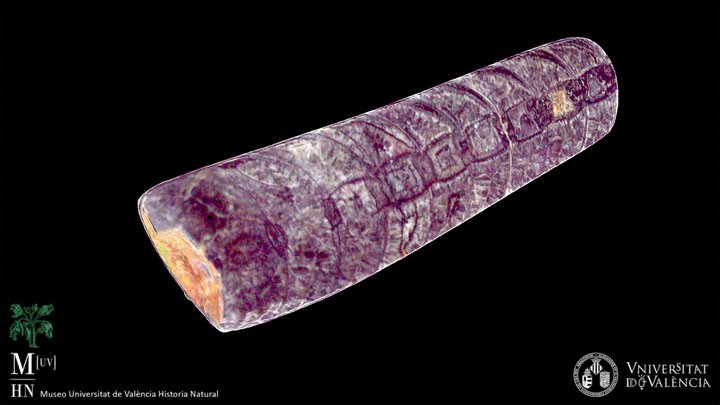
3D model
- Source
- Sketchfab
- Licence
- CC Attribution
- Commercial use
- cannot be read from the licence given — check the record
Smithsonian Open Access and MorphoSource were not reached for this taxon, so this list is what the others held rather than everything there is.
The description on this site
- Licence
- CC BY-SA 4.0
This is what the site found, which is not the same as what exists.
Keep going
What may have been alongside itOrthoceratidae through timeFormations of the CarboniferousThe world it lived on
Occurrence data from the Paleobiology Database, CC BY 4.0. Foerste 1932