Panthera tigris
The tiger is a large cat and a member of the genus Panthera native to Asia. It has a powerful, muscular body with a large head and paws, a long tail and orange fur that fades to white in parts, with black, mostly vertical stripes. It is traditionally classified into nine subspecies, though some recognise only two subspecies, the mainland Asian tiger and the Sunda Islands tiger.

Charles J. Sharp · CC BY-SA 4.0 · via Wikipedia/Commons. May be a photograph of a specimen, or an artist’s reconstruction — an interpretation of a skeleton, since colour and soft tissue are almost never preserved.
On record
Recorded, not inferred- Also called
- tigerPBDB
- Sits inside
- PantheraPBDB
- Diet
- carnivorePBDB, for Panthera
- Life habit
- scansorialPBDB, for Felidae
- Motility
- actively mobilePBDB, for Osteichthyes
- Environment
- terrestrialPBDB, for Eutheria
- Mass
- 1.19 kgWikidata
Time the record covers
At least 762 thousand years on record.
The record covers at least 774 ka to 11.7 ka. No occurrence read is dated outside 2.58 Mya to 0 Mya.
24 occurrences of Panthera tigris on record, most of them in the Pleistocene. The Paleobiology Database records this as a living group. Bar height is expected occurrences, not a count: each fossil is spread across the span it is dated to, so a tall narrow bar means tight dating and a low wide one means loose.
When
24 occurrences- Pleistocene96%
- Holocene4%
These are dates about fossils, not the animal: the record can only begin after it arose and end before it died out, so either end may reach further. Shares are expected occurrences: a fossil dated to a span is counted partly in each period it straddles. More on what this infers.
Found in
3 formations
Loading coastlines…
The named rock units Panthera tigris has been recovered from, largest first. Drawn where the rock is now, not where it formed. 21 occurrences have no formation on record, which is common for older literature.
Panthera tigris and its relatives
PleistoceneWhere Panthera tigris and its relatives were recorded in the Pleistocene.
Found in the same rock
370 taxa- Sus scrofa12 sites
- Muntiacus muntjak10 sites
- Sus9 sites
- Macaca8 sites
- Cervus unicolor7 sites
- Felis7 sites
- Hystrix7 sites
- Panthera pardus7 sites
- Rhinoceros sinensis7 sites
- Tapirus (Megatapirus) augustus7 sites
- Tapirus indicus7 sites
- Ursus thibetanus7 sites
- Arctonyx collaris6 sites
- Capricornis sumatraensis6 sites
- Cervus6 sites
- Cuon6 sites
- Stegodon insignis6 sites
- Ailuropoda melanoleuca5 sites
- Bos (Bibos)5 sites
- Pongo pygmaeus5 sites
- Rhinoceros sondaicus5 sites
- Rusa5 sites
- Ursus malayanus5 sites
- Bison4 sites
The Paleobiology Database records 24 sites for Panthera tigris, and this reads all of them. The number is how many of those sites it was catalogued from too. The 24 sharing the most are listed.
This is not a list of everything alive at the time. It is only what has come out of the same ground as this animal and been written down.
Entered from
20 references- The Late Neogene elephantoid-bearing faunas of Indonesia and their palaeozoogeographic implications. A study of the terrestrial faunal succession of Sulawesi, Flores and Java, including evidence for early hominid dispersal east of Wallace's Line4
- Quaternary vertebrates from Shiriya area, Shimokita Pininsula, northeastern Japan2
- A late Pleistocene fossil from Northeastern China is the first record of the dire wolf (Carnivora: Canis dirus) in Eurasia1
- First discovery of Pleistocene orangutan (Pongo sp.) fossils in Peninsular Malaysia: Biogeographic and paleoenvironmental implications1
- The Middle Pleistocene mammalian fauna from Tam Hang karstic deposit, northern Laos: New data and evolutionary hypothesis1
- Antemortem trauma and survival in the late Middle Pleistocene human cranium from Maba, South China1
- Huanglong Cave: A Late Pleistocene human fossil site in Hubei Province, China1
- A preliminary study of the Bailong Cave Paleoanthropological Site in Yunxi County, Hubei Province1
- Large mammal fossil occurrences and associated archaeological evidence in Pleistocene contexts of peninsular India and Sri Lanka1
- Geochronology of Ailuropoda–Stegodon fauna and Gigantopithecus in Guangxi Province, southern China1
- Early Pleistocene equids (Mammalia, Perissodactyla) of Nalaikha, Mongolia, and the emergence of modern Equus Linnaeus, 17581
- The first fossil record of a short-finned pilot whale (Globicephala macrorhynchus) from the Penghu Channel1
Each of the 24 occurrences read was entered from one of these publications, ordered by how many each accounts for. This is not a search for papers mentioning the name. 8 further references are not listed. Entries link to doi.org where the Paleobiology Database holds an identifier, and to its own record where it does not. Relayed as the Paleobiology Database holds them, not checked against what they resolve to.
Media and terms
Media content2
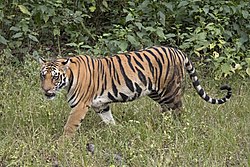
Picture of Panthera tigris
- Source
- Wikipedia/Commons
- Credit
- Charles J. Sharp
- Licence
- CC BY-SA 4.0
- Commercial use
- the licence allows it
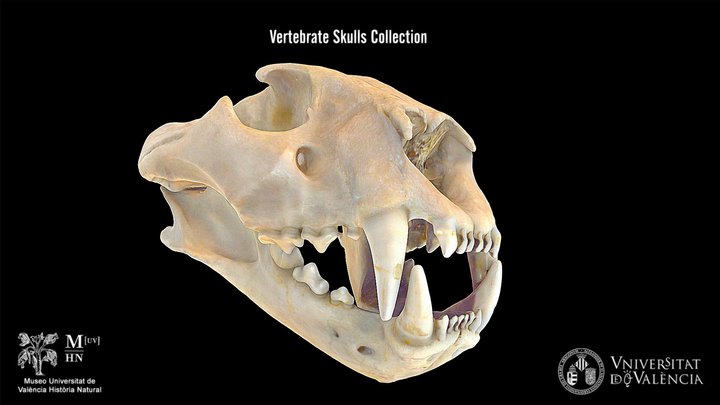
3D model
- Source
- Sketchfab
- Licence
- CC Attribution
- Commercial use
- cannot be read from the licence given — check the record
Smithsonian Open Access and MorphoSource were not reached for this taxon, so this list is what the others held rather than everything there is.
The description on this site
- Source
- Wikipedia, “Tiger”
- Licence
- CC BY-SA 4.0
This is what the site found, which is not the same as what exists.
Keep going
What may have been alongside itPanthera through timeFormations of the PleistoceneThe world it lived on
Occurrence data from the Paleobiology Database, CC BY 4.0. (Linnaeus 1758)